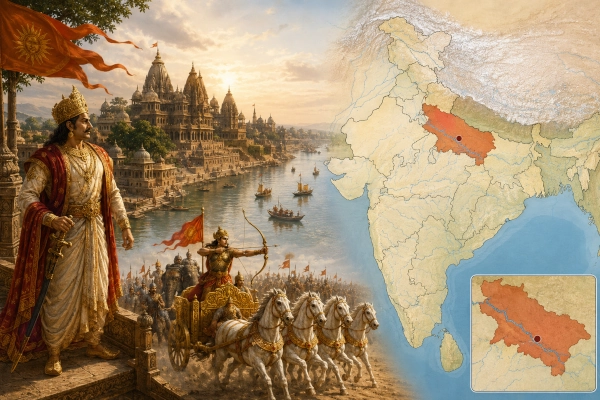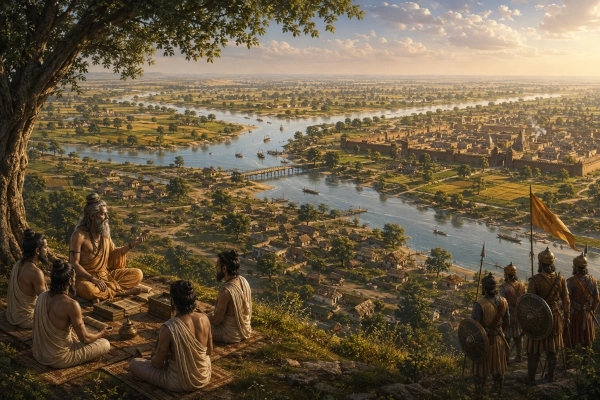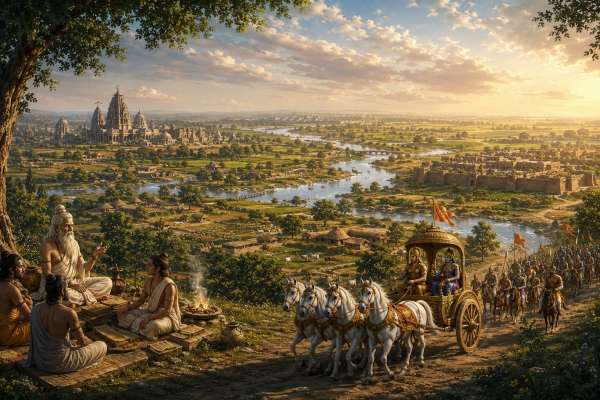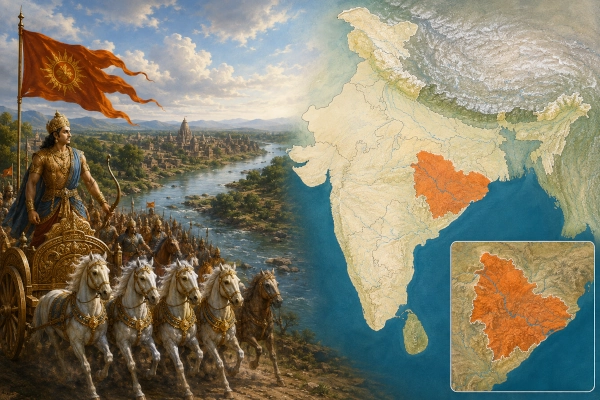
Suvela Mountain and the Military Science of High Ground: How Rama Turned Terrain into Intelligence Before the Siege of Lanka
When Rama’s army reached Lanka, the war had already passed through its first great test.
News, articles and Essays on Sanatana Dharma, Hinduism and Indian way of life.
When Rama’s army reached Lanka, the war had already passed through its first great test.
This is the essence of military logistics. Courage carries warriors into danger, but supply keeps them there. A thirsty army becomes weak before the enemy even appears. A hungry army loses speed, discipline and concentration. A force that camps in the wrong ground exposes itself to confusion, disease, panic and surprise. The Ramayana recognises this with striking simplicity. Before the arrows fly and the maces fall, the army must be placed where life can be sustained.
The relics originate from the historic Buddhist heritage connected with Sanchi, one of India’s most revered Buddhist sites and a UNESCO World Heritage Site in Madhya Pradesh. Their journey to Mongolia carries spiritual meaning because Buddhism has been one of the strongest civilisational bridges between India and Mongolia for centuries. India is the land of Buddha’s enlightenment and teaching, while Mongolia has preserved a deep Buddhist tradition through its monasteries, monks, rituals and public faith.
The copper plate also reveals the prestige of the temple in the Chera period. A royal presence in a temple-related resolution shows that Vazhappally was part of a wider political network. The temple was not standing outside history; it was inside the machinery of early Kerala society. The king, local elites, Brahmin authorities and temple functionaries all appear in the background of this sacred institution. Through Vazhappally, one can see how the temple became a centre of order, memory, economy and legitimacy.
The ocean before Rama was more than water. It was a wall without gates, a
By the time Unni Rama Koil I appears in the historical record, the Malabar coast was already a crowded theatre of power. The Zamorin of Kozhikode held great influence over maritime trade, while Kochi sought space to protect its autonomy and build its own commercial importance.
The Vanara force had already achieved the impossible by crossing the ocean through engineering, organisation and morale. Ravana needed to know whether this army was a wild mass of forest warriors or a disciplined invasion force guided by intelligence, leadership and purpose.
The Vyala is one of the most powerful figures in South Indian temple architecture. Usually imagined as a composite mythical creature with leonine strength and other animal features, it appears across temple pillars, gateways and sculptural panels as a symbol of protection, royal authority and sacred energy. At Hazara Rama Temple, the new discovery is important because it suggests that such figures were not merely part of wall reliefs or mural-like sculptural programmes, but may also have been carved and installed near major architectural points such as the temple entrance.
By the time Rama’s army reaches Lanka, the campaign has already achieved something extraordinary. The ocean has been crossed. The bridge has been built. The Vanara host has arrived at the doorstep of Ravana’s island fortress. But reaching Lanka is only the beginning. The real challenge lies ahead
In the Yuddha Kanda of the Ramayana, Vibhishana’s arrival in Rama’s camp is one of