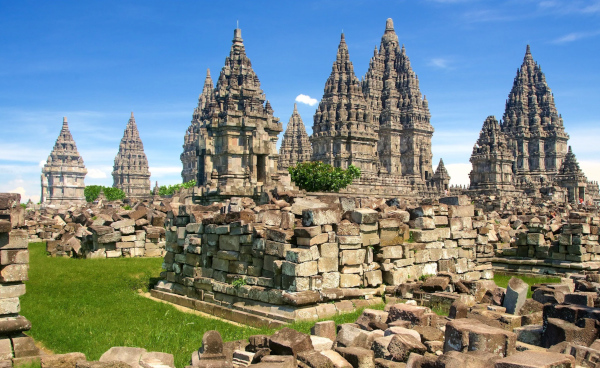
Prime Minister Narendra Modi’s visit to Indonesia has carried a strong diplomatic, strategic and cultural message. While the visit produced major outcomes in defence, maritime cooperation, critical minerals, digital payments, technology and education, one announcement stood out for its civilisational depth: India will assist Indonesia in the restoration and conservation of the historic Prambanan Temple in Yogyakarta.
Prambanan is not only Indonesia’s largest Hindu temple complex. It is also one of the most powerful symbols of the ancient cultural bridge between India and Southeast Asia. Built in the ninth century, the temple complex reflects the deep presence of Hindu philosophy, Sanskritic influence, temple architecture and Ramayana traditions in Java. Its restoration with Indian support therefore marks more than a heritage project. It is a renewal of shared memory between two great Asian civilisations.
Located near Yogyakarta, Prambanan stands close to the great Buddhist monument of Borobudur. The presence of these two grand sacred complexes in the same cultural landscape shows how Hindu and Buddhist traditions flourished side by side in ancient Java. This coexistence gave Indonesia a unique civilisational identity, where Indian spiritual ideas were absorbed, localised and expressed through Javanese art, architecture, dance, literature and ritual.
The Prambanan complex was built during the reign of the Mataram kingdom, especially under rulers such as Rakai Pikatan and Rakai Balitung. Unlike a single temple structure, Prambanan is a large sacred complex consisting of hundreds of shrines. Traditionally, the site is associated with 240 temples, arranged in a carefully planned layout. At its heart are the main temples dedicated to the Hindu trinity: Shiva, Vishnu and Brahma.
The central Shiva temple is the tallest and most majestic structure in the complex, rising around 47 metres. Its height, vertical form and sculptural richness give Prambanan its commanding visual identity. The Shiva shrine is flanked by the Brahma temple on one side and the Vishnu temple on the other, forming a sacred architectural expression of Hindu cosmology.
Inside the Shiva temple are four chambers. The main chamber contains the image of Shiva, while the other chambers house figures associated with the Shaivite tradition, including Durga, Ganesha and Agastya. This shows how deeply Shaivism influenced the religious imagination of ancient Java. The presence of Agastya is especially important, as the sage is strongly associated with the spread of Hindu knowledge and spiritual traditions across southern and Southeast Asian cultural zones.
Prambanan is also a living archive of the Ramayana. Its walls carry detailed relief carvings that narrate scenes from the epic. These carvings are not merely decorative; they are stone storytelling. Through them, the Ramayana travelled into Javanese memory and became part of Indonesia’s artistic and cultural identity. Even today, the Ramayana continues to live in Indonesia through dance, theatre, shadow puppetry, temple art and public performance.
The famous Ramayana ballet performed near Prambanan is one of the most beautiful examples of this living tradition. On full moon evenings, dancers bring the epic to life against the dramatic backdrop of the ancient temple. This performance shows how a sacred story that originated in India became deeply rooted in Indonesian culture and continues to inspire audiences in the modern age.
Like many ancient monuments, Prambanan has faced long periods of decline. The temple was abandoned around the 10th century, and over time, earthquakes and natural forces damaged many of its structures. Large parts of the complex were reduced to ruins, with stones scattered across the site. Yet its architectural power and cultural importance remained undeniable. In 1991, Prambanan was recognised as a UNESCO World Heritage Site, confirming its outstanding value to humanity.
India’s decision to support the restoration of Prambanan carries major cultural significance. The project will be undertaken with the involvement of the Archaeological Survey of India, which has experience in conservation work both in India and abroad. Earlier assessment work at the site examined the condition of the temple remains and the challenges involved in preservation.
The restoration is expected to use the technique of anastylosis, a careful conservation method in which original stones and architectural fragments are identified, catalogued and reassembled as accurately as possible. This is a demanding process because each stone must be studied, matched and placed with precision. In a complex like Prambanan, where many architectural blocks are scattered across the grounds, restoration requires patience, scholarship and technical skill.
This is where India’s role becomes meaningful. India has a long tradition of temple conservation and archaeological restoration. By helping restore Prambanan, India is not exporting culture; it is helping preserve a shared civilisational inheritance that belongs to both India and Indonesia in spirit. The temple may stand on Indonesian soil, but its sacred vocabulary speaks to a wider Indic world that once connected the Indian Ocean through trade, knowledge, faith and art.
Prime Minister Modi’s visit to Prambanan with Indonesian President Prabowo Subianto highlights the importance both countries attach to cultural diplomacy. Modern India-Indonesia ties are built on defence cooperation, trade, maritime security and technology, but their emotional strength comes from older bonds. Prambanan gives that relationship a visible and sacred symbol.
The restoration also fits into India’s broader heritage diplomacy. India has supported conservation projects at sites such as Mỹ Sơn Sanctuary in Vietnam and the Bagan Archaeological Zone in Myanmar. These projects show India’s willingness to work with partner countries in preserving shared cultural spaces shaped by Hindu, Buddhist and Indic traditions.
Prambanan’s restoration can therefore become a powerful example of India’s cultural outreach in Southeast Asia. It strengthens people-to-people ties, supports heritage tourism, deepens academic cooperation and reminds the region that India’s relationship with Southeast Asia is not recent. It is rooted in centuries of maritime exchange, sacred geography, language, literature and art.
For Indonesia, the project helps preserve one of its most iconic monuments. For India, it reinforces civilisational friendship with a major Indo-Pacific partner. For the wider world, it is a reminder that heritage conservation is also a form of diplomacy — one that builds trust through respect, memory and shared pride.
Prambanan is a cultural bridge between India and Indonesia. Its towers carry the memory of a time when ideas moved freely across the seas, when the Ramayana became Javanese, when Shiva stood in Java, and when culture travelled without conquest. India’s role in restoring this magnificent temple is a fitting tribute to that shared past and a meaningful investment in a shared future.
You may also like
-
Samatata — The Low-Lying Deltaic Realm of Southeastern Bengal
-
Tamralipta — The Maritime Gateway of the Lower Ganga
-
Suhma — The River-and-Forest Country of Southwestern Bengal
-
Gauda — The Western Bengal Country of the Bhagirathi and the Rise of Karnasuvarna
-
Pundra — The Northern Bengal Kingdom of the Karatoya and the Ancient City of Pundranagara
