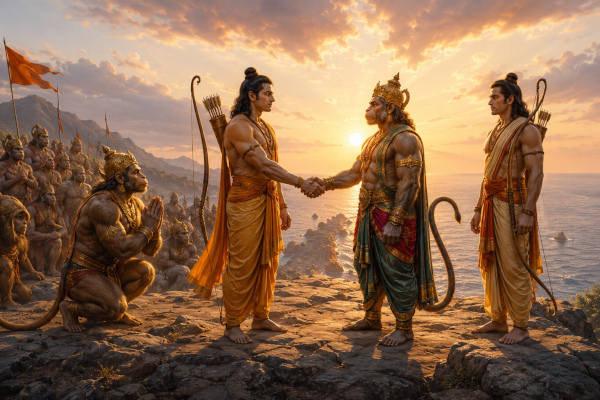
The Ramayana is often remembered for its moral power, emotional depth and civilisational influence, but it also contains one of the most sophisticated lessons in ancient strategic warfare: Rama does not win by fighting alone. His victory over Ravana is not merely the triumph of one heroic warrior over a powerful king. It is the success of coalition-building, local partnership, intelligence gathering, operational patience and moral legitimacy.
This is the first major war tactic in the Ramayana — strategic alliance-building. Rama begins the military phase of the epic with almost nothing that a commander normally requires. He has no army, no kingdom under his immediate command, no intelligence network in the south, no navy to cross the sea, and no knowledge of Lanka’s internal defences. Ravana, by contrast, sits inside a fortified island capital protected by the ocean, commanded by experienced Rakshasa warriors, supported by a wealthy kingdom and surrounded by layers of fear, loyalty and military power.
A direct assault by Rama and Lakshmana alone would have been courageous, but strategically unsound. Rama’s greatness lies not only in his archery or personal valour, but in his ability to convert isolation into partnership. Before he defeats Ravana on the battlefield, he defeats the problem of distance, manpower, intelligence and access. He does this through alliances.
The first decisive alliance is with Sugriva. This partnership is not accidental. Sugriva is a displaced ruler, driven out of power by Bali, while Rama is a prince in exile searching for Sita. Both men have lost something. Both face an adversary stronger in immediate resources. Both require external support to regain strategic initiative. Their alliance is therefore built on mutual need, not empty sentiment. Rama helps Sugriva recover Kishkindha; Sugriva commits the Vanara forces to Rama’s search for Sita.
This is classic coalition warfare. In modern defence terms, Rama secures a local partner force. Sugriva controls fighters who understand the terrain, possess mobility across forests and mountains, and can mobilise search parties over vast regions. Rama, though a prince of Ayodhya, is operating far from Ayodhya’s power base. He cannot project force into the southern theatre without local support. Sugriva provides that missing theatre access.
Modern warfare repeatedly proves the same principle. A powerful commander or state may possess superior weapons, but success in unfamiliar terrain often depends on local allies. External strength needs local knowledge. A force operating in mountains, forests, deserts, islands or dense urban zones cannot rely only on distant power. It needs guides, scouts, interpreters, logistics channels, political partners and terrain-adapted fighters. Rama understands this instinctively. He does not treat Sugriva merely as a subordinate; he recognises him as the key to entering an entirely new operational environment.
The Sugriva alliance gives Rama three crucial advantages. First, it gives him manpower. The Vanara forces become the army that Rama does not possess in exile. Second, it gives him reach. Search parties can now be sent in multiple directions to locate Sita. Third, it gives him specialist capability. From this alliance emerges Hanuman, the single most important reconnaissance and special-operations figure in the campaign.
Modern India follows a similar strategic logic, though in a very different geopolitical setting. It is not pretending that self-reliance means isolation. Instead, India is building partnerships to fill capability gaps while steadily strengthening its own base. In defence, it works with France on areas such as Rafale-Marine, helicopter and jet-engine cooperation, and defence technology collaboration; with the United States on critical and emerging technologies including semiconductors, AI, telecom, defence, space and critical minerals; and with partners such as Vietnam, Germany, South Korea, Sweden and the Netherlands across security, industry, innovation and supply-chain domains. This is not weakness; it is strategic humility. Like Rama recognising that he needed Sugriva’s terrain knowledge, Hanuman’s reach, Nala’s engineering skill and Vibhishana’s insider intelligence, modern India is recognising that great-power rise requires alliances, co-development, supply-chain resilience and technology absorption. The objective is not dependence, but capability-building: to learn, co-produce, plug urgent gaps and gradually convert partnerships into national strength.
Hanuman’s role shows why alliances are not just about numbers. Sometimes the greatest value of an alliance is access to one extraordinary capability. Through Sugriva, Rama gains Hanuman — a warrior, diplomat, scout, saboteur and psychological operator rolled into one. Hanuman crosses the sea, penetrates Lanka, locates Sita, assesses enemy strength, observes Ravana’s court, destroys part of the enemy’s urban space, survives capture, burns Lanka and returns with confirmed intelligence.
No conventional army could have given Rama this result at that stage. Hanuman functions like a strategic reconnaissance asset operating deep behind enemy lines. His mission provides what modern militaries call intelligence preparation of the battlefield. Before the main invasion, Rama’s side learns where Sita is held, how Lanka is defended, what kind of enemy leadership they face, and whether the island fortress is psychologically vulnerable. A single allied operative changes the entire campaign.
This is where the Ramayana becomes strikingly modern. In contemporary warfare, alliances often provide niche capabilities that a commander may not organically possess — mountain scouts, special forces, cyber intelligence, airlift, naval access, satellite data, electronic warfare support, local militias, resistance networks or political contacts. Sugriva’s coalition gives Rama precisely this layered advantage. The Vanaras are not merely a mass of fighters; they are a complete operational ecosystem.
The Vanara army itself represents a powerful form of irregular warfare. They are not conventional soldiers in the style of royal infantry, cavalry or chariot forces. Their strength lies in mobility, physical agility, numbers, terrain familiarity and unconventional combat methods. They move through forests, leap across difficult ground, climb heights, throw rocks and trees, and operate with raw shock force. Against Lanka’s fortified and organised Rakshasa power, this irregular force becomes extremely useful.
In modern terms, Rama is not trying to reproduce Ayodhya’s conventional military system. He adapts to the theatre. The battlefield is not the plains of Kosala. It is the southern wilderness, the ocean barrier and the island fortress of Lanka. For that campaign, the Vanaras are not a compromise; they are the right force. A good commander does not merely ask, “Which army is the most prestigious?” He asks, “Which force is best suited for this mission?” Rama’s coalition works because it matches capability to terrain.
The search for Sita also shows alliance-building as an intelligence multiplier. After Sugriva regains power, he does not send a token party. He organises a wide search operation, dispatching Vanara teams in different directions. This is systematic reconnaissance. The mission is divided by geography, responsibility and command. The southern search party, led by Angada and guided by Jambavan’s wisdom, eventually reaches the seashore. There, through Sampati’s information and Hanuman’s leap, the location of Lanka becomes known.
This chain of intelligence is possible only because Rama built an alliance. One contact leads to a network; one network leads to movement; movement leads to information; information leads to action. This is the invisible side of warfare. Battles are seen by everyone, but the intelligence architecture that makes battle possible is often hidden. Rama’s alliance with Sugriva creates that architecture.
The second great alliance decision is even more delicate: Rama accepts Vibhishana, Ravana’s own brother. If Sugriva provides external manpower and terrain access, Vibhishana provides internal knowledge of the enemy system. His defection is one of the most important political and military events in the war.
Every commander faces a difficult question when an insider from the enemy camp seeks refuge. Is he genuine? Is he a spy? Is he a trap? Can he be trusted? The Vanara leadership naturally worries about this. Their suspicion is militarily valid. In modern warfare, defectors, informants and political exiles are valuable but risky. They may carry intelligence, but they may also carry deception. Accepting them requires judgement.
Rama’s response reveals strategic clarity. He accepts Vibhishana, not out of naivety, but because the war is being fought under a larger moral framework. Vibhishana has rejected Ravana’s adharma and sought refuge. Rama’s decision gives the coalition both intelligence and legitimacy. By accepting Vibhishana, Rama sends a powerful message: the war is not against Lanka as a people, nor against the Rakshasas as a community. The war is against Ravana’s unlawful act and his refusal to correct it.
This distinction is vital in military ethics and political warfare. A campaign that defines the enemy too broadly creates endless resistance. A campaign that clearly distinguishes between the guilty leadership and the wider population has greater moral strength. Rama does not demonise everyone inside Lanka. He accepts Vibhishana, honours him, and later installs him as the legitimate ruler. This transforms the war from a revenge campaign into a restoration of order.
Modern warfare recognises this principle in different language. Successful campaigns require political end-state planning. It is not enough to defeat an enemy militarily; one must also consider what comes after. Who governs? Who stabilises the territory? Who represents lawful authority once the hostile regime collapses? Vibhishana answers that question in the Ramayana. He is not only an intelligence asset during the war; he is the political solution after the war.
His presence also weakens Ravana psychologically. When a king’s own brother defects to the opposing side, it signals internal moral collapse. Ravana may still command troops, but he has lost ethical authority even within his own house. In psychological warfare, this is devastating. It tells soldiers, ministers and citizens that the ruler’s cause is not universally trusted. The enemy’s fortress still stands, but its inner confidence begins to crack.
Rama’s alliance system therefore works at several levels. Sugriva gives him army and access. Hanuman gives him reconnaissance and special operations capability. Jambavan gives counsel and institutional memory. Nala and Nila give engineering capability for the bridge. Angada gives youthful command energy and diplomatic boldness. Vibhishana gives insider intelligence and political legitimacy. Each ally fills a different operational gap.
This is the essence of coalition warfare. A coalition is not merely a crowd of supporters. It is a system in which different actors contribute different strengths towards a common objective. Rama’s genius lies in integrating these strengths without losing command coherence. He remains the moral and strategic centre, but he does not suffocate the initiative of others. Hanuman acts boldly. Sugriva commands his forces. Jambavan advises. Vibhishana counsels. Nala builds. Lakshmana strikes. Rama leads.
That balance is difficult even in modern coalitions. Alliances often suffer from ego clashes, different priorities, uneven capabilities, mistrust and command confusion. Rama avoids this by keeping the mission clear: rescue Sita, punish adharma, restore justice. The coalition does not exist for conquest, loot or vanity. It exists for a defined moral and strategic objective. This clarity holds the alliance together.
The building of Rama Setu is the most visible symbol of this coalition. No single warrior, however mighty, can carry an army across the sea. The ocean is Lanka’s natural defence, the equivalent of a massive anti-access barrier. Ravana’s geography protects him. Rama overcomes that barrier not by rage, but by engineering, organisation and collective effort. Nala’s skill, Vanara manpower and Rama’s leadership combine to create a passage to Lanka.
In modern military thinking, this is combat engineering and theatre access. Armies do not win only by firing weapons. They win by crossing rivers, building bridges, opening roads, maintaining supply lines, securing ports, preparing airfields and overcoming natural barriers. Rama Setu is not just a miracle image; it is a strategic lesson. Logistics and engineering turn intention into operational reach. Without the bridge, Rama’s army remains on the shore. With the bridge, the war moves to Lanka.
This is why alliance-building is the foundation of the Lanka campaign. Every later success depends on this earlier political work. Hanuman’s reconnaissance, the search operation, the bridge, the siege of Lanka, the use of insider intelligence, the morale of the army and the post-war settlement all emerge from alliances. Rama’s war is won not by a single duel at the end, but by the patient construction of a coalition before the decisive battle begins.
Ravana, by contrast, fails in alliance politics. He has power, wealth, warriors and fortifications, but he is increasingly isolated. He ignores wise counsel. He insults Vibhishana. He allows pride to overpower strategy. He mistakes fear for loyalty. His court contains strength, but not healthy dissent. His commanders fight fiercely, but his political base narrows. This is a classic failure of authoritarian command: the ruler hears praise, suppresses warning and loses the ability to correct course.
The contrast between Rama and Ravana is therefore not only moral; it is strategic. Rama listens, allies, absorbs and integrates. Ravana dominates, dismisses, alienates and isolates. Rama turns strangers into partners. Ravana turns his own brother into an opponent. Rama’s coalition expands as the campaign progresses. Ravana’s circle shrinks as the war approaches.
This gives the Ramayana a powerful modern defence lesson: wars are won before they are fought. They are won in diplomacy, alliance-building, intelligence networks, logistics planning, local partnerships, legitimacy creation and command integration. Firepower matters, but firepower without political intelligence can fail. Courage matters, but courage without organisation can be wasted. A just cause matters, but even a just cause requires strategy.
Rama’s alliance-building also shows that morality and strategy are not opposites. His ethical conduct strengthens his military position. By keeping his cause just, he attracts allies. By honouring Sugriva, he gains the Vanara army. By trusting Hanuman, he gains decisive intelligence. By accepting Vibhishana, he gains legitimacy and insider knowledge. His dharma becomes a force multiplier.
This is a deeply Indian view of warfare: power must be guided by righteousness, but righteousness must also be organised into effective action. Rama does not merely declare that he is right. He builds the means to make justice victorious. That is the military brilliance of the Ramayana.
As the first article in a series on war tactics in the Ramayana, strategic alliance-building deserves pride of place because it is the foundation on which the entire campaign rests. Before the arrows fly, before Lanka burns, before Kumbhakarna falls and before Ravana is defeated, Rama first builds a coalition. He understands that no commander, however gifted, can win a complex war alone.
The lesson remains timeless. Whether in ancient epics or modern battlefields, victory belongs not only to the strongest warrior, but to the leader who can unite capabilities, earn trust, absorb intelligence, manage allies and give the campaign a moral purpose larger than personal revenge. In the Ramayana, Rama’s alliance with Sugriva and acceptance of Vibhishana show that coalition warfare is not a modern invention. It is an ancient strategic truth: the side that builds the better alliance often builds the road to victory before the first major battle begins.
You may also like
-
Namami Gange in 2026: 368 Projects Completed, 4,339 MLD Sewage Treatment Capacity Created as Ganga Rejuvenation Advances
-
Millworks Technologies Secures HAL Orders, Partners with TridenTech to Develop Indigenous UAV Engines
-
DRDO Develops Indigenous Radar-Absorbing Paint to Reduce Aircraft Radar Signatures
-
ASI’s Kashipur Archaeological Site Reveals Ancient Govisana, Gupta-Era Temples and Mahabharata Traditions
-
Manipur Governor Reviews India–Myanmar Border Fencing, Calls for Faster Progress on Strategic Security Project
