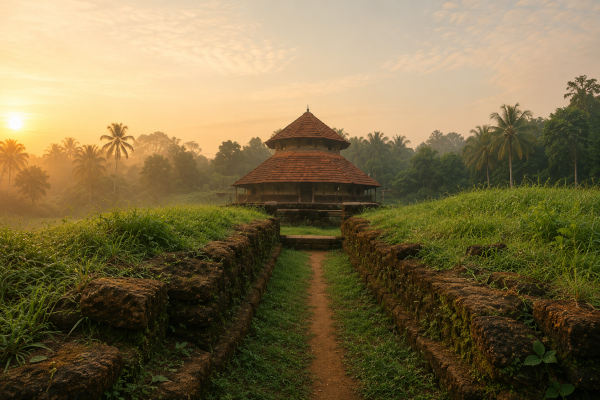
Ongallur Taliyil Shiva Temple, located near Pattambi in Palakkad district, is one of the notable old Shiva temples of the region. The temple stands as a sacred reminder of Kerala’s ancient Shaiva worship, traditional temple architecture and the deep cultural life of the Valluvanad–Palakkad belt. Kerala Tourism describes it as an ancient Shiva temple known for intricate laterite sculptures, Kerala-style architecture and its role in local religious and cultural traditions.
The presiding deity of the temple is Lord Shiva, worshipped in the form of a Shiva Linga. The sanctum faces east, following the traditional sacred orientation seen in many old Kerala temples. Kerala Tourism also notes that the Shiva Linga of this temple is known for its large girth, making the main deity especially distinctive among the Shiva shrines of the area.
The temple is believed to be more than 1,000 years old and is widely regarded as one of the oldest temples in Kerala. This antiquity gives Ongallur Taliyil Shiva Temple a special place in Palakkad’s spiritual geography. The shrine is not only a local place of worship but also a heritage centre that reflects the long continuity of Shaiva devotion in central Kerala.
The name Taliyil itself carries an old temple-centre feeling. In Kerala history, many “Thali” or “Tali” temples were associated with early settlement, Brahmin households, royal patronage and sacred administration. Ongallur Taliyil Shiva Temple belongs to this wider cultural world, where temples functioned as centres of worship, land organisation, ritual learning and community identity.
The architectural style of the temple follows the traditional Kerala model. The sanctum, wooden elements, temple courtyard and laterite-based artistic features reflect the natural building language of Kerala. Kerala Tourism highlights the temple’s intricate laterite sculptures, which make the shrine artistically important. Laterite, a common building material in Kerala, was shaped here into sacred art, giving the temple a deeply regional architectural identity.
The temple is also known for its subsidiary deities. Along with Lord Shiva, the shrine reveres Ayyappa, Dakshinamurti and Ganapati. Dakshinamurti represents Shiva as the supreme teacher, the silent guru who grants wisdom. Ganapati is worshipped as the remover of obstacles, while Ayyappa reflects the devotional traditions that became deeply rooted across Kerala.
This combination of deities gives the temple a complete Shaiva atmosphere. Lord Shiva stands at the centre as Mahadeva, Dakshinamurti expresses his wisdom aspect, Ganapati blesses new beginnings, and Ayyappa brings the spirit of discipline and devotion. For devotees, the temple becomes a place to seek inner peace, strength, learning and protection.
Ongallur Taliyil Shiva Temple also has a strong connection with Kerala’s Namboodiri temple tradition. Kerala Tourism records that the temple belonged to six manas, or houses, of Namboodiri Brahmins. This indicates the temple’s historical place within the old religious and landholding structure of Kerala, where Namboodiri households often played an important role in temple rituals, administration and preservation.
The temple’s location near Pattambi adds to its cultural importance. Pattambi and its surrounding regions were historically part of a rich cultural belt shaped by temples, rivers, learning centres, agrarian settlements and old trade paths. Ongallur lies within this wider sacred landscape, where village temples were deeply connected to community life.
For devotees, the temple is especially significant during Mahashivaratri, the great night of Lord Shiva. Kerala Tourism identifies Mahashivaratri as the most important festival for Shiva devotees at the temple, marked by fasting, prayers, night-long vigil and offerings.
Mahashivaratri at such an old temple carries a special spiritual atmosphere. Devotees gather to worship Shiva as the destroyer of ignorance and the giver of grace. Lamps, chants, offerings and night vigil create a sacred rhythm that connects the present generation with centuries of Shaiva worship.
The temple’s importance also lies in its role as a community centre. In Kerala’s older village life, temples were more than ritual spaces. They preserved music, festivals, social gathering, local memory and seasonal calendars. Ongallur Taliyil Shiva Temple continues this older function by remaining a place where devotion and community identity meet.
The laterite sculptures of the temple deserve special attention. Kerala’s temple art is usually associated with wood, stone, murals, metal lamps and tiled roofs, but laterite also has its own sacred beauty. In Ongallur, this material becomes a medium of artistic expression. The carvings give the temple an earthy, old-world character that distinguishes it from more polished stone temples.
Spiritually, the temple represents Shiva as both the cosmic lord and the village guardian. Devotees approach him for courage, peace, removal of difficulties and spiritual steadiness. The presence of Dakshinamurti adds a contemplative dimension, reminding worshippers that Shiva is also the source of knowledge and silence.
Ongallur Taliyil Shiva Temple is therefore an important heritage shrine of Palakkad. It carries the marks of antiquity, local craftsmanship, Namboodiri tradition, Shaiva devotion and village culture. Its significance rests not only in age but also in continuity — the fact that worship, memory and community life still revolve around the shrine.
In the larger temple map of Kerala, Ongallur Taliyil Shiva Temple stands as a quiet but powerful sacred landmark. It may not have the scale of larger pilgrimage centres, but it has the depth of an old Kerala shrine that has served generations of devotees. Its laterite sculptures, east-facing sanctum, ancient Shiva Linga and traditional ritual life make it a temple worthy of preservation and reverence.
Ongallur Taliyil Shiva Temple remains one of the spiritual treasures near Pattambi. It reflects the essence of Kerala’s old temple culture: simple in setting, profound in devotion, rich in art and deeply rooted in community life. Through Lord Shiva’s presence, the temple continues to bless the land, protect local memory and keep alive the sacred rhythm of Palakkad’s ancient Shaiva heritage.
You may also like
-
Sindhu: The Indus Kingdom of Jayadratha in the Mahabharata
-
Kuninda or Kulinda: The Himalayan Realm of the Mahabharata in Uttarakhand and Himachal Pradesh
-
Durga versus Mahishasura: Weapons, Battlefield Tactics and the Triumph of Shakti
-
Kuluta: The Kullu Valley Kingdom of the Mahabharata
-
Trigarta: The Kangra–Jalandhar Kingdom of the Mahabharata
