For much of the modern trading era, access to a large consumer market has carried political as well as economic value. Countries that depend heavily on one destination for exports can become vulnerable when tariffs rise, regulations change or market access becomes tied to wider strategic disputes. The greater the dependence on one market, the greater the disruption when that market suddenly becomes more difficult to enter.
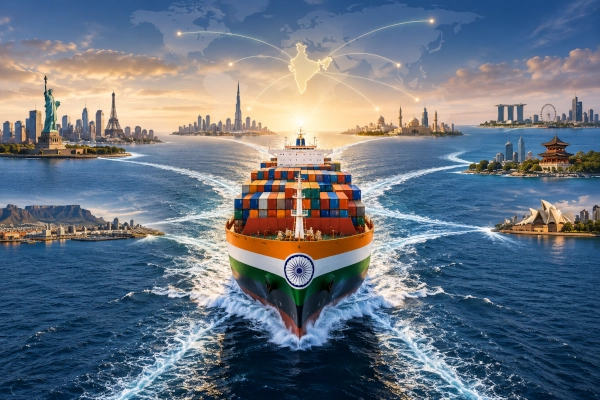
India is gradually trying to reduce that vulnerability by broadening the number of markets available to its exporters. Rather than allowing export growth to depend too heavily on one major destination, New Delhi has spent the past several years expanding a network of Free Trade Agreements across Europe, the Gulf, Asia and the Indo-Pacific. The purpose is not to move away from the United States or any other major economy, but to ensure that Indian companies have enough alternative markets that disruption in one relationship does not determine the direction of the entire export economy.
This strategy has become more relevant as tariffs, export restrictions and market-access measures have again become prominent instruments of global economic policy. India’s response has increasingly been to create more options for its exporters, more sources for its imports and more trade corridors through which companies can operate.
Overcoming Tariffs and the Weaponisation of Markets
Tariffs are traditionally understood as instruments for protecting domestic industries or correcting trade imbalances, but in periods of geopolitical tension they can also become instruments of leverage. Export controls, sanctions, licensing restrictions and selective access to large markets can all influence the economic decisions of countries that depend heavily on one trading partner.
A country that sends a large share of its exports to a single destination is particularly exposed to this kind of pressure. If tariffs rise sharply, the competitiveness of its exporters can deteriorate almost immediately. Orders may be cancelled, margins may shrink and industries can be forced to adjust production before alternative customers are found.
The best long-term protection against such pressure is not necessarily retaliation. It is reducing the amount of leverage any single market possesses in the first place. If Indian exporters can compete effectively in the United States, Britain, the European Union, the UAE, Australia, Southeast Asia, the Gulf and other major regions, a tariff imposed by one country becomes a commercial problem rather than a threat to the wider economy.
India’s expanding FTA network is gradually building exactly this kind of protection. By securing preferential access across multiple regions, India is creating a trade structure in which no single destination has to carry an excessive share of the country’s export ambitions.
The United States Can Remain Important Without Being Indispensable
The United States remains one of India’s most important trading partners and a major destination for Indian goods and services. There is therefore little economic sense in portraying the American market as something India should abandon or replace.
The more useful objective is to ensure that access to the United States does not become the only route through which Indian exporters can achieve scale. A large market becomes most powerful when companies have nowhere else to go, but that power diminishes when several alternative markets offer comparable opportunities.
India is therefore attempting to build what can be described as a portfolio of markets. American demand can remain highly valuable within that portfolio while becoming less capable of determining the overall health of Indian exports. The distinction is important because India does not need to make the American market irrelevant; it needs to make excessive dependence on the American market irrelevant.
India Is Building Several Trade Corridors at the Same Time
India’s recent FTAs cover economies with very different strengths. The UAE provides access to a major commercial and logistics centre linking South Asia with the Gulf, Africa and Europe. Australia combines a developed consumer market with important supplies of minerals and energy, while Britain offers a large services-oriented economy with strong demand for manufactured goods and professional services.
The EFTA agreement connects India with Switzerland, Norway, Iceland and Liechtenstein, while Oman strengthens India’s commercial position in the Gulf. The agreement with the European Union could eventually become even more significant because of the size and purchasing power of the European market. India is also building on existing arrangements with ASEAN, Japan, South Korea, Singapore, Malaysia, Sri Lanka and other partners.
No single one of these markets replaces the United States, nor does one need to. Their collective value lies in giving Indian companies more directions in which to expand, more customers to target and more room to adjust when conditions change in one region.
A Tariff Matters Less When an Exporter Has Somewhere Else to Sell
The practical value of diversification becomes clearer at company level. Consider an Indian manufacturer that sends most of its exports to one country. If that country suddenly raises tariffs by 20 or 30 percentage points, the manufacturer’s competitiveness can deteriorate immediately, and building a presence in another country may take years because distributors, certifications, logistics arrangements and customer relationships cannot be created overnight.
The situation is very different when that manufacturer is already selling into several markets under preferential trade arrangements. In that case, production can gradually be redirected, new investment can focus on markets where tariff treatment is more favourable and companies can design products specifically for Europe, Britain, Australia or the Gulf while continuing to serve American customers where commercially viable.
An FTA therefore provides more than a lower customs duty. It creates an alternative route for growth. The more such routes India builds, the less vulnerable its exporters become to disruption in any single one.
India’s Seafood Industry Shows Why Diversification Matters
India’s seafood industry offers a useful example of how market diversification can cushion the impact of weakness in one destination. When shipments to the United States declined amid tariff pressure, exports to other markets, including China and the European Union, continued to grow. This helped the sector absorb part of the decline in American demand and maintain overall export momentum.
The lesson extends well beyond seafood. Textiles, engineering goods, chemicals, pharmaceuticals, machinery, electronics and agricultural products can all benefit from the same principle if exporters develop multiple destinations rather than relying too heavily on one.
This is what trade resilience looks like in practice. A tariff in one market can still hurt, but it becomes less capable of stopping growth across an entire sector when companies have established buyers elsewhere.
Britain Opens Another Developed Market
The India-UK trade agreement is an important part of this diversification strategy because it gives Indian manufacturers and service providers another high-income destination where tariffs and commercial barriers are lower than before.
This matters particularly for labour-intensive industries such as textiles, footwear, leather goods and jewellery, but it also creates opportunities for engineering goods, automotive components, services and technology companies. For an Indian exporter, Britain does not have to become larger than America to be valuable; it simply has to become another profitable place to sell.
Every additional viable destination reduces the commercial damage that can be caused when another market becomes more restrictive. Over time, this allows Indian companies to spread risk more evenly across several regions.
Europe Could Change the Scale of Diversification
The European Union is even more important in this respect because of its size. India and the EU already conduct substantial trade, and a deeper trade arrangement creates new possibilities across manufacturing, agriculture, services and advanced technology.
For India, Europe offers something especially valuable: another very large developed-market alternative. An Indian manufacturer that can compete successfully across Germany, France, Italy, the Netherlands, Spain and other European economies is less dependent on conditions in North America.
The same applies in reverse. European businesses gain better access to the Indian market, while Indian businesses gain another major arena in which to expand. The result is greater interdependence across several economic centres rather than dependence on one.
The Gulf Gives India Another Economic Gateway
India’s agreements with the UAE and Oman serve a different but equally important purpose. The UAE is both a major consumer market and one of the world’s important trading and logistics hubs, while Dubai and other commercial centres connect Indian businesses with markets across the Middle East, Africa and beyond.
This means that access to the UAE is not only about selling to Emirati consumers. It also strengthens India’s position within a wider regional trade network. Oman adds further depth to that relationship, while future engagement with the wider Gulf could expand it further.
The strategic value lies in having several directions in which trade can grow simultaneously. When one market slows, another may be expanding, and that reduces the risk of overdependence on any single destination.
Australia Adds Another Indo-Pacific Route
Australia demonstrates the same principle. It is much smaller than the United States as a consumer market, but that comparison misses the point because trade diversification does not require every alternative market to be enormous.
What matters is having a sufficient number of commercially useful markets that collectively provide exporters with flexibility. Australia, Britain, the UAE, ASEAN, Europe and the Gulf can together absorb far more trade than any one of them individually.
This broad network gives Indian companies more room to adjust production, redirect investment and pursue customers in regions where demand and tariff conditions are more favourable.
FTAs Also Reduce Dependence on a Single Supplier
Market diversification works in both directions. India’s FTAs do not simply create more destinations for Indian exports; they also provide more sources of technology, machinery, capital, raw materials and industrial inputs.
This is equally important because dependence on a single supplier can create the same kind of vulnerability as dependence on a single market. Export restrictions or technology controls can become instruments of economic pressure when there are few alternatives.
A wider network of partnerships reduces that risk. Australia can provide critical minerals and energy resources, Europe can supply advanced industrial machinery and technologies, EFTA countries can contribute investment and specialised manufacturing capabilities, while Japan and South Korea remain important sources of industrial technology. The Gulf adds capital, logistics infrastructure and energy connections.
The result is a trading system with more redundancy, and that redundancy becomes especially valuable during periods of geopolitical or economic disruption.
The Real Strength of FTAs Is Optionality
The greatest value of India’s expanding FTA network may therefore be something that is difficult to measure directly: optionality.
A country with only one major export destination has very few options when conditions change. A country connected commercially to several major economic regions has many. It can negotiate, redirect investment, diversify customers, reorganise supply chains and design products for different markets.
That flexibility gives India greater room to respond to trade disputes without allowing any single dispute to dominate the economy. It also gives Indian companies greater confidence to invest in long-term export capacity because they are not tied to the fortunes of one market alone.
Record Exports Show the Base Is Growing
India is pursuing this diversification while its overall export base continues to expand. Merchandise and services exports have both grown strongly in recent years, and the country is increasingly combining traditional exports with higher-value sectors such as engineering, pharmaceuticals, electronics, software and professional services.
The important point is that this growth is being accompanied by a deliberate effort to broaden market access. India’s trade strategy is becoming less dependent on one or two destinations and more focused on building a wider commercial map.
That makes the economy more resilient not only to tariffs, but also to recessions, regulatory changes, sanctions, shipping disruptions and geopolitical shocks.
Market Access Should Be Commercial, Not Coercive
There is a broader principle behind this strategy. Global trade works best when access to markets is determined primarily by competitiveness, agreed rules and commercial considerations.
When access to a major market becomes intertwined with unrelated political disputes, businesses face uncertainty that has little to do with the quality or price of their products. This can distort investment decisions and weaken the predictability on which long-term trade depends.
India cannot prevent large economies from using tariffs, export controls or market restrictions when they consider it necessary. What India can do is reduce the consequences of such actions by ensuring that its exporters and manufacturers have alternatives.
The more widely Indian trade is distributed, the harder it becomes for any one government to use access to its consumers as decisive leverage over Indian economic policy.
Strategic Autonomy Is Becoming Economic as Well as Political
India has traditionally discussed strategic autonomy in the context of diplomacy and security, but the same idea is increasingly relevant to trade.
Economic strategic autonomy does not mean producing everything domestically or withdrawing from global commerce. Nor does it mean avoiding major economies such as the United States. It means maintaining enough alternatives that no single partner becomes indispensable.
An Indian company with customers in America, Europe, Britain, the UAE, Australia and Southeast Asia has greater commercial freedom than a company dependent on one market. An economy capable of sourcing capital, technology and industrial inputs from several regions has greater resilience than one dependent on a single supplier.
This is the economic form of strategic autonomy.
India Does Not Need to Choose Between America and the Rest of the World
The most productive outcome for India would be strong trade with the United States alongside strong trade with Europe, Britain, the Gulf, Australia, Asia and other major markets.
India gains little by replacing one dependency with another. The objective should instead be to create enough overlapping economic relationships that disruption in one corridor can be absorbed elsewhere.
American companies can continue selling to India, and Indian companies can continue exporting to the United States. At the same time, Indian exporters should be able to expand in London, Dubai, Sydney, Singapore, Frankfurt, Paris, Tokyo and dozens of other commercial centres.
That is a stronger position than dependence on any single market.
From Market Dependence to Market Choice
The real significance of India’s FTA expansion is therefore not simply that tariffs are being lowered. India is constructing choices.
Each agreement opens another market, each new market gives exporters another customer base, each additional supplier gives manufacturers another source of inputs and each new trade corridor reduces the economic importance of disruptions elsewhere.
Tariffs imposed by a major economy can still cause pain. They can reduce margins, shift orders and damage particular industries, but their wider power declines when exporters possess alternatives.
The same principle applies when access to a market is used as an instrument of geopolitical pressure. A country with many trade routes is harder to corner economically than a country dependent on one.
India’s emerging FTA network is gradually creating that resilience. The United States can remain an important trading partner, Europe can become another major pillar, the Gulf can expand further and Australia and Southeast Asia can grow alongside them.
India does not need one market to replace another. It needs enough markets that no single one can hold disproportionate influence over its economic future.
That is the larger significance of India’s FTA strategy: not withdrawing from global trade, but building enough connections to ensure that tariffs and market access become commercial variables rather than instruments capable of determining India’s growth path.
You may also like
-
Agnikul Advances Mission-02 with Long-Duration Test of 3D-Printed Agnite Rocket Engine
-
AM Intelligence Orders 20,000 NVIDIA Rubin GPUs as India’s AI Compute Build-Out Accelerates
-
Andhra Pradesh Launches India’s First 3D Concrete-Printed Rural Housing Pilot With 177 Homes
-
Japan’s Semiconductor Companies Deepen India Footprint as Chip Ecosystem Advances
-
India and UAE Explore New Avenues to Expand Trade, Investment and Business Cooperation
