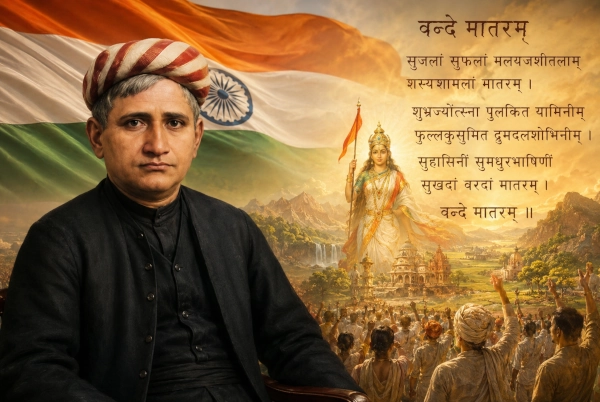
Before entering the verses of Vande Mataram, it is worth remembering that the complete six-stanza composition is not written in Sanskrit alone. Bankim Chandra Chattopadhyay shaped the song in a highly Sanskritised literary idiom while also retaining Bengali expressions such as tumi, tomarai and ke bole in the later stanzas. Those words belong to the original character of the hymn and should be preserved rather than replaced by artificial Sanskrit equivalents. The text that follows therefore presents the complete six-stanza version in Devanagari, with transliteration and meaning, while remaining faithful to Bankim Chandra Chattopadhyay ’s original linguistic texture.
The Birth of Vande Mataram
Vande Mataram emerged in the late nineteenth century, at a time when India was living under British colonial rule and a new sense of national consciousness was beginning to take shape. Bankim Chandra Chattopadhyay composed the hymn as an invocation to the Motherland, portraying India not merely as territory, but as a living mother who nourishes her children through her rivers, fields, forests, knowledge, strength and spiritual heritage. The song later became part of his celebrated novel Anandamath, published in 1882. Its opening words — Vande Mataram, “I bow to thee, Mother” — soon travelled far beyond literature. During the freedom movement, they became a cry of unity, courage and resistance, inspiring generations of Indians to see the struggle for freedom as service to the Mother herself.
Bankim Chandra Chattopadhyay
Bankim Chandra Chattopadhyay (1838–1894) was one of the great architects of modern Indian literature and an important intellectual voice of the nineteenth-century Bengal Renaissance. A scholar, novelist, essayist and civil servant, he combined a deep knowledge of Sanskritic thought with a powerful command of modern prose. Through works such as Anandamath, Devi Chaudhurani and Krishnacharitra, Bankim explored questions of Dharma, society, history, national identity and cultural renewal. Yet his most enduring contribution to India’s public imagination remains Vande Mataram. In those two words, Bankim transformed patriotism into something intimate and sacred: love of country became love of Mother. Long after his lifetime, the hymn continued to inspire India’s freedom movement and ultimately became recognised as the National Song of India.
Verse 1
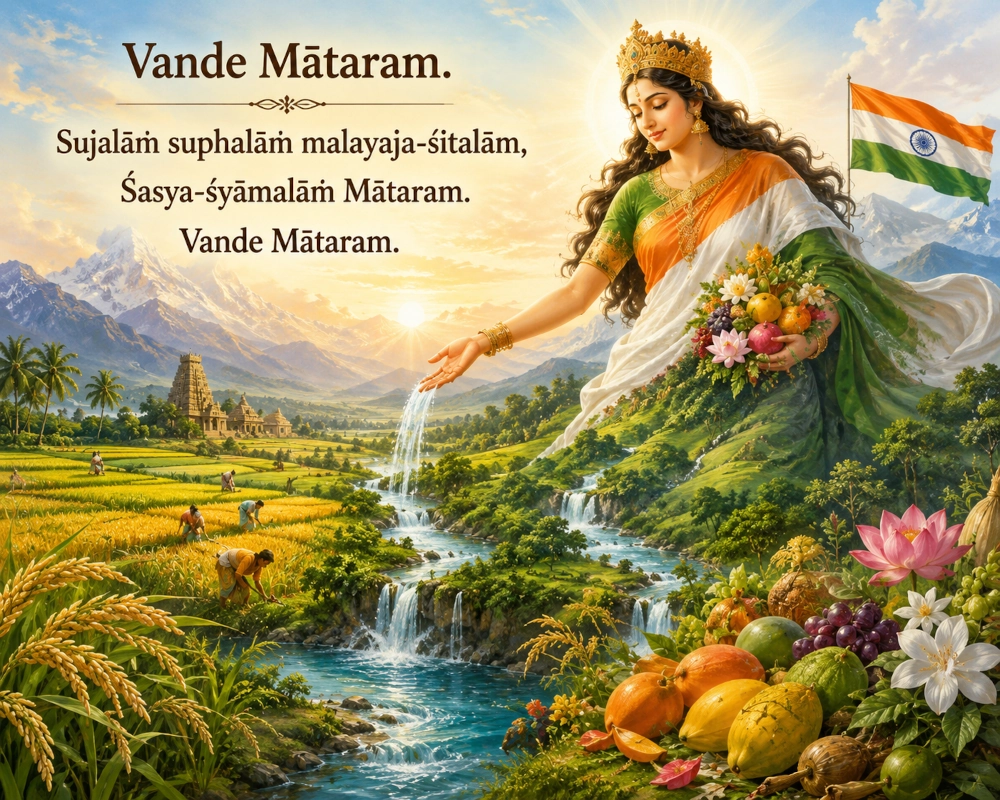
Sanskrit / Devanagari
वन्दे मातरम्।
सुजलां सुफलां मलयज-शीतलाम्,
शस्य-श्यामलां मातरम्।
वन्दे मातरम्॥
Transliteration
Vande Mātaram.
Sujalāṁ suphalāṁ malayaja-śītalām,
Śasya-śyāmalāṁ Mātaram.
Vande Mātaram.
Word-by-word meaning
वन्दे — Vande — I bow to; I salute; I revere.
मातरम् — Mātaram — the Mother; Motherland.
सुजलाम् — Sujalām — richly endowed with good and abundant water.
सुफलाम् — Suphalām — rich in fruits; abundantly fruitful.
मलयज — Malayaja — born of or coming from the Malaya mountains; traditionally associated with sandalwood and fragrant southern breezes.
शीतलाम् — Śītalām — cool, refreshing, soothing.
शस्य — Śasya — crops, grain, agricultural produce.
श्यामलाम् — Śyāmalām — dark-green, verdant, richly covered with vegetation.
मातरम् — Mātaram — Mother.
Meaning of the verse
I bow to thee, Mother — blessed with plentiful waters, abundant fruits and cooling, fragrant breezes; Mother, whose fields are dark-green with flourishing crops. I bow to thee, Mother.
The opening verse sees India as a living mother through the abundance of her land. Her rivers provide water, her soil produces fruit and grain, and her landscapes are covered in green fields. The Mother is therefore both beautiful and life-giving.
Verse 2
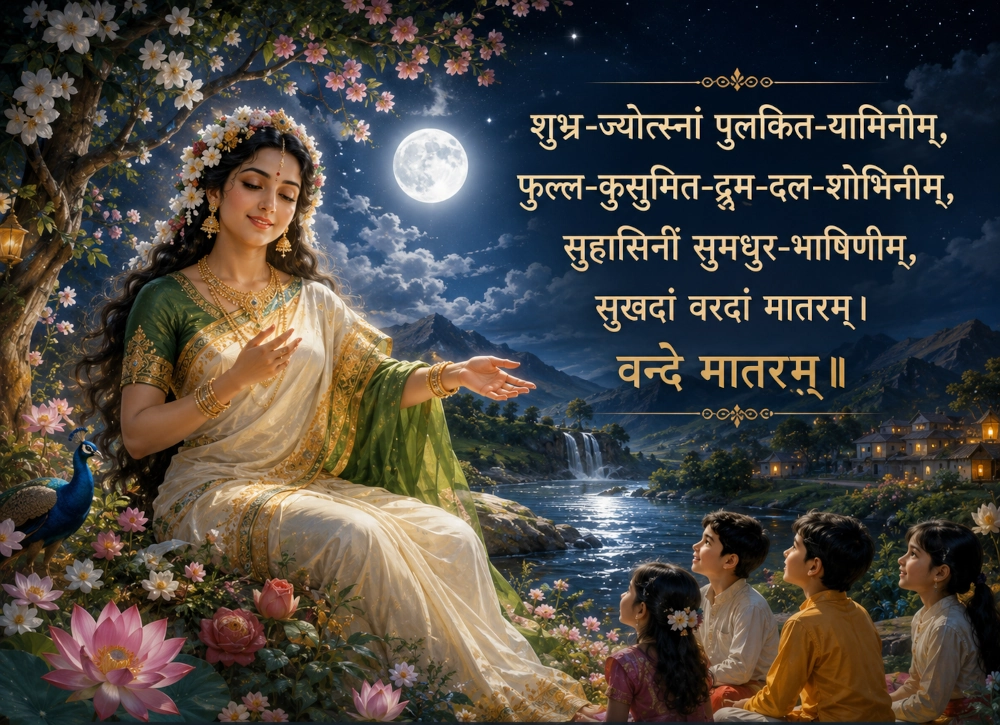
Sanskrit / Devanagari
शुभ्र-ज्योत्स्नां पुलकित-यामिनीम्,
फुल्ल-कुसुमित-द्रुम-दल-शोभिनीम्,
सुहासिनीं सुमधुर-भाषिणीम्,
सुखदां वरदां मातरम्।
वन्दे मातरम्॥
Transliteration
Śubhra-jyotsnāṁ pulakita-yāminīm,
Phulla-kusumita-druma-dala-śobhinīm,
Suhāsinīṁ sumadhura-bhāṣiṇīm,
Sukhadāṁ varadāṁ Mātaram.
Vande Mātaram.
Word-by-word meaning
शुभ्र — Śubhra — radiant, pure, white, brilliant.
ज्योत्स्नाम् — Jyotsnām — moonlight.
पुलकित — Pulakita — thrilled, delighted, filled with joy or wonder.
यामिनीम् — Yāminīm — night.
Thus:
शुभ्र-ज्योत्स्नां पुलकित-यामिनीम् — whose nights rejoice beneath pure white moonlight.
फुल्ल — Phulla — fully blossomed.
कुसुमित — Kusumita — flowering, filled with flowers.
द्रुम — Druma — tree.
दल — Dala — leaf, foliage.
शोभिनीम् — Śobhinīm — beautiful, shining, adorned.
Thus:
फुल्ल-कुसुमित-द्रुम-दल-शोभिनीम् — beautiful with flowering trees and luxuriant foliage.
सुहासिनीम् — Suhāsinīm — sweetly smiling.
सुमधुर — Sumadhura — exceedingly sweet, melodious.
भाषिणीम् — Bhāṣiṇīm — speaking; she who speaks.
सुखदाम् — Sukhadām — giver of happiness.
वरदाम् — Varadām — giver of blessings and boons.
मातरम् — Mātaram — Mother.
Meaning of the verse
I bow to the Mother whose nights glow joyfully beneath brilliant moonlight; whose land is adorned with flowering trees and foliage; who smiles gently and speaks in sweet voices; who gives happiness and blessings.
Here the Motherland becomes almost a divine personality. Moonlit nights, flowering forests and the many melodious languages spoken by her people become her beauty, smile and voice.
Verse 3
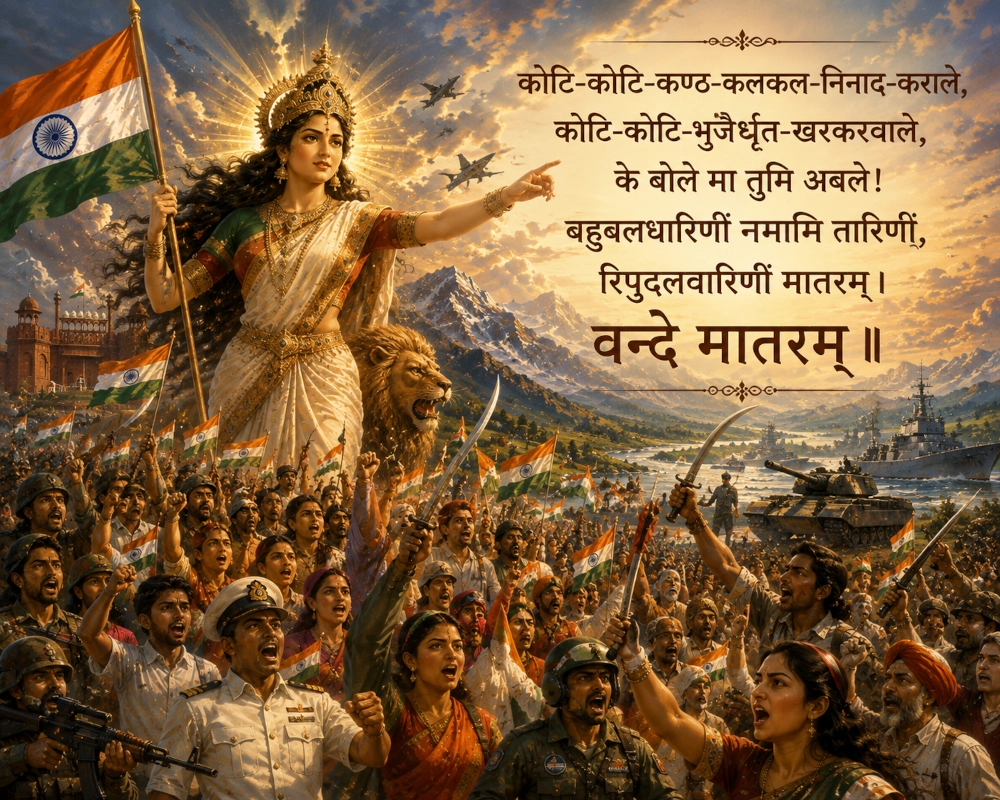
Devanagari
कोटि-कोटि-कण्ठ-कलकल-निनाद-कराले,
कोटि-कोटि-भुजैर्धृत-खरकरवाले,
के बोले मा तुमि अबले!
बहुबलधारिणीं नमामि तारिणीं,
रिपुदलवारिणीं मातरम्।
वन्दे मातरम्॥
Transliteration
Koṭi-koṭi-kaṇṭha-kalakala-nināda-karāle,
Koṭi-koṭi-bhujair-dhṛta-kharakaravāle,
Ke bole Mā tumi abale!
Bahubala-dhāriṇīṁ namāmi tāriṇīm,
Ripudala-vāriṇīṁ Mātaram.
Vande Mātaram.
Word-by-word meaning
कोटि-कोटि — Koṭi-koṭi — crores upon crores; countless millions.
कण्ठ — Kaṇṭha — throats, voices.
कलकल — Kalakala — a great continuous sound, roar or resounding murmur.
निनाद — Nināda — resonance, reverberation, mighty sound.
कराले — Karāle — formidable, awe-inspiring, terrible to the enemy.
कोटि-कोटि-कण्ठ-कलकल-निनाद-कराले — formidable with the resounding voices of countless millions.
भुजैः — Bhujaiḥ — by arms.
धृत — Dhṛta — held, borne.
खर — Khara — sharp, fierce.
करवाल — Karavāla — sword.
Thus the line evokes millions of arms bearing sharp swords or weapons.
के बोले — Ke bole — who says? (Bengali)
मा — Mā — Mother.
तुमि — Tumi — you. (Bengali)
अबले — Abale — powerless, weak.
बहु — Bahu — much, manifold.
बल — Bala — strength.
धारिणीम् — Dhāriṇīm — bearer or possessor.
नमामि — Namāmi — I bow to.
तारिणीम् — Tāriṇīm — saviour; she who carries one across difficulty.
रिपु — Ripu — enemy.
दल — Dala — host, army, forces.
वारिणीम् — Vāriṇīm — she who repels, restrains or destroys.
Meaning of the verse
With the thunderous voices of countless millions and the strength of countless arms, who can call you weak, O Mother? Possessing immense power, you are the saviour who protects your children and drives back the forces of the enemy. To you I bow.
The peaceful Mother of rivers, moonlight and crops becomes the collective strength of her people. Her power lies in millions of voices and millions of arms acting together.
Verse 4
Sanskrit / Devanagari
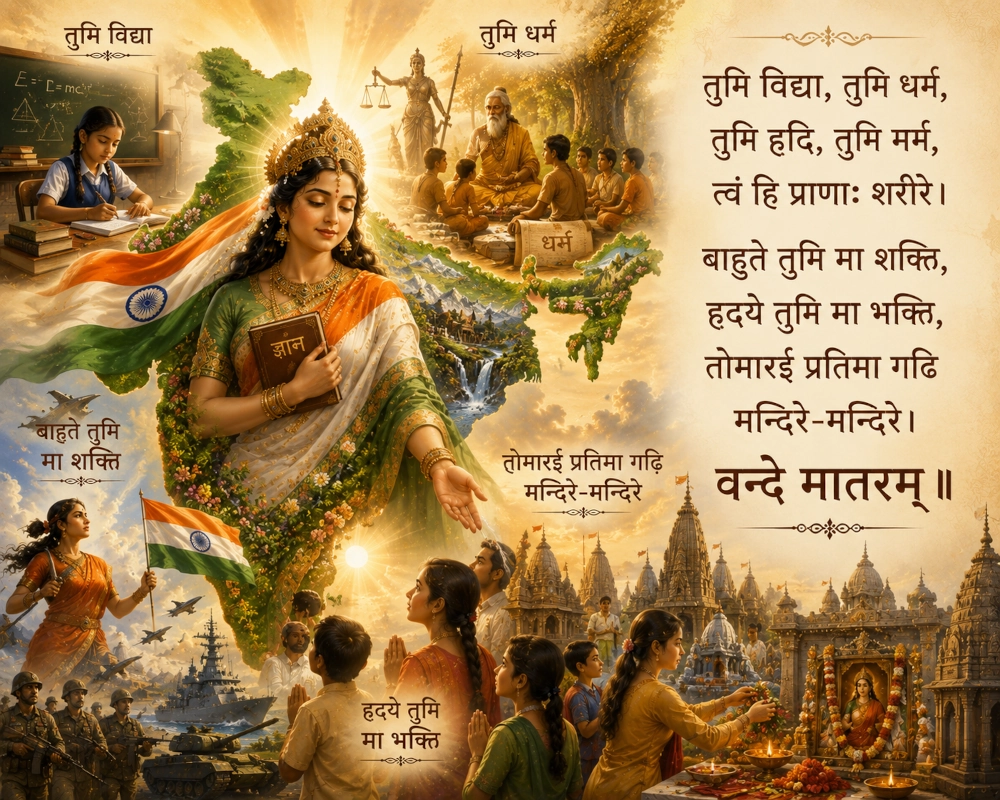
तुमि विद्या, तुमि धर्म,
तुमि हृदि, तुमि मर्म,
त्वं हि प्राणाः शरीरे।
बाहुते तुमि मा शक्ति,
हृदये तुमि मा भक्ति,
तोमारई प्रतिमा गढ़ि मन्दिरे-मन्दिरे।
वन्दे मातरम्॥
Transliteration
Tumi vidyā, tumi dharma,
Tumi hṛdi, tumi marma,
Tvaṁ hi prāṇāḥ śarīre.
Bāhute tumi Mā śakti,
Hṛdaye tumi Mā bhakti,
Tomārai pratimā gaḍi mandire-mandire.
Vande Mātaram.
This stanza particularly illustrates the Sanskrit-Bengali character of Bankim’s original composition.
Word-by-word meaning
तुमि — Tumi — you are. ( in Bengali)
विद्या — Vidyā — knowledge, learning, wisdom.
धर्म — Dharma — righteousness, duty, moral order, sustaining principle.
हृदि — Hṛdi — in the heart.
मर्म — Marma — innermost essence; vital core.
त्वम् — Tvam — you.
हि — Hi — indeed, truly.
प्राणाः — Prāṇāḥ — life-breaths; vital force.
शरीरे — Śarīre — in the body.
बाहुते — Bāhute — in the arms.
मा — Mā — Mother.
शक्ति — Śakti — power, strength.
हृदये — Hṛdaye — in the heart.
भक्ति — Bhakti — devotion.
तोमारई — Tomārai — yours alone; your very own. (Bengali)
प्रतिमा — Pratimā — image, representation, sacred form.
गढ़ि — Gaḍi — we fashion, form or mould.
मन्दिरे-मन्दिरे — Mandire-mandire — in temple after temple; in every temple.
Meaning of the verse
You are our knowledge; you are our Dharma. You dwell in our hearts and are our innermost essence. You are the very life within our bodies. Mother, you are the strength in our arms and the devotion within our hearts. It is your image that we fashion and honour in every temple.
This is one of the deepest philosophical sections of Vande Mataram. The Mother is no longer merely geographical territory. She represents knowledge, Dharma, life, strength and devotion. The nation lives through the moral, intellectual and spiritual life of its people.
Verse 5
Sanskrit / Devanagari
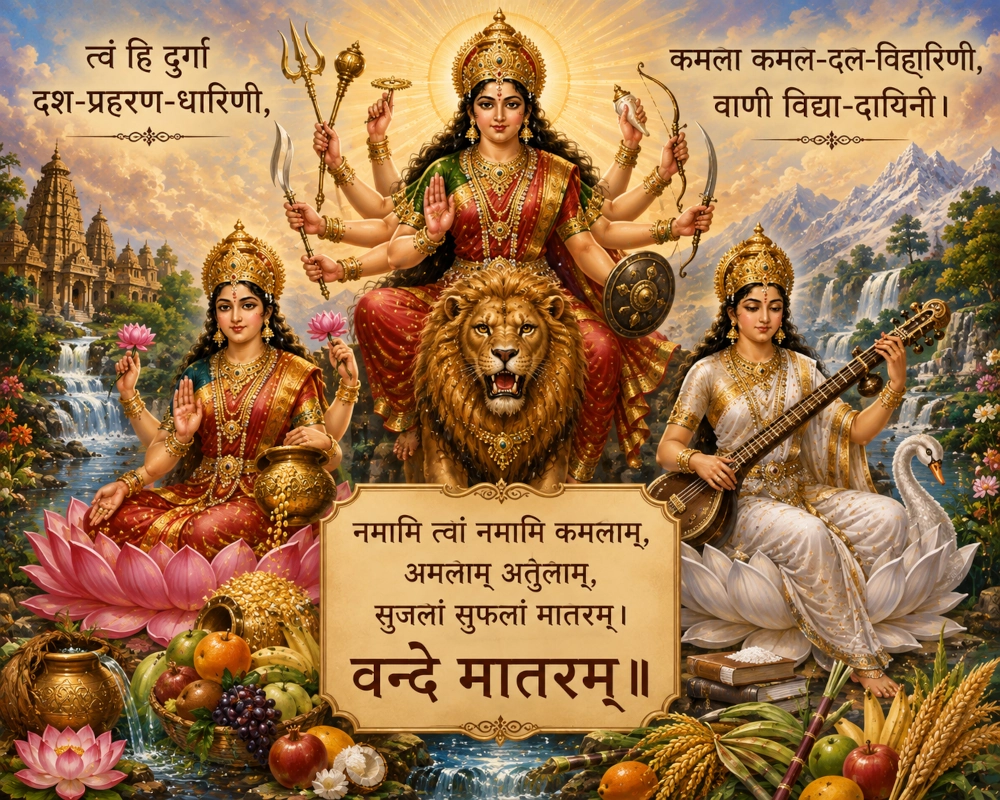
त्वं हि दुर्गा दश-प्रहरण-धारिणी,
कमला कमल-दल-विहारिणी,
वाणी विद्या-दायिनी।
नमामि त्वां नमामि कमलाम्,
अमलाम् अतुलाम्,
सुजलां सुफलां मातरम्।
वन्दे मातरम्॥
Transliteration
Tvaṁ hi Durgā daśa-praharaṇa-dhāriṇī,
Kamalā kamala-dala-vihāriṇī,
Vāṇī vidyā-dāyinī.
Namāmi tvāṁ namāmi Kamalām,
Amalām atulām,
Sujalāṁ suphalāṁ Mātaram.
Vande Mātaram.
Word-by-word meaning
त्वम् — Tvam — you.
हि — Hi — indeed.
दुर्गा — Durgā — Goddess Durga; embodiment of divine power and protection.
दश — Daśa — ten.
प्रहरण — Praharaṇa — weapons.
धारिणी — Dhāriṇī — she who bears or carries.
दशप्रहरणधारिणी — she who bears ten weapons.
कमला — Kamalā — Lakshmi, goddess of prosperity; literally “the lotus one.”
कमल — Kamala — lotus.
दल — Dala — petal.
विहारिणी — Vihāriṇī — she who dwells, moves or delights in.
वाणी — Vāṇī — Saraswati, goddess of speech and knowledge.
विद्या — Vidyā — knowledge.
दायिनी — Dāyinī — giver.
नमामि — Namāmi — I bow.
त्वाम् — Tvām — to you.
अमलाम् — Amalām — spotless, pure.
अतुलाम् — Atulām — incomparable, beyond comparison.
सुजलाम् — Sujalām — abundant in water.
सुफलाम् — Suphalām — abundant in fruits.
Meaning of the verse
You are Durga, bearer of mighty weapons and embodiment of strength. You are Kamala, Lakshmi, dwelling upon the lotus and bestowing prosperity. You are Vani, Saraswati, giver of knowledge. I bow to you — pure, incomparable, rich in waters and fruits — O Mother.
The Verse presents the Motherland through three dimensions of Shakti:
Durga — शक्ति — Power and protection
Lakshmi — श्री — Prosperity and abundance
Saraswati — विद्या — Knowledge and wisdom
The Motherland therefore sustains civilisation through strength, prosperity and knowledge together.
Verse 6
Sanskrit / Devanagari
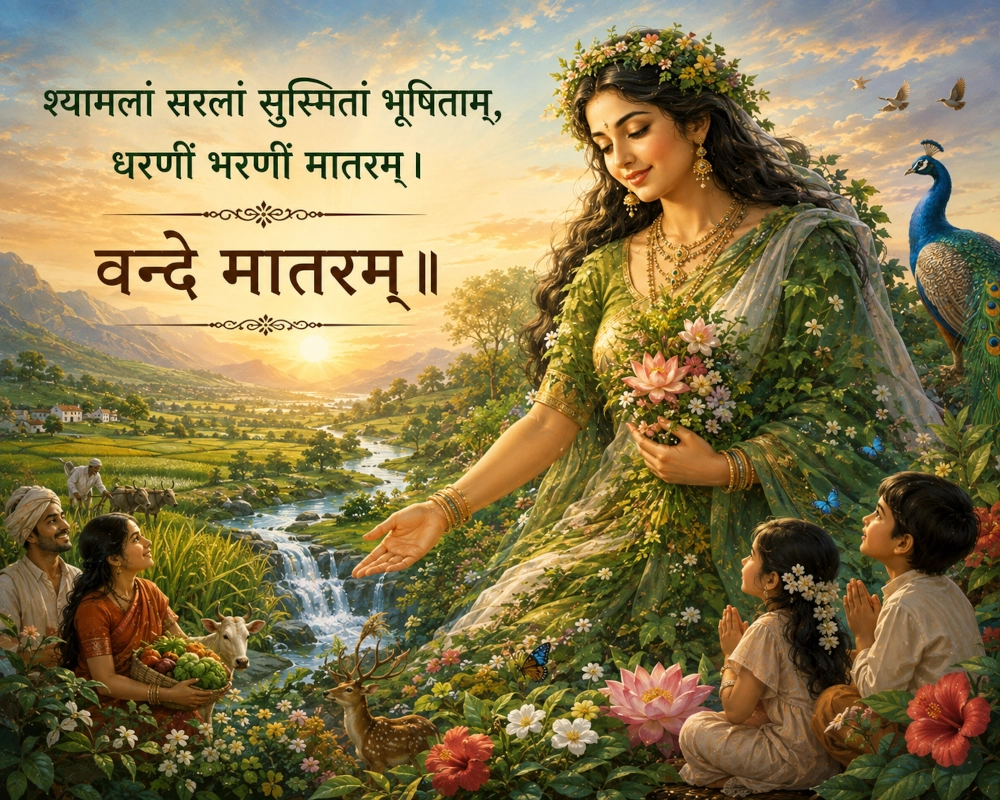
श्यामलां सरलां सुस्मितां भूषिताम्,
धरणीं भरणीं मातरम्।
वन्दे मातरम्॥
Transliteration
Śyāmalāṁ saralāṁ susmitāṁ bhūṣitām,
Dharaṇīṁ bharaṇīṁ Mātaram.
Vande Mātaram.
Word-by-word meaning
श्यामलाम् — Śyāmalām — green, dark-hued, verdant.
सरलाम् — Saralām — simple, pure, straightforward, gracious.
सुस्मिताम् — Susmitām — beautifully smiling.
भूषिताम् — Bhūṣitām — adorned, decorated, made beautiful.
धरणीम् — Dharaṇīm — the Earth; she who bears and supports all beings.
भरणीम् — Bharaṇīm — she who nourishes, sustains and supports.
मातरम् — Mātaram — Mother.
Meaning of the verse
I bow to the Mother who is verdant, gracious and beautifully smiling; the adorned Earth who bears us, nourishes us and sustains our lives. I bow to thee, Mother.
The song closes by returning to its opening image: Mother as the land itself. Yet after the intervening verses, she now carries a much larger meaning. She is fertile earth, beauty, collective strength, knowledge, Dharma, devotion, prosperity and divine Shakti.
The Deeper Meaning of “Vande Mataram”
The expression is deceptively simple.
वन्दे — Vande comes from the Sanskrit root वन्द् — vand, meaning to salute, praise, honour or bow reverentially.
मातरम् — Mātaram is the accusative singular of मातृ — mātṛ, “Mother.”
Thus its literal sense is:
“I bow to the Mother.”
But the Mother of Bankim’s hymn operates simultaneously at several levels.
She is Bhūmi, the physical land with rivers, fields, forests and fruit.
She is Janani, the mother who nourishes her children.
She is Shakti, the collective power of the people.
She is Vidya, knowledge and civilisation.
She is Dharma, the moral foundation of society.
She is Durga, protective strength.
She is Lakshmi, prosperity.
She is Saraswati, learning, culture and wisdom.
And finally, she is the Motherland itself.
That is why Vande Mataram moves deliberately from the beauty of the land to the strength of its people and finally to the spiritual conception of the nation as Mother.
The Government of India’s current official version contains these six stanzas, with a prescribed rendition of approximately 3 minutes and 10 seconds. PIB also confirmed the adoption and broadcasting of the complete six-stanza version in 2026. (pib.gov.in)
You may also like
-
Kapisa: The Ancient Kingdom North of Kabul at the Gateway of the Hindu Kush
-
Lampaka: The Mountain Kingdom of Laghman on the Kabul River Frontier
-
Navaratri and Ayurveda: The Nine Divine Medicinal Plants Associated with Navadurga
-
Bahlika: The Ancient Bactrian Realm of Balkh in the Mahabharata
-
Kamboja: The Horse-Breeding Frontier Kingdom of the Hindu Kush in the Mahabharata
