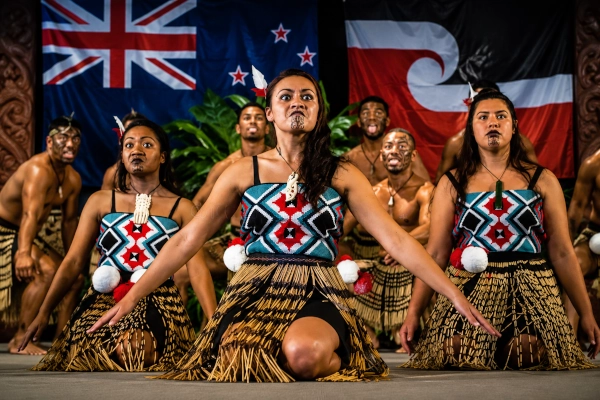
Prime Minister Narendra Modi has highlighted the cultural affinity between India and New Zealand’s Māori community, pointing to their shared respect for nature, collective wellbeing and sustainable development.
Addressing a Business and Sports Engagement event in Auckland, the Prime Minister said these common values could support a more inclusive model of economic cooperation between India and New Zealand. He welcomed the participation of Māori business leaders and noted that the recently concluded India–New Zealand Free Trade Agreement includes provisions intended to create opportunities for Māori enterprises.
According to the Prime Minister, both Indian civilisation and Māori traditions place considerable importance on the relationship between people, community and the natural environment. By bringing these values into trade and investment partnerships, the two countries could build commercial links that promote prosperity while protecting social and environmental interests.
The Māori economy has a strong presence in agriculture, fisheries, forestry and land-based industries. Māori-owned enterprises have also expanded into tourism, property development, renewable energy, professional services and international trade. Many of these businesses follow a long-term approach centred on community benefit, responsible resource use and intergenerational growth.
Prime Minister Modi said such an economic philosophy closely complements India’s emphasis on sustainable development, rural livelihoods and inclusive growth. The Free Trade Agreement could therefore provide a platform for partnerships between Indian companies and Māori enterprises in areas such as food processing, agribusiness, tourism, clean energy, forestry, education and traditional knowledge.
Earlier, the Prime Minister received a traditional Māori pōwhiri ceremonial welcome at Government House in Auckland. He described the ceremony as a deeply moving expression of New Zealand’s indigenous heritage and cultural identity.
The welcome formed part of Prime Minister Modi’s official visit to New Zealand, the first by an Indian Prime Minister in four decades. The visit marked a significant stage in bilateral relations, with India and New Zealand agreeing to elevate their ties to a Strategic Partnership.
Prime Minister Modi also held delegation-level discussions with New Zealand Prime Minister Christopher Luxon. The two leaders reviewed cooperation in trade, defence, maritime security, agriculture, education, tourism, culture and people-to-people relations.
A major outcome of the visit was the conclusion of the India–New Zealand Free Trade Agreement. Prime Minister Modi praised the speed with which negotiations had progressed following Prime Minister Luxon’s earlier visit to India.
He said the agreement reflected strong political commitment and broad support across New Zealand. The FTA is expected to expand bilateral trade, improve market access and encourage greater investment across multiple sectors.
The Auckland business event was also intended to strengthen direct engagement between companies, investors, sporting organisations and community leaders from both countries. Prime Minister Modi acknowledged the contribution of New Zealand’s business sector, including Māori enterprises, in building a stronger economic relationship with India.
India and New Zealand are increasingly describing themselves as natural partners connected by democracy, maritime geography and shared interests in the Indo-Pacific. Both countries support open sea lanes, regional stability and closer economic cooperation.
The Prime Minister expressed confidence that the new Strategic Partnership would contribute to peace, security and sustainable prosperity in the wider Indo-Pacific region.
The emphasis on Māori participation gave the visit a distinct cultural and economic dimension. It placed indigenous enterprise, ecological responsibility and community-led development within the broader India–New Zealand partnership.
By linking commercial cooperation with shared values, the two countries have opened the way for a relationship that extends beyond trade volumes and investment figures. The emerging partnership seeks to combine economic growth with cultural respect, social inclusion and environmental responsibility.
More about India New Zealand Cultural Link
References
- DD India. “India, Māori Traditions Share Respect for Nature and Community, Says PM Modi in Auckland.” 11 July 2026.
https://ddindia.co.in/2026/07/india-maori-traditions-share-respect-for-nature-and-community-says-pm-modi-in-auckland/ - Prime Minister’s Office, Government of India. “Prime Minister Addresses Business Leaders in New Zealand.” 11 July 2026.
https://www.pib.gov.in/PressReleaseDetail.aspx?PRID=2283531&lang=1®=48 - Prime Minister’s Office, Government of India. “India–New Zealand Joint Statement.” 11 July 2026.
https://www.pmindia.gov.in/en/news_updates/india-new-zealand-joint-statement-2/ - Prime Minister’s Office, Government of India. “India–New Zealand Strategic Partnership: Roadmap to 2030.” 11 July 2026.
https://www.pmindia.gov.in/en/news_updates/india-new-zealand-strategic-partnership-roadmap-to-2030/ - Prime Minister’s Office, Government of India. “Prime Minister Holds Official Talks with Prime Minister of New Zealand.” 11 July 2026.
https://www.pmindia.gov.in/en/news_updates/pm-holds-official-talks-with-prime-minister-of-new-zealand/
You may also like
-
India, Russia and the Ukraine Conflict: Putin Highlights Modi’s Continued Push for Dialogue and a Negotiated Settlement
-
India and France Discuss Aerospace Manufacturing, UPI Integration and India-EU FTA
-
Côte d’Ivoire Military Delegation Visits HAL, Shows Interest in India’s Indigenous Aerospace Platforms
-
India and Netherlands Move to Deepen Agricultural Cooperation in Seeds, Horticulture and Innovation
-
Samatata — The Low-Lying Deltaic Realm of Southeastern Bengal
