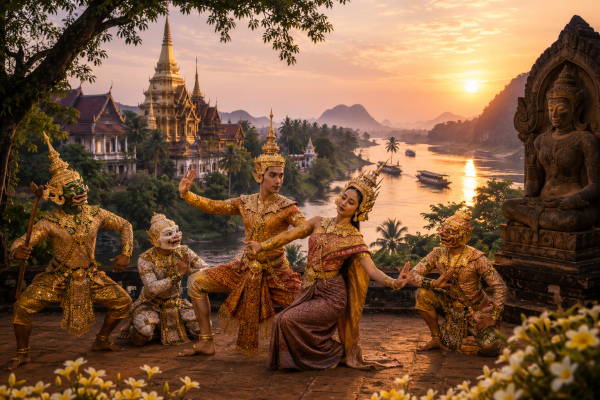
Laos preserves one of the most beautiful Southeast Asian forms of the Ramayana through Phra Lak Phra Lam, also written as Phra Lak Phra Ram or Phalak Phalam. In this Lao tradition, the Indian epic is retold through the moral universe of Theravada Buddhism, Mekong river culture, royal dance-drama, temple storytelling, and local folklore. The story of Rama became the story of Phra Lam, Lakshmana became Phra Lak, Sita became Nang Sida, and Ravana entered the Lao imagination through a world of kings, forests, rivers, nagas, spirits, merit, karma, and Buddhist ethics.
In a positive Akhand Bharat sense, Laos represents Brihattar Bharat — the larger civilisational sphere shaped by Bharat’s epics, Sanskrit-Pali vocabulary, sacred geography, Hindu-Buddhist art, maritime and overland exchange, and shared Asian memory. This is a cultural Akhand Bharat: a world where ideas travelled through monks, scholars, traders, artists, temple-builders, manuscripts, dancers, and storytellers. India’s Ministry of Culture has also described Brihattar Bharat as a vision that highlights India’s cultural influence on Southeast Asia through shared heritage, Sanskrit inscriptions, religion, art, and traditions.
Phra Lak Phra Lam: The Lao Ramayana
Phra Lak Phra Lam is the Lao adaptation of Valmiki’s Ramayana. Luang Prabang cultural documentation describes it as a Lao version of the Indian literary epic, with the central figures of Rama, Sita, and Lakshmana transformed into Phra Lam, Nang Sida, and Phra Lak within a Lao cultural setting.
The Lao version is especially significant because it places the Ramayana inside a Buddhist framework. The story is treated as a Sadok, from the Pali Jataka, meaning a tale of a previous birth of the Buddha. In this tradition, Phra Lam is understood as the Buddha in one of his previous lives, and the epic becomes a vehicle for teaching morality, karma, self-control, righteous kingship, and compassion.
This gives the Lao Ramayana a special character. In India, Rama is worshipped as an avatar of Vishnu and as Maryada Purushottama, the ideal king and man of dharma. In Laos, Phra Lam becomes a Buddhist moral prince, a figure whose life demonstrates merit, restraint, ethical kingship, and spiritual discipline. The outer story remains heroic, while the inner meaning becomes deeply Buddhist.
The Mekong Setting of the Epic
One of the most striking features of Phra Lak Phra Lam is its local geography. The Lao version shifts the epic world into cities and landscapes along the Mekong River. The story is no longer only Ayodhya, Lanka, and the forests of ancient India. It becomes a Lao sacred geography of rivers, kingdoms, nagas, forest beings, local spirits, and Buddhist moral order. Luang Prabang Culture notes that the Lao version places events in cities along the Mekong and reflects Lao moral sensibilities.
This is the genius of Southeast Asian Ramayana traditions. The epic travels from Bharat, but it does not remain foreign. It enters the local river, the local court, the local temple, the local dance, and the local imagination. In Laos, the Ramayana flows like the Mekong — ancient, sacred, adaptable, and life-giving.
Phra Lak Comes First
The title itself is meaningful: Phra Lak Phra Lam places Lakshmana before Rama. In the Indian Ramayana, Lakshmana is the loyal younger brother who follows Rama into exile and serves him with complete devotion. In the Lao title, Phra Lak’s name receives honoured placement, giving special importance to brotherly loyalty, service, and voluntary sacrifice.
This reflects a central Lao moral value: loyalty within family, duty within society, and devotion within sacred relationships. Phra Lak represents the strength of companionship. Phra Lam represents righteous kingship. Together, they become a two-fold ideal: the noble ruler and the loyal companion.
Nang Sida and the Moral Centre of the Story
Nang Sida, the Lao Sita, remains the emotional and moral centre of the epic. Her abduction creates the great crisis. Her dignity gives the story its emotional force. Her suffering tests the courage, loyalty, and righteousness of the heroes.
In Hindu tradition, Sita is associated with purity, endurance, fertility, and the grace of Lakshmi. In the Lao Buddhist setting, Nang Sida becomes a symbol of moral strength, patience, and karmic testing. She is not simply a queen to be rescued. She is the sacred reason the heroes must act according to dharma.
Hanuman, Ravana, and the Theatre of Laos
The Lao Ramayana also preserves the dramatic world of heroic animals, demons, divine forces, and courtly conflict. Hanuman remains a beloved figure across Southeast Asian Ramayana traditions because he combines courage, intelligence, strength, humour, and devotion. Ravana remains the grand figure of pride, desire, and destructive kingship.
In Lao performance, these figures are brought alive through court dance, music, costume, masks, and stylised movement. The Royal Theatre of Luang Prabang continues to present the Phralak Phralam performance, with more than one hundred dancers and musicians bringing the Lao Ramayana epic to life.
Prime Minister Narendra Modi witnessed a Lao Ramayan performance called Phalak Phalam or Phra Lak Phra Ram in 2024, and the official release described Ramayan as continuing to be celebrated in Laos while reflecting shared heritage and age-old civilisational connections between India and Laos.
Vat Phou: Hindu Memory in the Sacred Landscape of Laos
Laos also carries a powerful Hindu-Buddhist memory through Vat Phou in Champasak. UNESCO describes the Vat Phou cultural landscape as a planned sacred landscape more than 1,000 years old, shaped to express the Hindu vision of the relationship between nature and humanity through an axis from mountain top to river bank, with temples, shrines, and waterworks spread over nearly 10 km.
The official Vat Phou heritage site explains that the religious complex is of Khmer architecture and Hindu religion, situated at the foot of Phou Kao mountain, whose shape was identified in ancient times with the linga, the symbol of Shiva. The site also notes that the permanent spring at the cliffs helped make the area a Shivaite sanctuary.
This makes Vat Phou one of the strongest symbols of India-Laos civilisational connection. It shows how Shiva worship, sacred mountains, water symbolism, temple architecture, Sanskritic ideas, and Buddhist transformation came together in Laos. India’s Archaeological Survey of India has also been involved in the restoration and conservation of Vat Phou under Indian assistance, giving this shared heritage a living diplomatic and cultural dimension.
Hindu Gods and Lao Traditional Culture: A Cultural Comparison
The comparison between Hindu gods and Lao traditional culture must be understood as cultural resonance and historical contact. Laos has its own religious personality shaped by Theravada Buddhism, indigenous spirit traditions, naga worship, royal court culture, Khmer influence, Pali learning, Sanskritic vocabulary, and local ecology. The result is a graceful blending, where Indian deities and ideas were absorbed into Lao Buddhist and folk worlds.
Vishnu and Phra Lam
In Hinduism, Rama is an avatar of Vishnu, the preserver of cosmic order. His mission is the restoration of dharma. In Laos, Phra Lam carries the same moral function, but the interpretation becomes Buddhist. He is presented as a previous life of the Buddha, so his kingship becomes a lesson in merit, restraint, karma, and righteous conduct. The Hindu concept of Vishnu’s avatar thus finds a Lao Buddhist form through the Bodhisatta-like figure of Phra Lam.
Lakshmana and Phra Lak
Lakshmana in the Indian epic represents loyalty, discipline, and brotherly devotion. In Laos, Phra Lak receives special honour by appearing first in the title. This gives the Lao version a beautiful ethical emphasis: the greatness of the hero is strengthened by the greatness of the companion. Phra Lak becomes a model of voluntary service, family duty, and steadfast courage.
Sita, Lakshmi, and Nang Sida
Sita in the Indian tradition is often associated with Lakshmi, fertility, royal grace, and sacred womanhood. In Laos, Nang Sida becomes the moral heart of the Buddhist epic. Her suffering and dignity create the field where Phra Lam and Phra Lak must prove their virtue. In this way, the Lakshmi-Sita ideal of grace and purity becomes a Lao ideal of patience, karmic strength, and moral beauty.
Shiva and Vat Phou
The clearest Shaiva connection in Laos is Vat Phou. Its sacred mountain, linga symbolism, spring, and planned Hindu landscape express a deep memory of Shiva worship in southern Laos. UNESCO identifies Vat Phou as a landscape shaped by the Hindu vision of nature and humanity, while the official Vat Phou site connects Phou Kao with the linga of Shiva and the creation of a Shivaite sanctuary.
Indra and Lao Buddhist Cosmology
Indra appears across Hindu and Buddhist worlds. In the Indian tradition, Indra is king of the devas, lord of rain, thunder, power, and celestial authority. In Buddhist Southeast Asia, Indra is often absorbed into the Buddhist cosmos as a divine protector. In Phra Lak Phra Lam, the story itself includes the god Indra in a key narrative episode, showing how Indic divine vocabulary remained alive within Lao storytelling.
Bhumi Devi, Prithvi, and Mae Thoranee
The Lao figure Mae Thoranee is a powerful bridge between Indian and Southeast Asian sacred imagination. Luang Prabang Culture describes Mae Thoranee as the original mother earth goddess in Lao culture and central to one of the most popular stories in Lao Buddhism. She is connected with the famous Buddhist scene where the Earth Goddess bears witness to the Buddha’s merit.
This connects beautifully with Hindu Bhumi Devi or Prithvi, the earth goddess. Both traditions honour the earth as witness, mother, support, and sacred force. In Laos, Mae Thoranee carries this earth-mother power through Buddhist symbolism.
Nagas in Hinduism and Laos
The naga is one of the strongest shared symbols between India and Laos. In Hindu and Buddhist traditions, nagas are serpent beings connected with water, fertility, protection, hidden wisdom, and sacred geography. In Laos, nagas are deeply linked with rivers, ponds, temples, and the Mekong imagination. Luang Prabang Culture describes nagas and ngeuak as water spirits living in rivers, ponds, and underground, with nagas generally acting as benevolent guardians when respected.
This is a powerful civilisational continuity. The Indian naga entered Southeast Asian culture and became a living Lao guardian of rivers, temples, cities, and Buddhist sacred spaces.
Devas, Thevada, and Phi Spirits
Lao culture has a rich spirit world known as phi. These spirits inhabit trees, ground, fields, rocks, water places, houses, and sacred spaces. Luang Prabang Culture notes that spirit belief predates the adoption of Buddhism in Laos and remains an innate part of local culture.
This can be compared with Hindu and Buddhist ideas of devas, yakshas, bhutas, grama-devatas, and place guardians. In both worlds, nature is alive, sacred places have guardians, offerings maintain harmony, and human life is connected with unseen powers. John Clifford Holt’s work on Lao religious culture also highlights the enduring importance of phi spirit traditions in shaping how Lao people understand Buddhist temples, relics, ritual spaces, and sacred power.
The Buddhist Transformation of the Ramayana
The Lao Ramayana shows how Bharat’s epic became a Buddhist teaching text. The story of exile becomes a lesson in patience. The abduction of Nang Sida becomes a test of moral endurance. The war against Ravana becomes a fight against pride, delusion, and wrongful desire. The hero’s return becomes the restoration of order.
This is why Phra Lak Phra Lam is so important. It proves that the Ramayana is not locked inside one language or one religious form. It can become Sanskrit poetry, Tamil devotion, Thai mural, Cambodian dance, Malay shadow play, Indonesian temple relief, and Lao Buddhist Jataka. Its core message remains alive because its values are universal: loyalty, courage, restraint, righteousness, honour, compassion, and the victory of moral order.
Akhand Bharat and Laos
In the Lao context, Akhand Bharat should be presented as civilisational unity through culture. It is the memory of a time when Bharat’s stories, gods, scripts, sacred words, temples, and philosophical ideas travelled across Asia and became part of local traditions. Laos received this inheritance through Khmer-Hindu temple culture, Buddhist monastic networks, royal courts, manuscripts, performance traditions, and sacred geography.
The connection is visible in Phra Lak Phra Lam, in Vat Phou, in naga symbolism, in Pali-Sanskrit sacred vocabulary, in Buddhist storytelling, and in India’s continuing role in restoring shared heritage sites. This is Akhand Bharat in its finest positive meaning: a family of cultures bound by story, dharma, art, memory, and respect.
Cultural Importance Today
Today, Phra Lak Phra Lam continues to be an important part of Lao cultural identity. It survives in performance, dance, temple memory, manuscripts, Buddhist interpretation, and the cultural life of Luang Prabang. Luang Prabang Culture notes that the stories are performed through traditional dance, especially during Lao New Year in the grounds of the former royal palace, where beautifully costumed dancers present stories known widely to Lao people.
For India, Laos is a reminder that the Ramayana was one of the greatest cultural ambassadors of Bharat. For Laos, Phra Lak Phra Lam is a reminder that Lao civilisation has always been open, sacred, artistic, and deeply connected to the larger Asian world.
Conclusion
Ramayana influence in Laos is one of the most graceful examples of Bharat’s cultural journey into Southeast Asia. Through Phra Lak Phra Lam, the story of Rama became a Lao Buddhist epic. Through Phra Lam, Rama became a previous birth of the Buddha. Through Phra Lak, Lakshmana’s loyalty received special honour. Through Nang Sida, Sita’s dignity entered Lao moral imagination. Through Vat Phou, Laos preserved the memory of Shiva, sacred mountains, Hindu landscape design, and ancient temple culture. Through naga worship, phi spirits, Mae Thoranee, and Buddhist storytelling, Indian ideas blended beautifully with Lao traditional culture.
In the positive light of Akhand Bharat, Laos is a sacred partner in the larger civilisational ocean of Asia. The Ramayana crossed mountains and rivers, entered the Mekong world, and bloomed as Phra Lak Phra Lam. It remains a living bridge between Bharat and Laos — a bridge of dharma, art, memory, and shared spiritual heritage.
You may also like
-
Kirata: The Himalayan and Eastern Hill Peoples of the Mahabharata
-
Kamarupa — The Historic Kingdom of the Brahmaputra Valley and the Eastern Himalayas
-
Bharat Vandana Park: Delhi’s ‘Mini India’ Brings the Nation’s Heritage Together in One Landscape
-
Pragjyotisha — Bhagadatta’s Kingdom of the Brahmaputra Valley
-
Samatata — The Low-Lying Deltaic Realm of Southeastern Bengal
