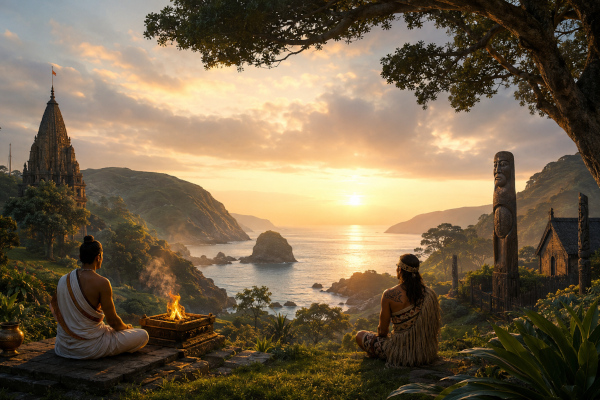
India and New Zealand stand on opposite sides of the Indo-Pacific world, yet both preserve civilisational traditions in which nature is sacred, speech carries spiritual force, ancestry shapes identity, and the visible world is connected to a deeper cosmic order. In Bharat, this vision appears through Vedic and Hindu traditions that honour Agni, Surya, Vayu, Varuna, Prithvi, Indra and countless other expressions of the divine within nature. In Aotearoa New Zealand, Māori tradition speaks of atua, sacred powers, Ranginui the sky father, Papatūānuku the earth mother, Tāne of the forests, Tangaroa of the sea, Tāwhirimātea of winds and storms, Rongo of cultivated food, and Tūmatauenga of war and human struggle. Te Ara, New Zealand’s official encyclopedia, describes traditional Māori religion as a world where atua stood at the centre and where the natural and supernatural worlds were understood as one connected reality.
This makes the India–New Zealand comparison fascinating. The connection is strongest when understood as a study of parallel wisdom traditions rather than a single-origin claim. Modern scholarship places Māori origins in East Polynesia, with New Zealand settlement generally dated to around 1250–1300 CE, while te reo Māori belongs to the Austronesian language family and the Polynesian-Tahitic branch. Sanskrit, by contrast, belongs to the Indo-European world and is central to India’s Vedic heritage. These two language worlds are distinct, but the cultural imagination of both societies reveals striking similarities in how human beings relate to sky, earth, water, stars, ancestors, ritual purity, sacred speech and divine power.
A Careful Reading of Origins
In the 19th and early 20th centuries, some writers tried to connect Māori origins directly with India, Sanskrit and so-called Aryan ancestry. Te Ara records that Edward Tregear argued in the 1880s that Māori language, mythology and customs contained signs of Aryan-Indian heritage, and Te Ara also notes that older theories placed Māori origins in many places, including India, Greece, Egypt, Palestine and the Americas. Modern historical, linguistic and genetic understanding places the ancestral origin of Māori within the wider Polynesian migration story rather than within a direct Indian origin theory.
India and New Zealand can be compared without forcing history into a claim that the evidence does not support yet. The beauty lies in civilisational resonance. Across oceans and centuries, both traditions developed sacred ways of reading the world. Both saw the universe as alive. Both placed human society within a moral order larger than politics and economics. Both treated land, water, wind, stars, food and ancestors as bearers of meaning.
Sky Father and Earth Mother: Ranginui–Papatūānuku and Dyaus–Prithvi
One of the most powerful parallels between Māori and Vedic thought is the sacred pairing of sky and earth.
In Māori cosmology, Ranginui is the sky father and Papatūānuku is the earth mother. Te Ara describes Ranginui as the sky father who formed the vault of the heavens, while Papatūānuku stands as the earth mother from whom life is nourished. Their children include gods associated with forest, sea, cultivated food, war and natural forces.
In Vedic tradition, the pairing of sky and earth appears through Dyaus and Prithvi. Prithvi is the earth, the nourishing ground of life, while Dyaus represents the shining sky. The wider Vedic world also honours Surya as the sun, Vayu as wind, Agni as fire, Varuna as cosmic order and waters, and Indra as power associated with storm, rain and kingship. The Rigvedic religious imagination often speaks through natural forces, cosmic phenomena and divine functions connected to the human world.
The comparison is not a claim that one tradition copied the other. It is a sign that ancient peoples across the world often perceived the sky and earth as living parents of creation. In both traditions, the human being is born inside a sacred environment rather than outside it. The land is not merely property. The sky is not merely atmosphere. The earth is mother. The heavens are father. Life becomes a relationship rather than a possession.
Gods as Forces of Nature
The Māori concept of atua and the Indian idea of devata both allow nature to be experienced as divine presence. In Māori tradition, Tangaroa is linked with the sea, Tāne with forests and birds, Tāwhirimātea with weather and storm, Rongo with cultivated food, Haumia with wild food, and Tūmatauenga with war and human activity. These are not distant abstractions. They are living presences within the world of land, ocean, wind, food and society.
In Vedic and Hindu culture, the same civilisational instinct appears through Agni, Surya, Vayu, Varuna, Indra, Soma, Ushas, Saraswati, Prithvi and other devatas. Fire becomes Agni, the carrier of offerings and the witness of ritual. The sun becomes Surya, source of light and life. Wind becomes Vayu, breath and movement. Waters and cosmic order become associated with Varuna. Dawn becomes Ushas. Earth becomes Prithvi. This is sacred ecology in poetic form.
Both traditions therefore resist a purely material view of nature. A river is more than flowing water. A forest is more than timber. A mountain is more than stone. The sea is more than a trade route. The world is alive with dignity, memory and responsibility.
This is one of the best India–New Zealand heritage similarities to present on a cultural website. It is respectful, visually rich and intellectually sound. Bharat and Aotearoa both preserve a worldview in which ecology and spirituality meet.
Mana, Shakti, Tejas and Prana
Another meaningful comparison lies in the idea of sacred power.
In Māori culture, mana describes authority, prestige, spiritual force, dignity and presence. Te Ara explains that mana comes from the atua and is closely tied to tapu, the principle of sacred restriction. Mana belongs to people, places, lineages, objects and actions. It can be inherited, protected, increased or damaged through conduct.
Indian culture has several related ideas, though none is identical. Shakti refers to power or divine energy. Tejas suggests radiance, brilliance and inner force. Prana refers to life-breath. Ojas suggests vitality and strength. Dharma refers to order, duty and right conduct. Tapas refers to inner heat, discipline and spiritual force. Together, these ideas show that Indian civilisation also treats power as moral, spiritual and embodied.
Mana and shakti should not be treated as direct linguistic equivalents. Their roots and contexts are different. Yet they reveal a similar civilisational intuition: power is not merely physical strength. True power carries sacred responsibility. Authority is connected with conduct. A person of standing must protect balance, uphold duty and honour the world that grants power.
This comparison is valuable for modern readers because it challenges the shallow idea that ancient cultures were simply myth-making societies. They were also ethical systems. They understood that power without responsibility becomes disorder. Mana and dharma, read side by side, show two ancient worlds thinking deeply about the moral burden of leadership.
Tapu, Noa and Indian Ideas of Sacred Purity
Māori culture also preserves the concepts of tapu and noa. Tapu refers to sacredness, restriction and protected status. Noa refers to the ordinary, free or unrestricted state. These concepts shaped ritual conduct, social behaviour, handling of objects, approach to sacred places and respect for people of authority. Te Ara describes tapu as closely linked to mana within Māori spiritual thought.
Indian culture also developed a rich vocabulary around sacred condition, ritual purity, auspiciousness and discipline. Terms such as shaucha, achara, pavitratva, vrata, niyama and samskara show how daily life, worship, food, body, place and speech could be aligned with sacred order. A temple sanctum, a fire ritual, a vow, a sacred river, a guru’s seat, a mantra or a festival day may all carry a special condition requiring disciplined conduct.
The similarity lies in the idea that sacredness changes behaviour. When something is sacred, people approach it differently. They become careful with speech, food, touch, movement and intention. In both traditions, culture trains the body to remember the sacred. Ritual becomes a way of carrying civilisation through daily action.
Karakia and Mantra: The Power of Sacred Speech
One of the most beautiful parallels between Māori and Vedic culture is the power given to spoken words.
Māori karakia are sacred chants, prayers or ritual formulae used in relation to atua, protection, healing, daily activity, travel, food, birth, death and social ceremony. Te Ara notes that karakia depended on spoken words and the mana of the person reciting them.
In Vedic culture, mantra holds a central place. The Vedas themselves were preserved through sound, rhythm, metre, accent and oral transmission. The spoken word was treated as a vehicle of order. A mantra was not merely a sentence. It carried vibration, intention, memory and sacred authority. The priest, rishi, guru or practitioner was trained to preserve sound with precision.
This gives a strong cultural bridge. Karakia and mantra both reflect a world where speech can heal, protect, invoke, bless, remember and transform. Sound is not casual. Words are not empty. The tongue becomes a sacred instrument.
This is an especially important comparison for Indian readers because the Vedic tradition places extraordinary value on shruti, or that which is heard. Māori tradition also carries memory through oral performance, genealogy, chant and ceremony. Both cultures remind modern society that spoken tradition can preserve knowledge with discipline and dignity.
Tohunga, Rishi and the Custodians of Knowledge
Traditional Māori society had tohunga: experts, priests, healers, ritual specialists, navigators, builders, artists and keepers of sacred knowledge. A tohunga could guide ceremonies, preserve lore, advise chiefs, heal illness, conduct rituals and protect the community through specialised knowledge.
India’s civilisation has its own categories of knowledge custodians: rishi, muni, purohita, acharya, guru, vaidya, sthapati, jyotishi and kavi. The rishi preserves wisdom. The guru transmits knowledge. The vaidya heals through Ayurveda. The purohita performs ritual. The sthapati shapes sacred architecture. The jyotishi reads time, stars and auspicious cycles.
The parallel is clear. Both traditions recognised that knowledge requires lineage, training and responsibility. Sacred knowledge was not treated as casual information. It was transmitted with discipline, often through apprenticeship, oral learning and ethical restraint.
This gives another powerful cultural similarity: India and New Zealand both preserve traditions where knowledge is protected by people who carry duty, not merely profession.
Whakapapa, Gotra and the Sacred Memory of Lineage
Māori whakapapa is genealogy, but it is much more than a family tree. Te Ara explains that through whakapapa, Māori trace ancestry back to the beginnings of the universe, and that whakapapa orders both the seen and unseen worlds while shaping the Māori worldview.
India has a comparable civilisational emphasis on lineage through gotra, kula, vamsha, parampara and pitru-smriti. A person is not seen as an isolated individual. He or she belongs to a lineage, a family tradition, a teacher tradition, a sacred geography and a web of obligations. Ancestors are remembered through rituals, stories, festivals, names and inherited duties.
Whakapapa and gotra are different systems, but they share a deep respect for continuity. Identity is layered. The living are connected with the dead, the unborn, the land and the sacred order. Human life is not rootless. It is inherited, protected and passed on.
In both cultures, memory is a form of civilisation. A society survives because it remembers who it is, where it came from and what duties it carries forward.
Stars, Time and the Sacred Calendar: Matariki and Krittika
The stars offer one of the most poetic meeting points between India and New Zealand.
In Māori culture, Matariki is associated with the Pleiades star cluster and marks the Māori New Year. It is a season of remembrance, family gathering, gratitude, renewal and looking ahead. For 2026, New Zealand’s official tourism site lists Matariki as falling between 8 and 11 July, with the public holiday on 10 July; Te Papa also lists the 2026 Tangaroa lunar period as 8–11 July and the public holiday as 10 July.
In Indian astronomy and Hindu tradition, the Pleiades are known as Krittika, one of the nakshatras or lunar mansions. Krittika is associated with fire, Agni, sharpness, purification and the nurturing of Kartikeya or Skanda in later Hindu tradition.
Here the same cluster of stars becomes a bridge of imagination. Māori tradition sees Matariki as a marker of renewal, remembrance and seasonal rhythm. Indian tradition sees Krittika as a celestial marker connected with fire, time, ritual and mythology. Two distant civilisations looked upward and found meaning in the same stars.
This is not surprising. Ancient peoples lived under open skies. They watched dawns, winds, rains, seasons, tides, lunar cycles and star risings with an attention modern life has largely forgotten. Matariki and Krittika show that the sky was once a calendar, a scripture and a cultural memory.
Food, Agriculture and Sacred Sustenance
Another important similarity lies in the treatment of food as sacred.
In Māori tradition, Rongo is associated with cultivated food and peace, while Haumia is associated with uncultivated or wild foods. Food is not merely nutrition. It is linked with land, season, atua, labour, family and gratitude.
Indian civilisation also treats food as sacred. Anna is life. Bhojana is shaped by season, region, ritual and health. Ayurveda sees food as medicine, while Hindu practice treats food offered to the divine as prasada. Agriculture, rain, cattle, soil, seeds, cooking and sharing of meals all carry spiritual meaning. Festivals such as Pongal, Makar Sankranti, Onam, Baisakhi and Navanna show how food, harvest and cosmic rhythm are woven together.
Both traditions recognise that food links heaven and earth. Rain falls, soil receives, seed grows, human labour protects, fire cooks, family shares, and gratitude completes the cycle. In this sense, food becomes culture itself.
Oceanic Civilisations and Maritime Imagination
New Zealand’s Māori ancestors were among the great navigators of the Pacific world. Their movement across vast oceans belongs to the wider Polynesian story of canoe voyaging, star navigation and island settlement. Modern understanding places Māori settlement of New Zealand within this East Polynesian maritime world.
India too has a deep maritime history. From the coasts of Gujarat, Konkan, Kerala, Tamilakam, Odisha and Bengal, Indian sailors, merchants, monks, temple-builders and traders moved across the Indian Ocean and Southeast Asia. Indian cultural influence reached Indonesia, Cambodia, Vietnam, Thailand, Malaysia and beyond through trade, religion, art, scripts, Sanskritic vocabulary, temple architecture and maritime exchange.
The India–New Zealand maritime link is historically much less direct than India’s links with Southeast Asia. Yet one fascinating object stands out: the Tamil Bell. Te Papa, the Museum of New Zealand Te Papa Tongarewa, records a bronze ship’s bell with a Tamil inscription, commonly translated as the bell of the ship of Mohaideen Bakhsh. The bell was acquired by missionary William Colenso and eventually entered the museum collection; Te Papa notes that the object generated considerable interest and debate about its origins.
The Tamil Bell should be handled carefully. It is a remarkable Indian Ocean object found in New Zealand, but its route to Aotearoa remains uncertain. It may suggest indirect maritime movement, shipwreck, later transport or complex colonial-era circulation. It should not be used as proof of ancient Indian settlement in New Zealand. Its value is different: it reminds us that the oceans connect worlds in unexpected ways, and that maritime history often leaves behind mysterious fragments.
Cultural Similarities Without Overstatement
The best way to present India–New Zealand similarities is through cultural comparison, not forced ancestry. The comparison becomes stronger when it is honest.
Māori origins are Polynesian. Te reo Māori is Austronesian. Sanskrit belongs to the Indo-European world. These facts stand clearly in modern scholarship. At the same time, cultural similarities between Bharat and Aotearoa remain meaningful. Similarity does not always require direct borrowing. Civilisations can develop parallel answers to universal human experiences: birth, death, harvest, storm, ocean, sky, fire, memory, ancestry and moral order.
This is where the India–New Zealand comparison becomes profound. Both societies understood that human beings are not owners of the universe. They are participants in a sacred web. Land must be respected. Speech must be disciplined. Ancestors must be remembered. Power must carry responsibility. Food must be received with gratitude. Stars must be read with wonder. Knowledge must be transmitted with care.
Bharat and Aotearoa: A Shared Lesson for the Modern World
The modern world often separates ecology from spirituality, language from memory, power from duty and food from gratitude. Ancient civilisations did the opposite. They joined these things together.
From India, the world receives the vision of dharma, rta, yajna, mantra, Ayurveda, yoga, devata and sacred geography. From Aotearoa, the world receives the Māori wisdom of mana, tapu, whakapapa, mauri, karakia, atua and the living relationship between people, land and cosmos. These traditions are distinct, but they speak to each other with surprising warmth.
India and New Zealand therefore share more than diplomatic relations, cricket, education links or diaspora connections. They share a deeper civilisational possibility: the chance to rediscover sacred ecology in an age of climate anxiety, cultural loss and spiritual restlessness.
For Indian readers, Māori culture feels familiar because it treats nature with reverence. For New Zealand readers, Vedic and Hindu culture may feel familiar because it gives divine language to fire, wind, water, earth, sky, food and cosmic rhythm. Both traditions remind us that the earth is not dead matter. The world is alive, and human beings are expected to live with honour inside it.
Conclusion
The heritage similarities between India and New Zealand are best understood as echoes of sacred ecology, ancestral memory and cosmic respect. Māori culture should be honoured as a Polynesian tradition with its own dignity, language, history and worldview. Indian Vedic culture should be honoured as one of the world’s great sacred civilisations, rooted in Sanskrit, mantra, devata, dharma and cosmic order.
Between them lies a beautiful field of comparison: Ranginui and Dyaus, Papatūānuku and Prithvi, Tangaroa and Varuna, Tāwhirimātea and Vayu, sacred karakia and Vedic mantra, mana and shakti, whakapapa and gotra, Matariki and Krittika.
These are not proofs of a single origin. They are signs of a shared human capacity to see the divine in the world. Across the Indian Ocean and the Pacific, Bharat and Aotearoa show that ancient cultures knew something modernity is now trying to relearn: nature is sacred, memory is duty, and civilisation begins when people live in harmony with the visible and invisible worlds.
References
- Te Ara – The Encyclopedia of New Zealand. “Traditional Māori Religion – Ngā Karakia a te Māori.”
https://teara.govt.nz/en/traditional-maori-religion-nga-karakia-a-te-maori/print - Te Ara – The Encyclopedia of New Zealand. “When Was New Zealand First Settled?”
https://teara.govt.nz/en/when-was-new-zealand-first-settled/print - Te Ara – The Encyclopedia of New Zealand. “Ideas About Māori Origins.”
https://teara.govt.nz/en/ideas-about-maori-origins/print - Te Ara – The Encyclopedia of New Zealand. “Ranginui – The Sky.”
https://teara.govt.nz/en/ranginui-the-sky/print - Te Ara – The Encyclopedia of New Zealand. “Tangaroa – The Sea.”
https://teara.govt.nz/en/tangaroa-the-sea - Te Ara – The Encyclopedia of New Zealand. “Whakapapa – Genealogy.”
https://teara.govt.nz/en/whakapapa-genealogy/print - New Zealand Tourism. “Matariki: Māori New Year.”
https://www.newzealand.com/in/matariki/ - Museum of New Zealand Te Papa Tongarewa. “Tamil Bell.”
https://collections.tepapa.govt.nz/object/213397 - Encyclopaedia Britannica. “Polynesian Culture.”
https://www.britannica.com/place/Polynesia - Encyclopaedia Britannica. “Māori.”
https://www.britannica.com/topic/Maori - Encyclopaedia Britannica. “Vedic Religion.”
https://www.britannica.com/topic/Vedic-religion - Encyclopaedia Britannica. “Sanskrit Language.”
https://www.britannica.com/topic/Sanskrit-language
You may also like
-
Samatata — The Low-Lying Deltaic Realm of Southeastern Bengal
-
Tamralipta — The Maritime Gateway of the Lower Ganga
-
Suhma — The River-and-Forest Country of Southwestern Bengal
-
Gauda — The Western Bengal Country of the Bhagirathi and the Rise of Karnasuvarna
-
Pundra — The Northern Bengal Kingdom of the Karatoya and the Ancient City of Pundranagara
