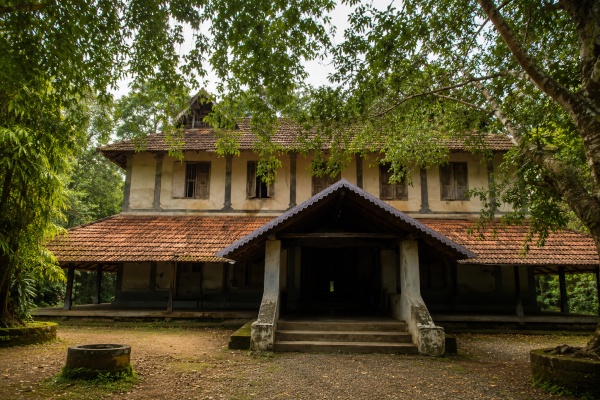
The Vadakkumkur Rajas were an important royal house of medieval and early modern central Kerala. Their domain formed part of the old political landscape of present-day Kottayam, Idukki, Thodupuzha, Vaikom, Kaduthuruthy, and nearby regions, standing alongside other regional powers such as Thekkumkur, Cochin, Poonjar, Meenachil, Kayamkulam, and Travancore. The name Vadakkumkur means the “northern division” or “northern principality,” traditionally paired with Thekkumkur, the “southern division.”
Vadakkumkur was not the story of one king alone. It was the story of a royal line, a regional state, and a cultural territory that shaped central Kerala before its absorption into the rising kingdom of Travancore under Marthanda Varma in the 18th century. Historical records connect Vadakkumkur with the old Vempolinad region, which split into Vadakkumkur and Thekkumkur around the medieval period.
Origin from Vempolinad
The early roots of Vadakkumkur are linked with Vempolinad, an old territorial unit of Kerala. According to the Idukki district history published by the Government of Kerala, by around 1100 AD, Vempolinad split into Vadakkumkur and Thekkumkur, and Karikkode in Thodupuzha Taluk became the capital of the Vadakkumkur Rajas.
This origin is important because it places Vadakkumkur within the old Kerala pattern of regional swaroopams and principalities. Kerala at that time was not ruled by one centralised authority. It was a landscape of royal houses, temple-centred settlements, feudal chiefs, martial households, Brahmin land networks, and spice-trade corridors. Vadakkumkur emerged as one of these central Kerala powers.
Capital and Territory
The traditional seat of Vadakkumkur is strongly associated with Karikkode near Thodupuzha, while other historical memories also connect the royal house with Kaduthuruthy, Vaikom, Ettumanoor, and parts of Kottayam–Idukki region. The Idukki district account specifically identifies Karikkode as the capital of the Vadakkumkur Rajas.
The territory of Vadakkumkur was strategically placed. It touched the fertile midlands, temple settlements, river routes, hill approaches, and spice-growing regions. This made the kingdom significant in both politics and trade. Pepper, cardamom, forest produce, and inland routes gave this region economic value, while temples and learned families gave it cultural depth.
Relationship with Cochin
For a long period, Vadakkumkur was connected with the Perumpadappu Swaroopam, the royal house of Cochin. The Government of Kerala’s Idukki history notes that Vadakkumkur remained subordinate to Perumpadappu Swaroopam for a long period, while Thekkumkur was often more powerful among the two sister principalities.
This relationship shows how Kerala politics worked through layered authority. A smaller royal house could retain local power while acknowledging a larger suzerain. Such relationships were shaped by marriage alliances, temple rights, military assistance, pepper trade, and protection from rival states.
Vadakkumkur and the Spice Trade
Vadakkumkur’s geography made it part of Kerala’s spice economy. The high ranges and midlands of the region were known for pepper, cardamom, and other valuable products. The Idukki district history notes that the Dutch East India Company was attracted to the pepper growth of the high ranges and that European trading powers made spice contracts with nearby Kerala states.
The Kottayam district history also records that the Portuguese and Dutch had business relations with both Thekkumkur and Vadakkumkur, with pepper and other spices being the main attractions.
This made Vadakkumkur more than a small inland principality. It was part of the global spice network that connected Kerala with Arabia, Europe, and Southeast Asia.
Political Character of the Rajas
The Vadakkumkur Rajas ruled in the traditional Kerala style. Their authority rested on land control, temple patronage, martial retainers, alliances with neighbouring powers, and control over important routes. Like many Kerala royal houses, their power was local, sacred, and economic at the same time.
The ruler was not only a political chief. He was a patron of temples, protector of settlements, manager of revenue, and leader of armed retainers. His court would have included ministers, warriors, Brahmin advisers, accountants, temple authorities, and local chiefs.
Vadakkumkur’s political position was delicate because it stood between stronger powers. Cochin influenced it from one side. Thekkumkur was a neighbouring rival and sister state. Travancore later rose from the south. European powers entered through the coast and spice trade. In this crowded political world, Vadakkumkur had to survive through diplomacy, alliances, and local strength.
Cultural Importance
Vadakkumkur had a strong cultural presence in central Kerala. The region was connected with temples, Sanskrit learning, Malayalam literary traditions, and old Kerala performing culture. A later cultural memory of the region is connected with Ramapurathu Warrier, the famous poet associated with Vadakkumkur. The Kottayam district history records that Kottayam gained importance in the cultural life of the Travancore court partly because Ramapurathu Warrier migrated to Thiruvananthapuram after Marthanda Varma’s annexation of Kottayam.
This shows how political annexation also moved talent. When old regional courts were absorbed into Travancore, poets, scholars, artists, soldiers, and administrators entered the Travancore system. In this way, the legacy of Vadakkumkur did not disappear; it flowed into the larger cultural world of Travancore.
Temples and Sacred Geography
The Vadakkumkur region was part of Kerala’s temple-rich central belt. Vaikom, Kaduthuruthy, Ettumanoor, Thodupuzha, and neighbouring areas are associated with major Shiva and Bhagavathy worship traditions. The royal house existed in a society where temples were centres of land, ritual, music, law, charity, and social order.
In Kerala’s old political culture, a Raja’s legitimacy was deeply tied to temple protection. Temple festivals, land grants, ritual privileges, and patronage of Brahmin settlements formed the sacred foundation of regional rule. Vadakkumkur belonged to this world of dharma, temple authority, and local cultural guardianship.
The Rise of Travancore
The 18th century changed Kerala’s political map. Marthanda Varma of Travancore began a major process of state-building. His aim was to transform Venad into a stronger, centralised kingdom. Through military reform, disciplined administration, alliances, and campaigns, Travancore expanded northwards.
The old principalities of central and southern Kerala gradually came under Travancore. The Kottayam district history records that Vempolinad had split into Thekkumkur and Vadakkumkur, and that these kingdoms were later annexed to Travancore by Marthanda Varma between 1748 and 1754.
The Idukki district history also places the annexation of Thekkumkur and Vadakkumkur within the Travancore expansion of 1749–50, after which nearby Poonjar too came under Travancore influence.
Absorption into Travancore
The absorption of Vadakkumkur marked the end of its independent political identity, but it also brought the region into a larger Kerala state structure. Travancore created a more centralised system of revenue, military control, temple administration, and territorial governance.
For Vadakkumkur, this meant that the old Raja’s power was reduced, while the region became part of the expanding Travancore state. For Travancore, the absorption of Vadakkumkur strengthened its northern frontier and gave it access to important central Kerala routes and resources.
This was one of the key moments in the making of modern Kerala’s political geography. The smaller swaroopams and principalities slowly gave way to larger state formations.
Historical Significance
Vadakkumkur is significant for five major reasons.
First, it preserves the memory of Vempolinad, one of the old territorial identities of Kerala.
Second, it represents the political world of central Kerala before Travancore’s rise.
Third, it shows the connection between local kingship and the spice trade.
Fourth, it contributed to Kerala’s temple and literary culture.
Fifth, its absorption into Travancore became part of the larger consolidation that shaped Kerala’s later history.
Vadakkumkur may not be as widely remembered as Travancore, Cochin, or the Zamorin of Calicut, but it was an important piece in Kerala’s historical puzzle.
Legacy
Today, the legacy of the Vadakkumkur Rajas survives through place names, temple traditions, local memories, old family histories, and the cultural identity of central Kerala. Regions such as Thodupuzha, Karikkode, Kaduthuruthy, Vaikom, and Kottayam still carry echoes of this old royal geography.
The royal house reminds us that Kerala history was built not only by large kingdoms, but also by regional dynasties that protected temples, managed trade, patronised learning, and shaped local society for centuries.
Conclusion
The Vadakkumkur Rajas were one of the important royal houses of central Kerala. Emerging from the old Vempolinad region, they ruled over a strategically placed territory connected with Thodupuzha, Karikkode, Vaikom, Kaduthuruthy, and Kottayam. Their history reflects Kerala’s medieval world of temples, trade, local kingship, spice routes, and shifting alliances.
Their absorption into Travancore under Marthanda Varma marked the end of one political chapter and the beginning of another. Vadakkumkur became part of the larger Travancore state, but its cultural memory remained alive in Kerala’s regional history.
In the story of Kerala’s royal houses, Vadakkumkur stands as the northern counterpart to Thekkumkur — a proud central Kerala lineage that helped shape the land before the rise of Travancore.
You may also like
-
Kamarupa — The Historic Kingdom of the Brahmaputra Valley and the Eastern Himalayas
-
Bharat Vandana Park: Delhi’s ‘Mini India’ Brings the Nation’s Heritage Together in One Landscape
-
Pragjyotisha — Bhagadatta’s Kingdom of the Brahmaputra Valley
-
Samatata — The Low-Lying Deltaic Realm of Southeastern Bengal
-
Tamralipta — The Maritime Gateway of the Lower Ganga
