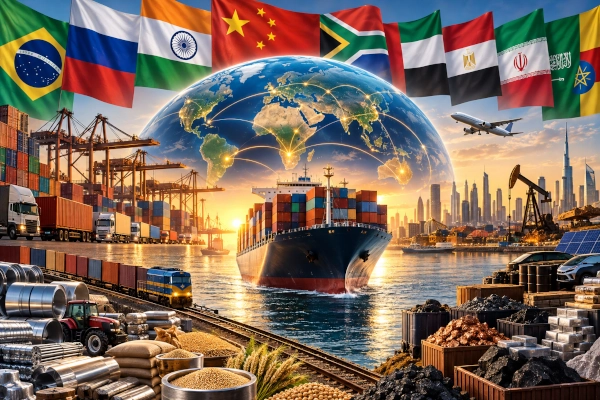
The most important question in international trade is often simpler than the geopolitical arguments surrounding it. A factory needs orders, its workers need wages, its suppliers need contracts, its machinery needs to remain in operation, and the goods coming off its production lines need buyers. From the perspective of an industrial economy, whether those buyers are in the United States, India, Brazil, China, Indonesia, Africa, or the Middle East is ultimately secondary to whether sufficient demand exists to keep production moving.
This is why the growing trade weight of BRICS matters far beyond statistics about exports. If the expanding grouping can create enough demand among its own members and across the wider Global South, its producers become progressively less dependent on any single overseas market. The geopolitical significance does not come from eliminating trade with the United States, but from reaching a point where the loss, restriction, or political disruption of one market can no longer bring industrial activity at home to a halt. That would represent a fundamentally different form of economic power based on market choice rather than market dependence.
Trade Means Factories, Jobs, and Industrial Continuity
Exports are frequently discussed as abstract numbers measured in billions or trillions of dollars, but behind every export figure lies a much larger industrial chain. When a country exports automobiles, the transaction supports assembly plants, steel producers, component manufacturers, electronics suppliers, logistics companies, ports, warehouses, and thousands of workers. Engineering exports keep machine-tool companies operating, pharmaceutical exports support chemical producers, laboratories, packaging companies, and research facilities, while agricultural exports sustain farms, fertilizer suppliers, processors, cold-storage operators, and transport networks.
The economic objective of trade is therefore not simply to achieve an impressive export figure. It is to maintain the continuous utilization of productive capacity across the economy. Industrial machinery that remains idle still incurs costs, workers cannot remain indefinitely employed without orders, and suppliers cannot maintain production when their customers stop buying. A factory built around one dominant export market can therefore become vulnerable if access to that market suddenly disappears.
Diversification changes this equation because it gives producers somewhere else to send their goods. If one market closes while several others can absorb the same product, factories can continue operating, workers can remain employed, suppliers can continue receiving orders, and capital invested in manufacturing remains productive. From the perspective of industrial continuity, the identity of the buyer becomes less important than the continued existence of buyers.
This Is Where BRICS Could Change the Trade Equation
The ten full BRICS members already account for approximately 24 percent of global merchandise exports, according to UN Trade and Development, while also representing a substantial share of global economic output. The significance of this trade weight is amplified by the diversity of the grouping, which brings together countries with very different but potentially complementary economic strengths.
China possesses enormous manufacturing capacity, while India combines a growing manufacturing base with pharmaceuticals, engineering, technology, and services. Brazil is a major agricultural and mineral producer, Russia remains an important exporter of energy, fertilizers, metals, and commodities, and the United Arab Emirates combines energy production with a major international logistics and financial role. Indonesia adds mineral resources, agricultural production, a large consumer market, and an expanding manufacturing sector.
These economies do not produce exactly the same things, which creates the possibility of deeper commercial complementarity. Energy exporters require machinery and industrial equipment, manufacturing economies require minerals and fuel, agricultural producers require fertilizers and vehicles, and rapidly urbanizing economies need steel, cement, electrical equipment, telecommunications systems, transport infrastructure, and consumer goods. If more of these requirements can be supplied through trade among BRICS members and their wider partners, the grouping could sustain a larger share of industrial production without depending excessively on any single external market.
BRICS Trade Is Already Moving in That Direction
The growth of intra-BRICS commerce shows that this process has already begun. UNCTAD calculates that merchandise exports among BRICS members increased from approximately $84.2 billion in 2003 to around $1.17 trillion in 2024, representing an increase of more than thirteen times over roughly two decades.
Despite that growth, intra-BRICS commerce remains well below what might be possible considering the size of the participating economies. This means BRICS does not necessarily need to invent an entirely new economic system before much greater trade can take place. A large part of the opportunity already exists in the enormous quantities of machinery, food, energy, minerals, chemicals, pharmaceuticals, consumer products, and intermediate goods that these economies purchase every year.
The practical challenge is therefore to connect supply with demand more effectively. If an Indian manufacturer loses an order in one Western market but can replace it with demand from Brazil, Indonesia, the UAE, or another economy, the machinery inside the Indian factory continues operating. The same logic applies to a Brazilian agricultural producer, a Chinese machinery manufacturer, a Russian fertilizer plant, or an Indonesian mineral processor because the economic requirement is ultimately the same: production needs customers.
The Crucial Measure Is Whether Someone Keeps Buying
Countries often become preoccupied with individual trade relationships, even though the greater industrial risk lies in excessive dependence on a small number of customers. Suppose a factory produces one million units annually and sells 400,000 of them into a single foreign market. If political tensions, tariffs, or economic conditions suddenly reduce purchases from that market by half, the manufacturer faces a serious problem unless alternative buyers can be found.
The danger in such a situation is not merely a deterioration in diplomatic relations. The immediate economic problem is unused industrial capacity. Factories operating below capacity must spread their fixed costs across fewer products, profitability declines, suppliers receive fewer contracts, employment can fall, and companies may postpone new investment because they cannot justify expanding while existing production lines remain underused.
A manufacturer operating across ten or twenty substantial markets occupies a very different position. Losing one customer can still hurt, but it does not necessarily stop production because orders can potentially be redirected elsewhere. The strongest export economy is therefore not simply the economy with the largest individual customer, but the one whose industries have the greatest range of credible customers across different regions.
Four Times U.S. Exports Would Mean More Than a Statistical Milestone
The scale involved is already considerable. World merchandise exports reached approximately $24.43 trillion in 2024, according to the World Trade Organization, while BRICS collectively accounted for roughly one-quarter of global merchandise exports. That places the combined value of BRICS goods exports at around the $6 trillion level, compared with a little over $2 trillion in merchandise exports from the United States during the same broad period.
If BRICS merchandise exports eventually reached roughly four times the level of U.S. merchandise exports, the significance would not simply be that a grouping of countries sold more goods than one country. The more important development would be the vast industrial ecosystem required to produce and deliver that volume of trade. Trillions of dollars in exports represent factories operating, energy being consumed, ships carrying cargo, ports loading containers, railway networks moving freight, suppliers receiving contracts, and millions of workers participating directly or indirectly in production.
This industrial momentum can become self-reinforcing because manufacturing creates income, income supports consumption, consumption generates new demand, and stronger demand encourages further investment in productive capacity. New capacity then produces additional goods for domestic consumption and export, allowing the industrial cycle to continue. The strategic value lies not simply in exporting more, but in keeping the machinery of production continuously engaged.
America’s Market Is Powerful Because It Buys So Much
The United States remains exceptionally important to world trade because this same principle operates strongly in America’s favor. The United States is one of the world’s greatest sources of demand and was the largest merchandise-importing country in 2024, purchasing approximately $3.36 trillion in goods from the rest of the world.
Access to American consumers is therefore enormously valuable for exporters. Manufacturers across the world have spent decades designing production strategies around supplying American households, companies, and governments with cars, electronics, machinery, clothing, pharmaceuticals, furniture, industrial components, and thousands of other products. The scale of this demand gives the United States substantial influence over international commerce.
The sensible response for other exporting economies is not necessarily to abandon the American market because doing so would mean voluntarily giving up an extremely valuable source of demand. The more practical objective is to ensure that the United States becomes just another important customer among many rather than the customer whose absence could cripple an entire industry. Diversification allows countries to continue benefiting from American demand without making their factories wholly dependent upon it.
Diversification Changes the Balance of Economic Pressure
Trade becomes geopolitical when market access can be used as a source of economic pressure. Tariffs, import restrictions, sanctions, and other barriers are most powerful when the targeted country’s producers have nowhere else to sell what they manufacture. The effectiveness of such pressure therefore depends partly on how concentrated an industry’s customer base has become.
A company receiving 70 percent of its foreign revenue from one country is extremely vulnerable to decisions taken in that market. A company selling comparable quantities across North America, Asia, Africa, Latin America, Europe, and the Middle East has considerably greater room to adjust when conditions change in one destination. National economies face the same basic calculation on a much larger scale.
If BRICS economies develop sufficiently broad commercial relationships among themselves and with Africa, Southeast Asia, Latin America, and the Middle East, their exporters may gain greater ability to redirect trade when individual markets become difficult. This does not make tariffs or trade restrictions harmless because changing customers takes time, products may need to satisfy different regulatory standards, logistics can become more expensive, and alternative buyers may offer different prices. Nevertheless, the existence of multiple markets fundamentally improves an exporter’s ability to absorb disruption.
South-South Trade Is Becoming More Important
Current trade trends suggest that developing economies are already purchasing much more from one another. UNCTAD reported that world trade reached approximately $35 trillion in 2025, while South-South trade expanded more rapidly than global trade as a whole. South-South merchandise trade had already exceeded $6 trillion in 2024, demonstrating the growing commercial importance of trade relationships that do not depend primarily on the traditional transatlantic economic centres.
This trend creates what can effectively become an industrial safety valve. An Indian engineering company selling machinery to Indonesia supports Indian employment just as an American order does. A Brazilian company buying Indian pharmaceuticals keeps Indian pharmaceutical factories operating regardless of whether the customer is located in North America, Latin America, or elsewhere. An Indonesian company purchasing Chinese construction equipment similarly supports Chinese industrial production because the economic effect inside the factory comes from the order itself.
For an industrial producer, the invoice matters more than the nationalitymake an image for this article. where america throws the tariff baseball and hits it back at trump of the buyer. What ultimately determines whether workers remain employed and factories continue running is whether sufficient customers continue placing orders.
The Same Principle Applies to American Industry
This argument is not unique to BRICS because American industry operates according to exactly the same economic principles. The United States exported approximately $2.20 trillion in goods and $1.23 trillion in services during 2025, bringing total goods and services exports to around $3.43 trillion.
Those exports support American factories, farmers, aircraft manufacturers, energy producers, technology companies, software developers, financial institutions, and professional-service firms. American exporters therefore also depend on customers abroad and benefit from having diversified access to markets around the world.
If other economies develop more suppliers and deepen commercial relationships with one another, American exporters will increasingly need to compete for international orders rather than relying on historical market dominance. Such a change would not remove the United States from international trade, but it would shift more commercial relationships from dependence on one dominant supplier toward competition among multiple suppliers.
The Strategic Goal Is Not to Stop Trading With America
For BRICS countries, attempting to exclude the United States from international trade would make little economic sense. The American market remains wealthy, technologically advanced, and capable of absorbing enormous quantities of goods and services, making continued access beneficial to exporters from almost every major economy.
A rational trade strategy should therefore seek to multiply markets rather than replace one dependency with another. An Indian manufacturer should ideally be able to sell simultaneously to the United States, Brazil, Europe, Indonesia, Africa, the Gulf, Southeast Asia, and Latin America. A Brazilian producer benefits from having buyers in China, India, Europe, the Middle East, and America, while a Chinese manufacturer is more secure when its customers are spread across many regions instead of concentrated overwhelmingly in one destination.
The strongest trading system is consequently one in which the closing of one market does not force factories to shut down. A country with several major export destinations possesses greater resilience than one whose prosperity depends on uninterrupted access to a single buyer.
Industrial Capacity Becomes Power Only When It Is Used
There is little strategic value in possessing enormous manufacturing capacity if factories cannot find enough buyers to use it. Steel mills need orders for steel, shipyards need vessels to construct, chemical plants need customers for their output, aircraft factories require orders, and pharmaceutical plants need markets large enough to justify continuous production.
Idle industrial capacity gradually loses economic value even when the physical machinery remains intact. Skilled workers may leave, supplier networks can weaken, investment declines, technological knowledge can disperse, and restarting production after a long interruption can be much more difficult than keeping a plant continuously operational.
Export diversification therefore has strategic importance far beyond improving the annual trade balance. It protects industrial ecosystems by keeping skilled workers employed, supplier relationships active, production knowledge current, and machinery in use. For emerging economies attempting to build sophisticated manufacturing sectors, keeping existing industrial capacity operational can be almost as important as constructing new factories.
BRICS Could Become a Network for Keeping Production Moving
The long-term significance of an expanded BRICS trading system lies in its potential to connect producers with a much wider range of consumers. BRICS does not need to become another European Union, adopt a common currency, establish a customs union, or operate a unified trade policy before substantial additional commerce can develop.
What the grouping requires more immediately is better connectivity between markets. Improved shipping links, lower trade barriers, simpler customs procedures, compatible technical standards, accessible trade finance, and reliable payment infrastructure can reduce the cost of moving goods between participating economies. Every reduction in commercial friction increases the number of markets that become economically viable for exporters.
Once manufacturers possess sufficiently diversified order books, economic disruption in any individual country becomes easier to absorb. Production may decline temporarily when one customer disappears, but manufacturers can seek replacement orders elsewhere instead of closing production lines altogether. This ability to redirect demand is the threshold at which trade diversification begins translating into meaningful economic resilience.
The Real Geopolitical Shift Is From Market Dependence to Market Choice
The future of global trade is unlikely to be defined by the disappearance of American commerce. U.S. exports remain enormous, American companies remain highly competitive, and the United States continues to possess one of the world’s most valuable consumer markets. BRICS countries have little economic reason to reject access to that market when profitable opportunities remain available.
The deeper transformation would occur if BRICS and the wider Global South generated enough internal and cross-regional demand that losing access to any single Western market no longer determined whether their industries remained viable. Under such a system, an exporter losing one market would look for another buyer rather than shut the factory. A shipment previously destined for the United States or Europe could instead travel to Asia, Africa, Latin America, or the Middle East if sufficient demand existed there.
A manufacturer that once depended heavily on American orders could eventually divide its production among customers in the United States, Brazil, India, Indonesia, the Gulf, Africa, and Southeast Asia. Trade would continue because the fundamental economic requirement would remain unchanged: someone would still be purchasing what the factory produced.
That is ultimately the central principle of industrial trade. A production line does not care whether its next container is destined for New York, Mumbai, São Paulo, Jakarta, Dubai, or Johannesburg. What matters to the economy behind that production line is that the container leaves the factory, another order arrives behind it, workers remain employed, suppliers continue receiving business, and the machinery continues to turn.
As BRICS builds a commercial network capable of sustaining this cycle at greater scale, its most significant achievement will be the steady reduction of dependence on any single export market. Participating economies can continue trading profitably with the United States while simultaneously expanding demand across Asia, Africa, Latin America and the Middle East, ensuring that their industries have multiple markets capable of keeping factories active, workers employed and production lines moving. This expanding network of buyers gives BRICS economies greater resilience, greater freedom of commercial choice and a more durable form of economic autonomy.
You may also like
-
Jubilant Pharmova Announces CAD 94.5 Million Expansion of Canadian Radiopharmaceutical Facility
-
Kabra Extrusiontechnik’s GEON Commissions 20 MWh Battery Storage Project in Rajasthan
-
India’s Wind Energy Capacity Reaches 59.20 GW as Government Targets 100 GW by 2030
-
GST Council Recommends Major Compliance Reforms, Raises Prosecution Threshold to ₹5 Crore
-
NTPC Subsidiary NVVN Targets 1,000 MWh Battery Storage Capacity by March 2027
