GI Produce of India — 06
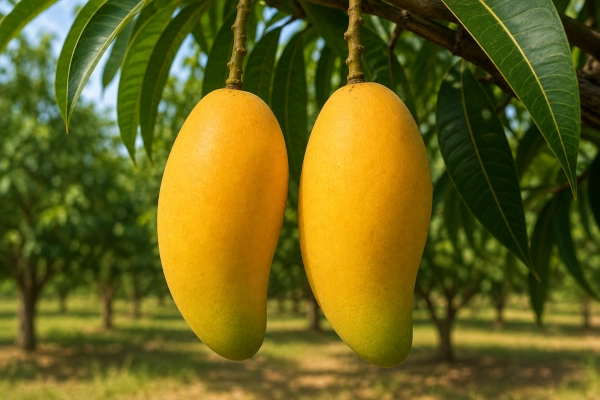
In the great mango markets of northern India, ripeness is usually announced through colour. Green fruit turns yellow, yellow deepens towards gold, and in some cultivars a warm blush develops across the shoulder. Banaras Langda Aam breaks this expectation. Even when perfectly ripe, the celebrated mango of Kashi can remain stubbornly green on the outside, concealing soft lemon-yellow flesh that is sweet, juicy, aromatic and almost devoid of fibre.
This contrast between its understated exterior and rich interior has become one of the mango’s most recognisable characteristics. The fruit is generally medium-sized and ovate, with smooth green skin and a relatively small stone. When properly ripened, the flesh becomes highly palatable and carries the distinctive sweet-acid balance that has made Langda one of the classic mango varieties of northern India.
Although Langda trees are now cultivated across several states, the variety retains an especially powerful historical relationship with Banaras—modern Varanasi—and the wider mango-growing landscape of eastern Uttar Pradesh. That association received formal recognition when Banaras Langda Aam was registered as a Geographical Indication on 31 March 2023.
Banaras Langda, Langra and the Name Consumers Know
The name itself requires some explanation because two spellings frequently appear. India’s GI Registry formally records the product as “Banaras Langda Aam (Mango)”, while horticultural literature, markets and everyday speech frequently use Langra or Banarasi Langra.
Both forms refer to the celebrated northern Indian cultivar. APEDA describes Langra as a mango distinguished by its green skin even after ripening, fibreless flesh and a characteristic tangy-sweet taste. The variety is particularly associated with Uttar Pradesh and Bihar, although cultivation has spread much farther.
What the GI protects, however, is more specific than the generic cultivar. It recognises the geographical reputation of the Banaras Langda Aam associated with Uttar Pradesh and particularly the historic Banaras-Purvanchal mango belt.
The Mango That Refuses to Turn Golden
The visual character of Banaras Langda is unusual enough that an inexperienced buyer may mistake a ripe fruit for an unripe one. The skin generally remains light green or greenish even when the flesh inside has developed considerable sweetness. Only with advanced ripening may the exterior begin moving towards yellow.
The official GI specification describes Banaras Langda as a medium-to-large, ovate mango with a rounded to slightly flattened base, nearly equal shoulders and only a very small or weakly developed beak. Mature fruit commonly falls within roughly 250 to 350 grams, although individual fruits naturally vary according to tree, season and orchard conditions.
Inside, the fruit is dramatically different from its exterior. The flesh is lemon yellow, juicy and low in fibre, while the flavour combines pronounced sweetness with a light acidic undertone. The official specification records total soluble solids in the vicinity of 20–21 per cent, illustrating the considerable sugar development achievable in mature fruit.
One of the most interesting figures recorded during evaluation of the variety is a pulp proportion of about 87.74 per cent, accompanied by a favourable pulp-to-stone ratio. For the consumer, this simply translates into one of the most desirable qualities a table mango can possess: a large quantity of edible flesh surrounding a comparatively modest stone.
A Mango Born in Banaras
The official GI documentation describes Banaras Langda as a superior chance seedling originating in the Banaras area. This is an important phrase because many famous Indian mango cultivars began in precisely this way.
Before modern breeding programmes, mango improvement often depended upon observation. Seedling mango trees produced enormous genetic variation. Most were ordinary, some disappointing, but occasionally a tree produced fruit possessing an exceptional combination of sweetness, aroma, texture, appearance or productivity.
When such a tree was discovered, growers preserved it through vegetative propagation.
Langda appears to belong to this old tradition of selection. The original seedling became valuable enough that its genetic characteristics were copied through grafting, gradually turning one exceptional tree into a recognised cultivar.
From Banaras the variety eventually travelled across northern India, becoming commercially important far beyond the place where its reputation first developed. The National Horticulture Board today records Langra among the important mango cultivars grown in Uttar Pradesh as well as Bihar, Gujarat, Haryana, Himachal Pradesh, Madhya Pradesh, Odisha, Punjab, Rajasthan and other regions.
Its geographic spread demonstrates the success of the cultivar.
Its GI registration demonstrates why origin still matters.
Why Is It Called Langda?
The origin of the unusual name has generated several stories, and it is important to distinguish tradition from established history.
One widely repeated Banaras legend associates the mango with a physically disabled caretaker or holy man connected with an old temple, whose tree became famous for producing particularly delicious fruit. According to the story, people gradually began referring to the mango through the physical description associated with its custodian.
The official GI documentation does not establish this version as definitive. Instead, it records several competing explanations. One connects the word Langra with physical lameness; another suggests that the original mother tree was damaged by a severe storm and subsequently developed an irregular or “lame” appearance; a third tradition links the name with a locality supposedly called Langra near Banaras.
The uncertainty is itself part of the mango’s heritage.
Agricultural varieties often survive much longer than written records explaining their names. Grafts continue moving from orchard to orchard even as stories evolve around them.
What can be stated with much greater confidence is that horticultural records recognise Banaras as the original selection centre of the Langra cultivar.
Kashi and the Great Fruit-Growing Plain
Banaras Langda developed within one of India’s most fertile agricultural landscapes.
Varanasi lies within the middle Gangetic plain, where generations of river deposition created deep alluvial soils. The Ganga and its tributary systems repeatedly redistributed fine sand, silt and clay across the region, producing agricultural land capable of supporting cereals, vegetables, fruit trees and extensive mango groves.
Historical gazetteers incorporated into the GI documentation describe the old Benares district as lying in Gangetic alluvium and note that mango trees performed exceptionally well in its soil and climate. Early twentieth-century records already described fine mango groves and Banaras’s reputation for fruit.
This historical evidence is significant because the connection between Banaras and mango cultivation clearly predates the modern GI system by many generations.
The fruit was famous before anyone imagined a geographical-indication certificate.
A Wider Purvanchal Mango Landscape
Banaras Langda should not be understood as belonging only to the municipal boundaries of Varanasi city. Its agricultural identity developed across a wider eastern Uttar Pradesh orchard landscape historically connected with the Banaras division and neighbouring districts.
The detailed GI documentation associates production particularly with Varanasi and the wider belt encompassing areas such as Mirzapur, Chandauli, Sonebhadra, Ghazipur and Ballia, while also referencing Jaunpur within the broader geographical description. This reflects the historical reality that orchard traditions spread across agricultural regions rather than stopping neatly at modern district boundaries.
These districts share important features of the eastern Gangetic environment, although soils, drainage, rainfall and local microclimates naturally vary.
The name Banaras therefore functions both geographically and culturally. Varanasi forms the historic centre of identity, while surrounding Purvanchal orchards constitute part of the larger agricultural landscape through which the variety became established.
The Climate Behind the Fruit
A mango tree requires more than tropical warmth. The timing of heat, moisture and dryness strongly influences flowering and fruit development.
Eastern Uttar Pradesh experiences a pronounced seasonal cycle. Winters are comparatively cool and dry. Temperatures begin rising during spring, followed by intense heat through May and June. The monsoon normally becomes dominant later, transforming the landscape just as many mango cultivars approach or complete their harvest period.
For mango production, the relatively dry period before flowering is important. Excessive moisture can encourage vegetative growth when the farmer needs flowers, while untimely rain or high humidity around flowering may increase fungal pressure and interfere with successful fruit set.
Banaras Langda trees begin their reproductive cycle well before consumers begin thinking about mango season. The GI studies recorded the first flowers appearing during winter, with flowering building through February and reaching its fuller expression by early March. Fruit then develops through the increasingly hot months before the principal harvest arrives around July.
Thus, the mango eaten during the monsoon-edge summer began its journey many months earlier in the cool season.
The July Mango of Banaras
Banaras Langda is particularly associated with the July mango season.
The GI specification identifies the principal Banarasi Langra season from the early part of July through approximately the third week of the month, with the second week of July representing an important maturity period. Seasonal conditions can naturally shift harvesting earlier or later, and the broader Varanasi fruiting window may extend beyond these dates in particular years.
This timing gives Langda an important place in the sequence of northern Indian mango varieties.
Dusseheri often establishes itself strongly in the market before Langda reaches its peak. As July progresses, Langda becomes increasingly prominent, while Chausa subsequently helps extend the mango season further into summer.
For consumers, these changing varieties form a natural calendar.
The arrival of Langda means that the north Indian mango season has entered one of its richest phases.
Ripeness Without the Usual Colour Signal
Banaras Langda creates an unusual harvesting challenge because green skin is one of its varietal characteristics.
Growers cannot simply wait until every mango becomes golden.
Instead, harvest maturity is judged through a combination of fruit size, shoulder development, surface appearance, skin characteristics, estimated fruit age and experience accumulated across repeated seasons. Internal pulp development and soluble solids can provide additional scientific indicators.
Like other mangoes, Langda is a climacteric fruit, meaning ripening continues after harvest. This characteristic allows farmers to pick fruit after it has reached physiological maturity but before it becomes too soft for transportation.
The balance is delicate.
Fruit harvested too early can soften without developing the full sweetness and flavour associated with a good Langda. Fruit left too late may become difficult to move through packing, wholesale and retail chains without bruising or deterioration.
A premium mango therefore depends just as much on the judgement of the grower as on the genetics of the tree.
Grafting Keeps Banaras Langda Banaras Langda
Planting the seed from an excellent Banaras Langda mango does not reliably produce another identical Langda tree.
Most important Indian commercial mango cultivars are maintained through vegetative propagation, particularly grafting. Seed propagation introduces genetic variation, while grafting allows growers to reproduce the essential characteristics of a selected mother plant.
The National Horticulture Board identifies techniques such as veneer grafting, inarching and epicotyl or stone grafting among established methods for propagating mango. In northern India, grafting has historically played an especially important role in commercial orchard establishment.
In practical terms, a rootstock seedling provides the root system, while a scion from the desired Langda tree provides the genetic identity of the fruit-bearing canopy.
The technique transformed the history of Indian mangoes.
Without grafting, a superior chance seedling might remain famous for only the lifespan of one tree. Through grafting, the qualities of that tree can be carried across centuries.
Establishing the Orchard
Banaras Langda trees are vigorous and spreading, meaning orchard layout becomes important from the moment young plants enter the ground. The variety can eventually develop a broad canopy, so growers must provide sufficient space for mature trees rather than judging planting distance solely by the size of young grafts.
The general mango cultivation recommendations of the National Horticulture Board place considerable emphasis on appropriate spacing, early tree training, irrigation and nutrient management. Planting is commonly undertaken during periods when adequate soil moisture allows roots to establish rapidly, particularly around the monsoon in rainfed areas.
The Langda orchard is therefore a long-term agricultural investment.
Unlike an annual crop, a mango tree occupies the same piece of land for decades. Decisions made during planting can affect productivity and ease of management for a generation.
Managing an Old Mango Tree
The spreading growth habit that makes an old Langda tree impressive can eventually become a management challenge.
When canopies become excessively crowded, sunlight and air movement decline within the tree. Dead, diseased, crossing or poorly positioned branches may accumulate. Fruit production can move towards the outside of the canopy, while harvesting and plant protection become increasingly difficult.
Canopy management and selective pruning therefore become important, particularly in older orchards.
Traditional mango trees were often allowed to grow into enormous structures because land was less intensively used and labour systems differed. Modern commercial horticulture increasingly seeks a balance between preserving mature trees and keeping orchards manageable.
Old orchards can also sometimes be rejuvenated through strategic pruning and top-working, whereby desirable cultivars are grafted onto new shoots emerging from established tree frameworks.
In this way, even an ageing orchard can sometimes be renewed rather than completely removed.
The Problem of Alternate Bearing
Langda is known for another characteristic familiar to mango growers: irregular or alternate bearing.
A tree may produce heavily in one season and substantially less in another. The phenomenon occurs in several mango cultivars and can arise from interactions involving crop load, vegetative growth, tree nutrition, flowering behaviour and environmental conditions.
For a household tree, alternate bearing may be little more than an inconvenience.
For a commercial farmer, it affects income, labour planning, market supply and orchard economics.
Scientific nutrient management, canopy regulation and improved orchard practices can reduce some of the instability, although the underlying bearing tendency remains an important characteristic of traditional cultivars such as Langda.
This reminds us that famous flavour does not automatically make a mango horticulturally perfect.
Many traditional cultivars became celebrated despite traits that modern breeders would prefer to improve.
A Mango Economy Extending Beyond the Orchard
During harvest season, Banaras Langda activates a rural economy considerably larger than the orchard itself.
Workers harvest fruit and carry it from the trees. Mangoes are sorted according to maturity and quality. Traders negotiate orchard contracts and market prices. Packaging suppliers, transporters, commission agents, wholesalers and retailers form the next stages of the chain.
Fruit intended for nearby markets can move relatively quickly.
Export-quality mangoes require far more elaborate handling, including scientific grading, phytosanitary compliance, protective packaging and controlled treatment according to the requirements of the destination country.
This is where the horticultural economy of modern Varanasi differs radically from that of a century ago.
The mango is still produced by a tree rooted in Gangetic soil, but the commercial infrastructure surrounding that tree increasingly reaches global markets.
Banaras Langda Goes Abroad
Varanasi has become an increasingly important centre for agricultural exports from eastern Uttar Pradesh.
In March 2023, the Prime Minister highlighted the emergence of modern processing, storage and transport infrastructure in Varanasi and specifically noted that Banaras Langda mangoes were already reaching overseas markets, alongside vegetables and other agricultural produce from the region. The Karkhiyaon integrated pack-house was developed to strengthen precisely this type of export activity.
The following mango season brought another symbolic milestone. The newly GI-recognised Banaras Langda entered export channels from Varanasi with consignments prepared through the integrated pack-house for the Gulf market.
This development matters because the GI tag creates the possibility of selling more than a generic mango.
It allows exporters to build a market around verified geographical identity.
The New Sea-Freight Opportunity
Fresh mango exports traditionally depend heavily on air freight because the fruit is highly perishable. Air transport preserves speed but adds substantial cost, restricting access to distant price-sensitive markets.
Indian researchers are now attempting to change this equation.
In 2026, ICAR-Central Institute for Subtropical Horticulture and APEDA successfully demonstrated commercial sea shipment of Dashehari and Langra mangoes from Uttar Pradesh to Dubai. A 12.5-tonne consignment travelled through a refrigerated container, and nearly 90 per cent of the mangoes were reported to remain marketable despite a 25-day harvest-to-market journey.
Those mangoes originated in Amroha rather than the Banaras GI production region, so the shipment should not be described as an export of GI-certified Banaras Langda.
Its significance for Banaras is technological.
If the same scientific cold-chain protocols can be successfully applied to authenticated GI fruit from eastern Uttar Pradesh, maritime freight could eventually reduce export costs and open wider overseas markets.
India’s Growing Mango Export Market
Banaras Langda participates in a much larger national mango economy.
APEDA reports that India exported 31,819.46 tonnes of fresh mangoes worth US$53.99 million during 2025–26. The principal destinations included the United Arab Emirates, United Kingdom, United States, Kuwait and Canada. Uttar Pradesh remained India’s leading mango-producing state, accounting for 26.56 per cent of national production in 2024–25.
Official trade data also increasingly separates some major mango varieties. Commerce Ministry data for 2023–24 recorded exports classified as Langda, although these figures refer to the cultivar nationally and cannot be treated as exports of GI-certified Banaras Langda alone.
That distinction is essential.
A Langda mango and a Banaras Langda Aam carrying the protected geographical identity are related but not interchangeable concepts.
The Road to Geographical Indication Recognition
The formal GI journey began when an application for Banaras Langda Aam (Mango) was filed on 4 November 2020.
The application received GI Application No. 716 under Class 31. It was subsequently advertised in Geographical Indications Journal No. 166, made available on 30 November 2022. The supporting documentation presented the variety’s physical characteristics, production practices, historical references and association with the Banaras mango-growing region.
Registration followed on 31 March 2023, when Certificate No. 462 was issued.
The current GI Registry and APEDA records identify Jaya Seeds Producer Company Limited and Human Welfare Association as the registered proprietors and record the registration as valid until 3 November 2030.
GI Details at a Glance
- Geographical Indication: Banaras Langda Aam (Mango)
- State: Uttar Pradesh
- Product: Agricultural
- Class: 31
- Application Number: 716
- Date of Filing: 4 November 2020
- GI Journal: No. 166
- Journal Availability Date: 30 November 2022
- Certificate Number: 462
- GI Certificate Date: 31 March 2023
- Registered Proprietor: Jaya Seeds Producer Company Limited and Human Welfare Association
- Geographical Area: Uttar Pradesh
- Registration Valid Until: 3 November 2030
What the GI Tag Protects
The GI registration does not mean that Langda trees may be cultivated only in Varanasi.
That would be biologically impossible to enforce and would misunderstand the purpose of geographical indications.
Langda is a widely propagated cultivar. The National Horticulture Board records it in numerous states, and APEDA recognises it as a major mango variety associated particularly with northern and eastern India.
The protected term Banaras Langda Aam, however, carries an additional claim of geographical origin.
This is the same distinction that appears throughout India’s mango heritage. A cultivar can travel through graftwood. A geographical identity belongs to the recognised production region whose environment, agricultural tradition and reputation gave the product its name.
GI protection is therefore fundamentally about authenticity.
Why Traceability Matters
A ripe Langda from Banaras and a Langda grown hundreds of kilometres away may look remarkably similar.
That creates a problem once geographical names acquire premium value.
The ordinary consumer cannot determine orchard origin by examining green skin or tasting yellow pulp. Effective GI protection therefore requires systems linking fruit to authorised producers and traceable supply chains.
Producer organisations are especially important because mango cultivation is fragmented among numerous farmers. Collective grading, branding, packaging and marketing can give small growers access to markets that would be difficult to reach individually.
GI recognition becomes economically meaningful only when the name on the box can be reliably connected with the orchard behind it.
Banaras as an Emerging Agricultural Export Hub
The expansion of agricultural infrastructure around Varanasi provides the GI with an important opportunity.
Uttar Pradesh has developed agro-processing and export facilities around Varanasi, including pack-house infrastructure capable of preparing perishable produce for international markets. State investment material identifies Varanasi among Uttar Pradesh’s agro and food-processing centres and highlights mango processing, packaging, warehousing and cold-chain development as important opportunities.
For Banaras Langda growers, this can reduce one of the disadvantages traditionally faced by inland fruit-producing regions.
A mango may possess extraordinary eating quality, but without sorting, cold-chain infrastructure, certification and efficient transport, much of that value can disappear before the fruit reaches a distant consumer.
Modern infrastructure therefore becomes part of the contemporary geography of a traditional mango.
Climate Variability and the Future Harvest
The long life of a mango tree makes climate variability particularly significant.
Flowering occurs months before harvest, and weather during a relatively short reproductive period can determine the eventual crop. Warm winters may alter flowering. Untimely rain can encourage disease. Strong winds can damage young fruit, while extreme heat during May and June may increase moisture stress.
Mango trees themselves are resilient, but commercial fruit production depends upon far more than survival.
Growers need adequate flowering, successful fruit set, healthy development, proper size and acceptable market quality.
Future Banaras Langda cultivation will therefore increasingly depend upon improved weather forecasting, efficient irrigation, orchard sanitation, canopy management, integrated pest control and scientific harvesting.
The challenge is not to replace traditional orchard knowledge but to strengthen it.
Preserving Genetic Identity
The future of Banaras Langda also depends on reliable planting material.
A geographical indication protects a name, but the quality associated with that name ultimately begins with the tree.
Because the cultivar is propagated vegetatively, genuine scion material must be maintained in nurseries and mother blocks. Misidentified grafts can create serious problems because a farmer may spend several years raising a tree before discovering that the fruit does not match what was expected.
Quality nurseries are therefore as important to the future of the GI as sophisticated export packaging.
Preserving a famous mango means protecting both geography and genetics.
Banaras Langda and the Wider Mango Heritage of Kashi
Banaras Langda is only one part of the remarkable agricultural identity of the Varanasi region.
The same GI movement that secured recognition for the mango also brought protection to other regional products, including Banaras Pan, Ram Nagar Bhanta and Adamchini Chawal, reflecting a broader effort to connect Purvanchal’s agricultural diversity with identifiable geographical brands. APEDA recorded Banaras Langda among the new Uttar Pradesh agricultural GIs recognised during 2022–23.
This matters because Varanasi is internationally known primarily for religion, philosophy, music, textiles and the Ganga.
Its agricultural heritage receives considerably less attention.
Yet the villages surrounding the ancient city have produced distinctive crops for generations.
Banaras Langda allows that rural landscape to enter the cultural story of Kashi.
The Green Mango That Carries Kashi’s Summer
Banaras Langda Aam is a fruit built around contradictions.
Its skin looks unripe when the pulp is ready.
Its appearance is comparatively restrained, yet its flavour is intense.
The cultivar has travelled across India, yet its name still points back towards Banaras.
Its beginnings belong to the uncertain world of chance seedlings and orchard tradition, while its future increasingly involves scientific pack houses, traceability systems, refrigerated containers and international markets.
Perhaps that combination explains why the mango has endured.
Banaras Langda was not created by modern branding. It survived because generations of consumers considered the fruit worth remembering and generations of growers considered the tree worth grafting.
The 31 March 2023 GI registration came much later, placing a legal framework around a reputation that had already existed for generations.
Today, a genuine Banaras Langda still announces itself in the same understated manner. The fruit remains green as summer reaches its height. Only when the skin is opened does the real character appear: lemon-yellow, juicy, sweet, scarcely fibrous flesh carrying the distinctive flavour of one of northern India’s great mango traditions.
Banaras Langda is therefore more than a variety associated with Varanasi.
It is Kashi’s green-skinned mango heritage—a fruit born from the Gangetic orchard landscape, preserved through grafting and carried from the groves of Purvanchal into the wider mango culture of India.
You may also like
-
India’s Economic Warfare Challenge: Strategic Autonomy, Energy Security and the Rise of a Global Power
-
India-US Trade Deal Stalemate: Why Washington’s Tariff Pressure Has Failed to Secure an Agreement
-
US Double Standards in Foreign Policy: 16 Recent Cases Involving India, Russia, China and Global Trade
-
India’s Arctic Energy Ambitions: Russian Oil, LNG and a New Sea Route to Indian Ports
-
India and Russia Explore Joint Icebreaker Construction as Maritime Industrial Cooperation Expands
