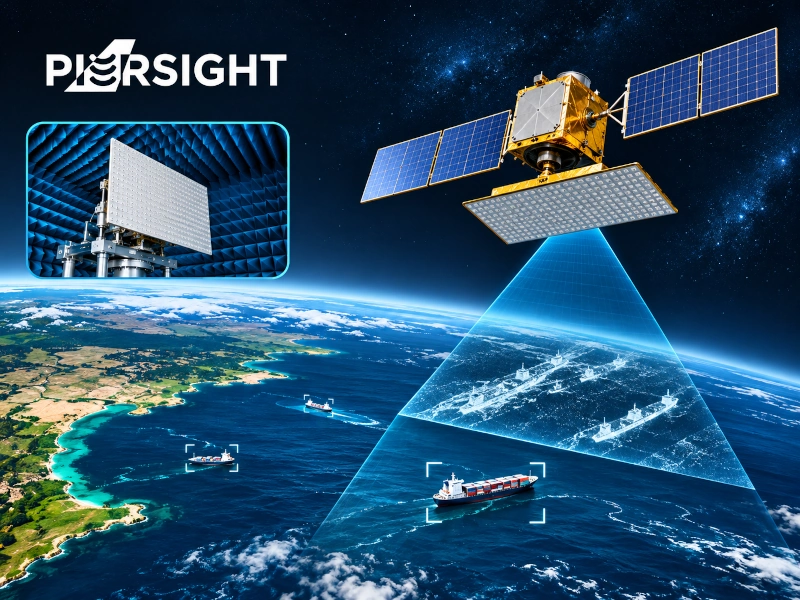
Ahmedabad-based space technology startup PierSight has advanced antenna testing for its Varuna 2.0 maritime surveillance satellite and Vidura drone-mounted radar system, marking further progress in the development of indigenous Synthetic Aperture Radar (SAR) technologies. The company recently shared details of radio-frequency testing activities conducted in a specialised anechoic chamber, where engineers evaluate antenna performance under controlled electromagnetic conditions before integrating the hardware into larger satellite and airborne surveillance systems.
The development was reported on November 2, 2026, with additional coverage published on November 4. PierSight is developing Varuna 2.0 as its first commercial satellite combining Synthetic Aperture Radar with Automatic Identification System (AIS) capabilities. The satellite is intended to form the foundation of a proposed 32-satellite constellation designed to provide persistent maritime surveillance, monitor vessel movements and strengthen ocean security through advanced space-based sensing technologies.
Indigenous Radar Antennas Undergo Specialised Testing
PierSight’s latest engineering activities involve testing antennas for both Varuna 2.0 and Vidura inside a radio-frequency anechoic chamber. Such facilities are designed to minimise unwanted electromagnetic reflections, allowing engineers to evaluate the characteristics of antenna systems under carefully controlled conditions.
Antenna testing is an important component of radar development because the performance of the antenna directly influences signal transmission, reception, sensitivity and imaging capabilities. Engineers can use specialised test facilities to examine radiation patterns, signal gain, polarisation characteristics, impedance matching and operating bandwidth.
These measurements help establish whether manufactured hardware performs according to its intended electromagnetic design. The information gathered during testing also supports adjustments to antenna configurations and the integration of radio-frequency components into larger systems.
For space-based radar applications, reliable antenna performance is particularly important because satellites must operate under demanding environmental conditions while transmitting and receiving signals over considerable distances.
The latest testing activities demonstrate PierSight’s continued work on the specialised electronic hardware required for indigenous radar systems. The company has not disclosed the operating frequencies, measured performance figures or final qualification status associated with the November testing update.
Varuna 2.0 Combines Radar Imaging With Vessel Identification
Varuna 2.0 is being developed as a commercial maritime surveillance satellite capable of combining Synthetic Aperture Radar imagery with vessel-identification information.
SAR technology uses radio-frequency signals to observe the Earth’s surface. Unlike conventional optical imaging systems, radar satellites do not depend on sunlight and can collect information during both day and night. Their ability to penetrate cloud cover also makes them valuable for monitoring regions where weather frequently limits optical satellite observations.
PierSight intends to combine radar observations with AIS information transmitted by ships. AIS is widely used in maritime operations to communicate information such as vessel identity, position, course and speed.
By integrating these two sources of information, a maritime monitoring system can compare vessels detected through radar imagery with their reported AIS positions. This provides an opportunity to identify vessels that appear in radar observations but are not transmitting corresponding identification signals.
The capability is particularly relevant to detecting so-called dark vessels, which may operate without broadcasting AIS information. Such situations can arise for different reasons and may require additional examination by maritime authorities.
PierSight’s integrated approach is intended to improve maritime situational awareness by bringing radar observations and vessel-tracking information together within a common monitoring framework.
Planned 32-Satellite Constellation to Support Ocean Surveillance
PierSight is working towards establishing a constellation of 32 satellites dedicated to maritime monitoring. The proposed network is designed to provide more frequent observations of ocean regions than would be possible using a single spacecraft.
The company’s Varuna architecture is being developed for applications involving exclusive economic zone surveillance, shipping intelligence, illegal fishing detection, oil spill monitoring and maritime security.
Coastal countries maintain extensive maritime areas that require regular monitoring for economic, environmental and security purposes. Conventional surveillance assets, including patrol vessels and aircraft, provide important operational capabilities but cannot maintain continuous physical coverage across every part of these large regions.
Satellite-based radar offers an additional source of information by enabling observations over extensive ocean areas without requiring monitoring platforms to be physically present at each location.
A constellation of multiple satellites can improve the frequency with which particular regions are observed. Combined with vessel-identification information and analytical software, this can support more comprehensive maritime monitoring.
PierSight’s proposed constellation is intended to serve government agencies, naval operators, maritime authorities and commercial organisations requiring reliable information about activities at sea.
The constellation remains under development, with Varuna 2.0 representing an important step towards the company’s planned commercial satellite network.
Earlier Varuna Mission Demonstrated Indigenous Radar Technologies in Space
PierSight’s development of Varuna 2.0 builds upon its earlier Varuna technology demonstration mission, launched aboard ISRO’s PSLV-C60 mission on December 30, 2024.
The experimental payload operated on the PSLV Orbital Experimental Module (POEM) platform and was designed to demonstrate several technologies required for future space-based radar systems.
According to PierSight, the mission successfully completed its primary objectives, including the testing of radar electronics, a deployable reflectarray antenna, an electronic power conditioner and associated radio-frequency components.
The company reported that the mission helped establish the space-readiness of its subsystems and validated important elements of its indigenous radar technology.
These achievements provided an engineering foundation for subsequent commercial satellite development. The experience gained from designing, testing and operating radar hardware in space is particularly relevant to the integration of more advanced payloads intended for operational maritime monitoring.
PierSight has also previously completed reflectarray antenna testing for Varuna 2.0 at the Compact Antenna Test Range Facility of ISRO’s Space Applications Centre in Ahmedabad.
The company reported that the antenna’s measured radiation patterns, gain characteristics and other functional parameters closely matched its simulation models. The results supported validation of its electromagnetic design, fabrication processes and material choices.
The latest antenna-testing activities form part of the continuing hardware development associated with the company’s commercial satellite programme.
Vidura Extends PierSight’s Radar Technology to Unmanned Aircraft
Alongside Varuna 2.0, PierSight is developing Vidura, a compact Synthetic Aperture Radar payload intended for integration with unmanned aerial vehicles.
The system is designed for surveillance applications involving terrain and vegetation where conventional optical sensors may encounter limitations. PierSight describes Vidura as a foliage-penetrating radar system intended to support observation in forested environments.
Unlike cameras, which rely on visible or infrared radiation, appropriately designed radar systems can collect information through certain forms of vegetation. The extent of penetration depends on factors including operating frequency, vegetation density, moisture and radar configuration.
PierSight is developing Vidura as an adaptable payload that could be integrated with different drone platforms. Its intended applications include specialised aerial surveillance and monitoring of areas where dense vegetation limits conventional observation.
The development of both satellite-based and drone-mounted radar technologies reflects the company’s focus on application-specific sensing systems.
By advancing radio-frequency engineering across different platforms, PierSight is building capabilities relevant to maritime surveillance, remote sensing and specialised defence applications.
Indigenous Space Technology Supports India’s Maritime Security Capabilities
PierSight was established in 2023 by Gaurav Seth, a former ISRO engineer, and Vinit Bansal. The company focuses on developing specialised radar technologies for applications requiring reliable observation under challenging environmental conditions.
Its work forms part of India’s expanding private space technology ecosystem, which includes startups developing satellites, sensors, propulsion systems, communication technologies and Earth observation capabilities.
The development of indigenous SAR systems is particularly relevant because radar satellites require expertise across several specialised engineering disciplines. These include antenna design, microwave electronics, signal processing, power systems, thermal engineering and spacecraft integration.
Domestic capability in these fields can strengthen India’s ability to develop space-based surveillance technologies while creating opportunities for specialised manufacturers, electronics companies and research institutions.
PierSight is also participating in India’s emerging public-private Earth observation satellite ecosystem. The company has been associated with the consortium selected under the Indian National Space Promotion and Authorisation Centre’s Earth Observation Public-Private Partnership initiative, alongside other Indian space enterprises.
Such collaborations provide opportunities for private companies to contribute advanced sensing technologies to national Earth observation capabilities.
Varuna 2.0 Advances Towards Commercial Satellite Development
PierSight’s latest antenna-testing activities represent another stage in the development of its Varuna 2.0 and Vidura radar systems. The work builds upon the company’s earlier in-orbit technology demonstration and subsequent hardware validation activities.
The company is preparing Varuna 2.0 as its first commercial SAR-AIS satellite, with a launch currently planned for 2027. The spacecraft is intended to establish the foundation for its proposed maritime surveillance constellation.
The simultaneous development of satellite and drone-mounted radar systems demonstrates PierSight’s emphasis on building specialised sensing technologies suited to different operational requirements.
For India’s space industry, the programme contributes to the growth of indigenous capabilities in radar electronics, antenna engineering, satellite integration and maritime intelligence.
PierSight’s ongoing engineering work highlights the increasing role of Indian space startups in developing advanced Earth observation systems and expanding the country’s participation in the global market for satellite-based intelligence and surveillance technologies.
You may also like
-
India’s Non-Fossil Power Capacity Reaches 308 GW as Vice President Highlights Clean Energy Progress
-
India and Italy Explore Expanded Textile Manufacturing, Technology and Investment Partnerships
-
Chennai Deep-Tech Startup Torus Motion Develops Indigenous Axial-Flux Motors for Electric Vehicles and Industrial Automation
-
Rekise Marine Advances Indigenous MPAUV and Jalkapi Autonomous Submarine Programmes with Sea Trials in Goa
-
Hyderabad Startup Perceptyne Develops Semi-Humanoid Robotic Platform for Precision Industrial Automation
