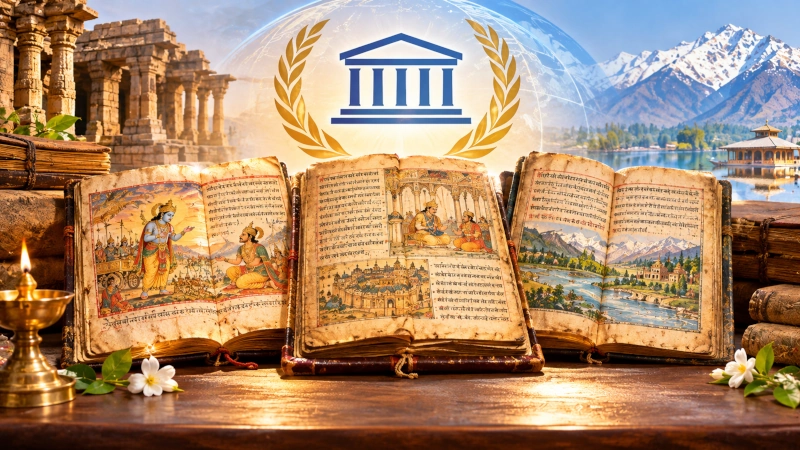
India’s rich manuscript heritage has received significant international recognition with the inscription of three classical works—the Mahābhārata, Kauṭilya’s Arthaśāstra and Kalhaṇa’s Rājataraṅgiṇī—in UNESCO’s Memory of the World Asia-Pacific Regional Register. The inscriptions were approved during the 11th General Meeting of the Memory of the World Committee for Asia and the Pacific (MOWCAP), held in Jakarta, Indonesia, with the announcement made on November 5, 2026.
The recognition acknowledges three important dimensions of India’s intellectual and civilisational heritage: historical documentation, philosophical and ethical thought, and the systematic study of governance and statecraft. With these additions, the number of Indian documentary heritage inscriptions in the Asia-Pacific Regional Register has increased from three to six, strengthening the country’s representation in UNESCO’s programme for safeguarding historically significant manuscripts and archival collections.
The Indira Gandhi National Centre for the Arts (IGNCA), functioning as India’s nodal institution for the UNESCO Memory of the World Programme, played an important role in preparing the nomination dossiers. The selection recognises the historical and intellectual importance of the surviving manuscripts while highlighting the need to preserve documentary evidence of India’s longstanding traditions of scholarship, literature and political thought.
Mahabharata: Preserving India’s Epic Tradition and Philosophical Heritage
The Mahābhārata, traditionally attributed to Maharishi Vyāsa, is among the world’s longest epic compositions and occupies a central position in Indian literary, philosophical and cultural traditions. Although its principal narrative concerns the conflict between the Kauravas and Pandavas, the work encompasses a much broader examination of Dharma, duty, justice, political authority, family relationships and the moral responsibilities of individuals and rulers.
The epic contains extensive discussions of the four Purusharthas—Dharma, Artha, Kama and Moksha—which represent fundamental objectives of human life within Indian philosophical traditions. Its treatment of Rajadharma, ethical conduct, political responsibility and the consequences of human decisions has influenced Indian thought for centuries. The Bhagavad Gita, situated within the Bhishma Parva of the Mahabharata, remains one of the most widely studied philosophical dialogues in Indian literature.
The manuscript recognised under the UNESCO regional programme is a rare, approximately 400-year-old birch-bark manuscript written in the Sharada script and preserved at the Bhandarkar Oriental Research Institute in Pune. According to the official MOWCAP nomination documentation, the manuscript was acquired in Kashmir in 1875 by the Indologist Georg Bühler and represents an important surviving witness to an older Kashmiri textual tradition of the epic.
The manuscript’s significance extends beyond the literary importance of the Mahabharata. Its material composition, script and textual characteristics provide valuable evidence for understanding the transmission of Sanskrit literature across generations and regions. Preserving such manuscripts enables scholars to examine historical variations in texts, reconstruct their transmission and study the development of India’s literary traditions through surviving documentary sources.
The Mahabharata also influenced literary and artistic traditions beyond the Indian subcontinent, including Southeast Asian theatre, sculpture and storytelling. Its narratives have been adapted across different cultural settings, demonstrating the historical reach of Indian epic literature and its continuing importance within the broader cultural heritage of Asia.
Arthashastra: International Recognition for Ancient Indian Statecraft
Kauṭilya’s Arthaśāstra is one of the most important surviving Sanskrit treatises on governance, political economy, public administration, diplomacy and military strategy. Traditionally associated with Kauṭilya, also known as Chanakya or Vishnugupta, the work presents a systematic examination of the responsibilities of rulers and the administrative institutions required for maintaining an organised state.
The text addresses subjects ranging from public finance, taxation and economic regulation to judicial administration, intelligence gathering, military organisation and foreign policy. Its detailed treatment of government institutions demonstrates the sophistication of political and administrative thought preserved in ancient Indian scholarship. The Arthaśāstra is particularly notable for integrating questions of economic management and national security within a broader framework of state administration.
Among its important political concepts are the Mandala theory of interstate relations, the six measures of foreign policy known as Shadgunya, and the four traditional approaches of Sama, Dana, Bheda and Danda. These concepts form part of Kauṭilya’s systematic analysis of diplomacy, strategic decision-making, conflict management and the exercise of political authority.
The manuscript nominated for UNESCO regional recognition is a complete sixteenth-century palm-leaf manuscript written in the Grantha script and preserved at the Oriental Research Institute in Mysuru. The official MOWCAP documentation identifies it as an important surviving source for the study of Kauṭilya’s work and the transmission of ancient Indian political literature.
The modern rediscovery of the Arthaśāstra is closely associated with Sanskrit scholar R. Shamasastry, who identified the manuscript in 1905 and subsequently brought the work to wider scholarly attention through publication and translation. Its rediscovery substantially expanded modern understanding of ancient Indian political institutions, administrative practices and strategic thought.
The UNESCO regional inscription acknowledges the value of this manuscript as documentary evidence of India’s intellectual contribution to the study of governance. Its preservation provides scholars with an important resource for examining the historical development of political economy, diplomacy and statecraft within the Indian knowledge tradition.
Rajatarangini: Kalhana’s Historical Chronicle of Kashmir
Kalhaṇa’s Rājataraṅgiṇī, composed during the twelfth century, is one of the most significant surviving works of historical writing in Sanskrit literature. The chronicle presents an account of Kashmir’s rulers, political developments, dynastic changes and social conditions, combining historical investigation with the literary conventions of classical Sanskrit poetry.
The title Rājataraṅgiṇī is commonly translated as River of Kings, reflecting the work’s presentation of Kashmir’s dynastic history as a continuous historical narrative. Kalhaṇa organised his account into eight sections known as Tarangas, or waves, tracing the succession of rulers and examining political events across different periods of Kashmir’s history.
The work is particularly important for its attention to historical sources and chronology. Kalhaṇa drew upon earlier chronicles, genealogical records, inscriptions and other available materials while attempting to reconstruct the history of Kashmir. Although portions of the narrative incorporate legendary material, the chronicle represents a substantial effort to examine political developments through available documentary and historical evidence.
The manuscript recognised through the UNESCO programme is preserved at the Oriental Research Library in Srinagar. Written in the Sharada script on old Kashmiri paper, it is identified in the official MOWCAP documentation as a direct copy of a lost manuscript archetype, making it an important surviving link to an earlier textual tradition.
The manuscript also played a significant role in the preparation of Marc Aurel Stein’s critical edition of the Rajatarangini. Its carefully prepared folios and extensive marginal annotations provide evidence of the scholarly attention devoted to the text across generations.
The inclusion of the Rajatarangini in the regional register is especially important for preserving Kashmir’s historical and literary heritage. The manuscript provides documentary evidence of a distinguished regional tradition of Sanskrit scholarship while contributing to the wider understanding of historical writing and political culture in the Indian subcontinent.
IGNCA’s Role in Preserving India’s Documentary Heritage
The Indira Gandhi National Centre for the Arts has played a central role in India’s engagement with UNESCO’s Memory of the World Programme. Designated as the national nodal institution for the programme in 2014, IGNCA coordinates activities relating to documentary heritage nominations, conservation, awareness and cooperation with international institutions.
For the 2026 nomination cycle, IGNCA contributed to the preparation of the dossiers supporting the inscription of the three manuscripts. Such dossiers document the historical importance, authenticity, condition, ownership and preservation requirements of nominated collections, allowing international experts to assess their significance within the regional heritage framework.
The Memory of the World Programme was established by UNESCO in 1992 to encourage the preservation of documentary heritage and improve access to historically important archives, manuscripts and records. Its activities recognise that documentary collections preserve evidence of human intellectual, scientific, cultural and social achievements that might otherwise be lost through deterioration, neglect or destruction.
The programme operates through international, regional and national mechanisms. The Memory of the World Committee for Asia and the Pacific supports regional cooperation in identifying and safeguarding documentary heritage of particular importance to the Asia-Pacific region.
The recognition of the Mahabharata, Arthashastra and Rajatarangini demonstrates the importance of India’s manuscript collections within this wider framework. It also highlights the contributions of libraries and research institutions that have preserved rare textual materials and made them available for scholarly investigation.
India’s Regional UNESCO Inscriptions Rise to Six
Before the latest announcement, India had three documentary heritage inscriptions in the Asia-Pacific Regional Register. These comprised illustrated manuscripts of Goswami Tulsidas’s Ramcharitmanas, a rare fifteenth-century manuscript of the Panchatantra, and the Sahṛdayāloka-Locana, an important Sanskrit work associated with the development of Indian literary criticism and poetics.
The earlier inscriptions were approved in 2024 and represented different aspects of India’s literary and philosophical heritage. The Ramcharitmanas manuscripts reflected the enduring influence of the Ramayana tradition, while the Panchatantra manuscript documented India’s extensive tradition of instructional storytelling. The Sahṛdayāloka-Locana represented the development of sophisticated theories concerning poetic expression, interpretation and aesthetic experience.
The addition of the Mahabharata, Arthashastra and Rajatarangini broadens the range of Indian knowledge traditions represented in the regional register. Together, the six inscriptions encompass epic literature, narrative traditions, literary aesthetics, historical scholarship and the systematic study of political administration.
The latest recognition also demonstrates the geographical diversity of India’s manuscript heritage, with important collections preserved in institutions located in Pune, Mysuru and Srinagar. These repositories continue to serve as important centres for the conservation and scholarly study of classical Indian texts.
Strengthening Manuscript Conservation Through Gyan Bharatam Mission
The UNESCO recognition comes amid India’s broader efforts to identify, document, conserve and digitise its extensive manuscript heritage. The Government of India’s Gyan Bharatam Mission is intended to strengthen the preservation of rare manuscripts and expand access to documentary collections through modern conservation practices and digital technologies.
India possesses manuscript collections preserved across research institutions, libraries, monasteries, temples, educational establishments and private repositories. These collections contain material relating to philosophy, mathematics, astronomy, medicine, architecture, grammar, literature, law and numerous other fields of knowledge.
Preserving these materials requires specialised approaches because manuscripts are often written on fragile media such as palm leaves, birch bark and handmade paper. Their conservation involves environmental management, physical restoration where appropriate, documentation and careful handling to prevent deterioration.
Digitisation can complement physical conservation by creating accessible records of manuscripts and reducing the need for repeated handling of delicate originals. Digital catalogues and manuscript repositories also provide opportunities for researchers to identify collections, compare textual traditions and conduct interdisciplinary investigations.
The recognition of three rare Indian manuscripts reinforces the importance of connecting traditional knowledge preservation with contemporary archival technologies. Institutions involved in manuscript conservation can use international documentary heritage recognition to strengthen awareness, promote scholarly collaboration and support the long-term protection of historically significant collections.
International Recognition of India’s Knowledge Traditions
The inscription of the Mahabharata, Arthashastra and Rajatarangini in UNESCO’s Memory of the World Asia-Pacific Regional Register represents an important acknowledgement of India’s contribution to the intellectual history of Asia. The three works illuminate different but interconnected traditions of Indian scholarship, covering ethical philosophy, political administration and the documentation of historical events.
The Mahabharata preserves a vast body of philosophical and cultural reflection concerning Dharma and human conduct. The Arthashastra provides a systematic examination of governance, public administration and strategic affairs, while the Rajatarangini records the political and historical experiences of Kashmir through a distinctive Sanskrit literary tradition.
Their recognition also draws attention to the manuscripts themselves as irreplaceable historical objects. The birch-bark Mahabharata manuscript, the palm-leaf Arthashastra manuscript and the Sharada-script Rajatarangini manuscript preserve evidence of the methods through which Indian knowledge was recorded, copied, studied and transmitted over centuries.
With India’s presence in the regional register increasing to six inscriptions, the latest development strengthens international recognition of the country’s literary and scholarly heritage. It also reinforces the importance of sustained manuscript conservation, institutional research and public access to the documentary foundations of India’s civilisational memory.
Through these three manuscripts, India’s traditions of Dharma, historical inquiry and statecraft receive renewed attention as part of the shared documentary heritage of the Asia-Pacific region.
You may also like
-
Bhutan King Dedicates Sacred Buddhist Stupa to PM Narendra Modi, Celebrating India–Bhutan Friendship
-
Jambūdvīpa: The Great Continent of the Mahabharata and the Place of Bhārata Within It
-
Tamraparni in the Mahabharata: The Sacred Southern River at the Edge of the Pandya Country
-
Simhala or Simhaladvipa in the Mahabharata: The Island Kingdom of Sri Lanka
-
Lanka in the Mahabharata: The Island Kingdom Beyond India’s Southern Shore
