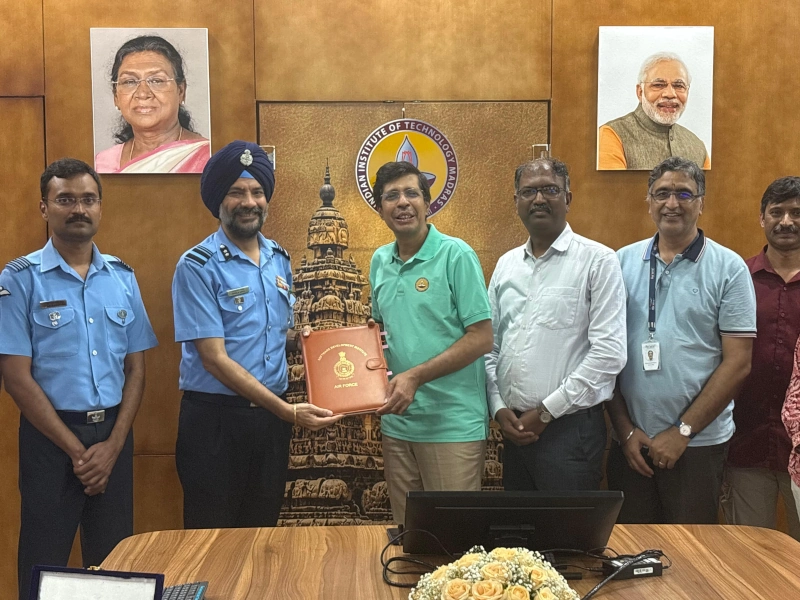
The Indian Air Force (IAF) has entered into a collaborative agreement with the Indian Institute of Technology Madras (IIT Madras) and IITM Pravartak Technologies Foundation to jointly design and develop an indigenous digital secure communication system for airborne applications. The initiative represents another step towards strengthening India’s domestic defence technology capabilities, particularly in secure military communications and advanced networking systems.
The Memorandum of Agreement (MoA) was signed between the Software Development Institute (SDI) of the Indian Air Force and IITM Pravartak Technologies Foundation. Air Vice Marshal Sarabjit Singh, Commandant of SDI, and Dr M. J. Shankar Raman, Chief Executive Officer of IITM Pravartak Technologies Foundation, signed the agreement in the presence of Professor V. Kamakoti, Director of IIT Madras.
Developing Indigenous Secure Communication Capabilities
The collaboration will focus on the joint development of advanced algorithms for digital communication and networking, with the objective of creating an indigenous communication system suitable for airborne applications. By combining the operational expertise of the Indian Air Force with the research capabilities of IIT Madras and IITM Pravartak Technologies Foundation, the initiative seeks to develop technologies addressing the specialised requirements of military aviation.
Secure communication is a fundamental component of modern air operations, enabling the reliable exchange of operational information between aircraft and supporting communication networks. Airborne communication systems must function in demanding operational environments where mobility, signal reliability, information security and the efficient transmission of data are important considerations. The development of indigenous algorithms and networking technologies can contribute to greater technological control over these critical capabilities.
The agreement establishes a framework for research and development rather than announcing the induction of an operational system. Its principal emphasis is on developing the underlying communication algorithms and networking technologies required for an indigenous airborne solution, creating opportunities for future integration into appropriate Indian Air Force platforms and systems.
Combining Military Expertise with Academic Research
The Software Development Institute of the Indian Air Force contributes specialised expertise in software development and the technological requirements of military operations. Its participation will help align the research programme with the practical demands of airborne communication, ensuring that the development process benefits from direct engagement with the intended operational environment.
IIT Madras brings academic research capabilities in engineering, computing and advanced technologies, while IITM Pravartak Technologies Foundation provides an institutional framework supporting technology development and collaboration. The partnership creates an opportunity to combine military requirements with academic research and indigenous technological innovation, strengthening cooperation between India’s defence establishment and its higher education institutions.
Such collaborations are increasingly relevant as military platforms become more dependent on software-driven capabilities, digital connectivity and integrated information systems. Developing these technologies domestically can help strengthen India’s ability to design, maintain and improve critical defence systems while expanding the national knowledge base in specialised engineering disciplines.
Reducing Dependence on Imported Defence Communication Systems
An important objective of the agreement is to reduce India’s reliance on imported communication systems for military aviation. Indigenous development provides greater control over technology design, software architecture, maintenance and future improvements, all of which are significant considerations for systems supporting national security.
Domestic expertise in secure digital communication can also support the development of technologies adapted to the specific requirements of the Indian Armed Forces. By establishing research and development capabilities within Indian institutions, the initiative seeks to strengthen long-term technological self-reliance and create a foundation for further innovation in military communication and networking.
The programme aligns with the broader Atmanirbhar Bharat initiative, which emphasises reducing external dependence in strategic sectors through indigenous research, design, development and manufacturing. In defence technology, this approach extends beyond producing hardware domestically to developing the software, algorithms and intellectual capabilities that underpin increasingly sophisticated military systems.
Strengthening India’s Defence Technology Ecosystem
The agreement between the Indian Air Force, IIT Madras and IITM Pravartak Technologies Foundation reflects the growing importance of institutional partnerships in India’s defence modernisation efforts. Advanced military capabilities increasingly depend on the integration of multiple technological disciplines, making collaboration between operational organisations, universities and research institutions an important component of indigenous development.
The project also highlights the strategic importance of developing expertise in communication algorithms and networking technologies. These capabilities form part of the technological foundation for modern military connectivity and can support broader research into secure, reliable and adaptable digital communication architectures.
By bringing together defence software expertise and academic research, the collaboration advances India’s efforts to establish a stronger domestic base for critical military technologies. The indigenous airborne communication initiative represents a focused investment in national technological capability, contributing to the Indian Air Force’s operational modernisation objectives and India’s wider pursuit of self-reliance in defence systems.
You may also like
-
Indian Navy Receives Indigenous Anti-Submarine Warfare Vessel ‘Amini’ from GRSE with Over 80% Domestic Content
-
India Hosts First BIMSTEC Maritime Security Exercise in Andaman and Nicobar Islands, Strengthening Bay of Bengal Cooperation
-
Indian Space Startup PierSight Advances Antenna Testing for Varuna 2.0 Maritime Surveillance Satellite
-
Chennai Deep-Tech Startup Torus Motion Develops Indigenous Axial-Flux Motors for Electric Vehicles and Industrial Automation
-
Rekise Marine Advances Indigenous MPAUV and Jalkapi Autonomous Submarine Programmes with Sea Trials in Goa
