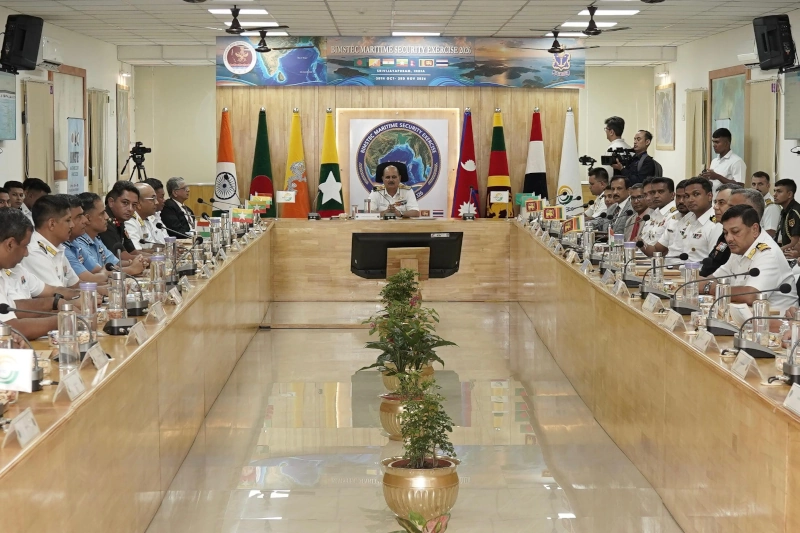
The inaugural BIMSTEC Maritime Security Exercise concluded successfully at Sri Vijaya Puram in the Andaman and Nicobar Islands on November 3, marking an important milestone in maritime security cooperation among countries bordering the Bay of Bengal. Conducted from October 30 to November 3 under the Andaman and Nicobar Command (ANC), the five-day exercise brought together naval forces and senior representatives from BIMSTEC member nations to strengthen operational coordination, maritime interoperability and regional security partnerships.
The exercise was hosted by the Andaman and Nicobar Command under the leadership of Vice Admiral Vineet McCarty, Commander-in-Chief of the Command. As India’s only operational integrated tri-service command, the ANC occupies a strategically important position in the eastern Indian Ocean, providing a platform for maritime surveillance, joint military operations and cooperation with regional partners.
Naval Forces from India, Myanmar and Sri Lanka Participate
The exercise featured five naval vessels representing three BIMSTEC member countries. The Indian Navy deployed INS Taragiri, INS Karmuk and INS Saryu, while the Myanmar Navy participated with UMS King Aung Zeya and the Sri Lanka Navy contributed SLNS Gajabahu. Their participation provided an opportunity for the respective navies to conduct coordinated maritime activities, exchange operational experience and improve their ability to work together in a shared maritime environment.
The maritime engagements were complemented by participation from senior military officers, government representatives and regional institutional leaders. BIMSTEC Secretary General Indra Mani Pandey attended the exercise alongside India’s National Maritime Security Coordinator, Vice Admiral Biswajit Dasgupta (Retd), and Rear Admiral Kyaw Kyaw Htoo, Commander of the Myanmar Navy’s Central Naval Command.
Other distinguished participants included Air Vice Marshal M. D. R. Prasad (Retd), Director of Monitoring and Evaluation in Sri Lanka’s Ministry of Ports and Civil Aviation, and Captain Mohammad Monzurul Islam, Commanding Officer of Bangladesh Navy ship BNS Prottoy. Their presence highlighted the broader diplomatic and institutional importance of the exercise, which extended beyond naval operations to strengthen cooperation among the participating countries.
Harbour and Sea Phases Strengthen Maritime Interoperability
The exercise was organised through harbour and sea phases, allowing participating countries to combine professional exchanges with practical maritime coordination. The harbour phase at Sri Vijaya Puram included high-level engagements, professional interactions and cultural exchanges designed to deepen institutional relationships and promote mutual understanding among the participating delegations.
These activities provided opportunities for naval personnel and officials to exchange knowledge, discuss operational approaches and strengthen professional relationships. Such interactions are particularly valuable in multinational maritime cooperation, where effective communication, familiarity with procedures and mutual confidence contribute to coordinated responses during operational deployments.
The sea phase, conducted off Sri Vijaya Puram from November 2 to 3, involved coordinated naval deployments and collaborative maritime activities. The participating ships operated together in the waters surrounding the Andaman and Nicobar Islands, demonstrating their commitment to strengthening interoperability and developing closer operational linkages among regional maritime forces.
The combination of harbour engagements and activities at sea enabled participating countries to translate diplomatic commitments into practical cooperation. By bringing naval personnel together in a common operational environment, the exercise strengthened the foundations for continued collaboration in maritime security, information exchange and coordinated regional responses.
Advancing Maritime Cooperation Under the BIMSTEC Framework
The inaugural exercise was conducted in the spirit of the Delhi Declaration and built upon the outcomes of the fourth BIMSTEC Experts Group Meeting on Maritime Security Cooperation, held in November 2025. It also reflected the broader objectives of the sixth BIMSTEC Summit, which emphasised developing a prosperous, resilient and open regional community through stronger cooperation among member countries.
BIMSTEC, the Bay of Bengal Initiative for Multi-Sectoral Technical and Economic Cooperation, brings together Bangladesh, Bhutan, India, Myanmar, Nepal, Sri Lanka and Thailand. The organisation provides an institutional framework connecting South Asia and Southeast Asia across several areas of cooperation, including trade, connectivity, economic development and regional security.
Maritime cooperation has particular importance within this framework because the Bay of Bengal supports major international shipping routes, regional trade, energy transportation and economic connectivity. The security of these waters is closely connected to the economic interests of participating countries, making cooperation in maritime surveillance, information sharing and coordinated responses an important regional priority.
The exercise provided a practical mechanism for advancing these objectives by enabling participating navies to develop closer professional relationships and improve their understanding of one another’s operational procedures. It also demonstrated how BIMSTEC’s institutional commitments can be translated into coordinated activities that contribute to maritime stability.
Strategic Importance of the Andaman and Nicobar Command
Hosting the inaugural BIMSTEC Maritime Security Exercise highlighted the strategic importance of India’s Andaman and Nicobar Islands in the evolving security architecture of the eastern Indian Ocean. Located near important sea lanes connecting the Indian Ocean with Southeast Asia, the islands provide India with a significant geographical advantage for maritime monitoring, regional engagement and the protection of vital shipping routes.
The Andaman and Nicobar Command integrates personnel and capabilities from the Indian Army, Navy and Air Force under a unified operational structure. Its responsibilities encompass maritime security, surveillance, joint operations and cooperation with regional partners, making it an important institution in India’s approach to maintaining stability across the eastern Indian Ocean.
The Command’s geographical position also supports cooperation in humanitarian assistance, disaster relief and maritime search-and-rescue activities. These capabilities are particularly relevant to the Bay of Bengal, where regional countries share common interests in protecting maritime commerce, responding to natural disasters and ensuring the safety of vessels operating across international waters.
By hosting the first BIMSTEC maritime exercise, the Command reinforced its role as a centre for regional military engagement and multinational maritime cooperation. The event also demonstrated India’s capacity to provide an operational platform for countries seeking to strengthen collective maritime security within an established regional framework.
Strengthening India’s Maritime Partnerships in the Bay of Bengal
The exercise represents a significant development in India’s maritime engagement with neighbouring countries and reflects the growing importance of regional security cooperation in the Bay of Bengal. By bringing together naval forces from India, Myanmar and Sri Lanka, alongside representatives from other BIMSTEC countries, the initiative established a practical foundation for deeper cooperation in safeguarding shared maritime interests.
For India, maritime engagement under BIMSTEC complements its broader efforts to strengthen connectivity and security partnerships across the Indian Ocean region. Cooperation among neighbouring countries contributes to a more coordinated approach towards challenges involving maritime safety, transnational threats, disaster response and the protection of commercial shipping.
The inaugural exercise also strengthened professional relationships among participating personnel, creating opportunities for continued exchanges and future joint activities. These institutional connections are important for developing sustained cooperation, particularly in a region where maritime security requires communication and coordination across national boundaries.
The successful conclusion of the first BIMSTEC Maritime Security Exercise establishes an important precedent for future multinational engagements under the organisation’s framework. With the Andaman and Nicobar Command serving as the host, India has reinforced its commitment to promoting a secure, stable and cooperative maritime environment while contributing to BIMSTEC’s shared vision of a prosperous, resilient and open Bay of Bengal.
You may also like
-
Indian Navy Receives Indigenous Anti-Submarine Warfare Vessel ‘Amini’ from GRSE with Over 80% Domestic Content
-
Indian Air Force Partners with IIT Madras to Develop Indigenous Secure Communication System for Aircraft
-
India and Guatemala Explore Expanded Trade and Investment Cooperation Across Key Industrial Sectors
-
India-Led International Solar Alliance Expands to 116 Members as Bahamas Joins
-
India and Italy Explore Expanded Textile Manufacturing, Technology and Investment Partnerships
