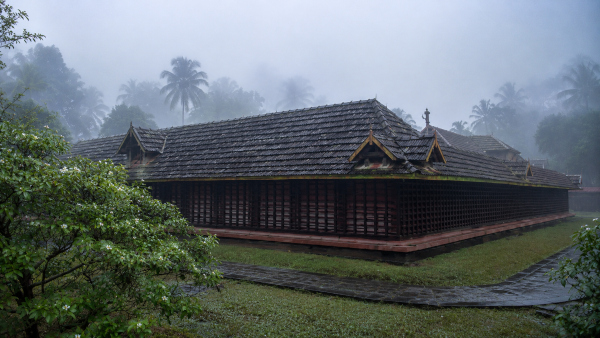
Sree Thiruvegappura Temple is one of the prominent ancient temples of Palakkad district, located in the Thiruvegappura region near Pattambi–Ottappalam belt. Palakkad lies to the north of Thrissur and forms one of Kerala’s great cultural corridors, linking the temple traditions of central Kerala with the old Valluvanad heritage zone. In this sacred landscape, Thiruvegappura stands out as a rare temple where Lord Shiva with Goddess Parvathy, Lord Vishnu, and Lord Sankaranarayana are worshipped within the same temple complex. Kerala Tourism describes it as a 14th-century temple known for its three principal deities, architectural elegance, cultural performances, and festivals.
The Sacred Identity of the Temple
The special greatness of Sree Thiruvegappura Temple lies in its three-fold divinity. The temple brings together Shaiva and Vaishnava worship in a harmonious spiritual arrangement. Lord Shiva with Parvathy represents the power of tapas, protection, and cosmic dissolution. Lord Vishnu represents preservation, compassion, and dharmic order. Lord Sankaranarayana represents the beautiful union of Shiva and Vishnu tattva, showing that different forms of worship ultimately flow toward the same divine truth.
This makes Thiruvegappura a powerful example of Kerala’s inclusive temple culture. The temple does not present Shiva and Vishnu as separate spiritual worlds. It places them together in sacred unity, reminding devotees that dharma is vast, layered, and deeply integrated.
Antiquity and Sthala Purana
The temple is traditionally regarded as an ancient shrine and is believed to have been built by sages. Kerala Tourism notes this belief while also highlighting the temple’s architectural value and sacred importance.
A local temple tradition connects the origin of the shrine with Garuda. According to the sthala purana, Garuda was bringing the Shiva lingam from the Himalayas, and as the auspicious time for installation was approaching, he was urged to fly swiftly. The phrase associated with this legend, connected with “vegam” or speed, is linked to the name Thiruvegappura in popular tradition.
Whether read as history, devotion, or sacred memory, the legend gives the temple a strong pan-Indian spiritual imagination. The Himalayas, Garuda, Shiva, Vishnu, and Kerala’s riverine temple culture all come together in this single sacred narrative.
Three Deities, Three Flag Masts
One of the temple’s rare features is the presence of three prime deities and three flag masts within the same complex. Kerala Tourism identifies this as the major feature that distinguishes Sree Thiruvegappura Temple from many other Kerala temples.
The three flag masts symbolise the independent ritual dignity of the deities. They also give the temple a unique visual and ceremonial identity. In Kerala temple culture, the kodimaram is not merely an architectural object. It marks the axis of worship, festival authority, and sacred presence. At Thiruvegappura, the three flag masts turn the temple into a rare spiritual confluence of Shiva, Vishnu, and Sankaranarayana worship.
Architecture and Koothambalam
Sree Thiruvegappura Temple is admired for its traditional Kerala temple architecture. The temple is especially noted for its beautifully built Koothambalam, the sacred temple theatre used for classical ritual and performance traditions. Kerala Tourism specifically mentions the temple’s exquisitely built Koothambalam and its role as a cultural space where performances are held.
The Koothambalam is an important part of Kerala’s sacred performing tradition. It is associated with art forms such as Koothu and Koodiyattam, where performance becomes an offering, narration becomes worship, and theatre becomes temple ritual. In this sense, Thiruvegappura is not only a place of puja. It is also a house of sacred art, sound, rhythm, literature, and oral tradition.
Ritual Life and Festivals
The temple has a rich festival calendar. Kerala Tourism lists several important observances, including Oushadaseva on Karkidakam 16, Kodiyettam after Uthrattathi asterism in Kumbham, Theeyattu on the first Saturday of Edavam, Anayoottu during the first week of Karkidakam, and Erinjupuranpattu from the first Sunday of Medam for 13 days.
Among these, Oushadaseva has special importance. It is associated with the Malayalam month of Karkidakam, a period traditionally linked with health, healing, Ayurveda, austerity, and spiritual renewal. The observance gives the temple a strong connection with Kerala’s ancient idea that worship, medicine, seasonal discipline, and divine grace are connected.
Theeyattu adds a ritual-theatre dimension to the temple. Anayoottu, the ceremonial feeding of elephants, reflects Kerala’s temple ecology, where elephants, music, offerings, lamps, and processions form part of the sacred festival world. Erinjupuranpattu, extending for thirteen days, adds devotional music and local tradition to the temple’s annual rhythm.
Cultural Importance of Thiruvegappura
Thiruvegappura belongs to the old cultural geography of Valluvanad and Palakkad. This region has produced poets, scholars, performers, ritual specialists, and temple traditions that shaped Kerala’s literary and spiritual life. The temple’s Koothambalam, festivals, and multi-deity worship make it a living cultural centre rather than a monument of the past.
Its location in Palakkad also gives it a special place in Kerala’s sacred map. Palakkad has always been a gateway region: geographically through the Palakkad Gap, culturally between Malabar and central Kerala, and spiritually through its many Shiva, Vishnu, Bhagavathy, and village temples. Sree Thiruvegappura Temple stands as one of the important ancient shrines in this wider sacred landscape.
Spiritual Message
The deepest message of Sree Thiruvegappura Temple is harmony. Shiva, Vishnu, and Sankaranarayana together express the unity of different paths within Sanatana Dharma. The temple teaches that devotion has many forms, but the divine centre is one. The devotee who enters this temple does not encounter division. He encounters balance: Shiva’s stillness, Vishnu’s compassion, and Sankaranarayana’s unity.
This is why Thiruvegappura is more than an ancient temple of Palakkad. It is a spiritual statement carved into Kerala’s sacred architecture.
How to See the Temple
Sree Thiruvegappura Temple is located in Palakkad district, close to the Pattambi–Ottappalam region. Kerala Tourism’s location page places Thiruvegappura around 16 km from Pattambi and 6 km from Valancheri, making it accessible from both Palakkad and Malappuram side routes.
Visitors usually experience the temple best during the morning or evening hours, when the lamps, wooden architecture, and quiet temple atmosphere reveal the old-world beauty of Kerala’s sacred spaces.
Conclusion
Sree Thiruvegappura Temple is one of Palakkad’s treasured ancient shrines. Its greatness lies in its rare three-deity arrangement, its three flag masts, its Koothambalam, its festival calendar, and its deep message of Shaiva–Vaishnava unity. The temple carries the grace of Lord Shiva, the compassion of Lord Vishnu, and the integrated power of Lord Sankaranarayana.
In the sacred geography of Kerala, Thiruvegappura stands as a temple of harmony — a place where architecture, ritual, music, legend, and devotion come together. For devotees, it is a kshetra of blessing. For heritage lovers, it is a jewel of Kerala temple culture. For Palakkad, it remains one of the district’s most meaningful ancient spiritual landmarks.
You may also like
-
Sindhu: The Indus Kingdom of Jayadratha in the Mahabharata
-
Kuninda or Kulinda: The Himalayan Realm of the Mahabharata in Uttarakhand and Himachal Pradesh
-
Durga versus Mahishasura: Weapons, Battlefield Tactics and the Triumph of Shakti
-
Kuluta: The Kullu Valley Kingdom of the Mahabharata
-
Trigarta: The Kangra–Jalandhar Kingdom of the Mahabharata
