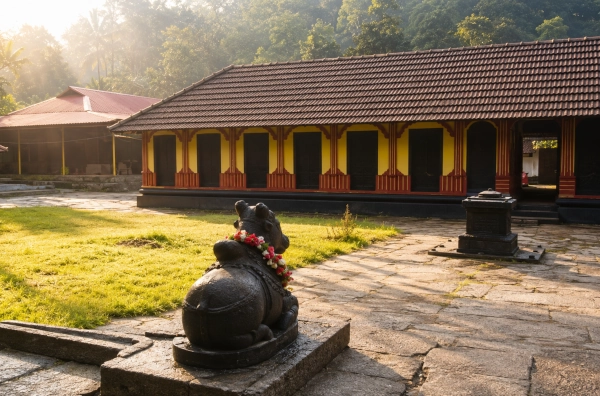
Sree Thrissilery Mahadeva Temple is one of the oldest and best-known centres of Shiva worship in Wayanad. Situated at Thrissilery near Mananthavady, the temple stands amid the forested hills and agricultural landscape of northern Wayanad, an inland highland district lying north-east of Kozhikode. Its antiquity, traditional Kerala architecture, sacred water shrine and close ritual connection with Thirunelli Mahavishnu Temple give it a distinctive place in Kerala’s temple heritage.
The exact date of the temple’s foundation remains uncertain. Official Kerala Tourism records describe it as an ancient shrine and one of Kerala’s oldest temples, while local tradition places its origins deep in Wayanad’s early sacred history. The temple is dedicated primarily to Lord Shiva, worshipped here as Mahadeva. Shrines for Goddess Parvati, Goddess Durga and Lord Ayyappa are also present within the complex.
A Sacred Centre in the Wayanad Highlands
Thrissilery lies close to Mananthavady in northern Wayanad. The region is surrounded by wooded hills, streams, paddy fields and routes leading toward the Brahmagiri mountains and Thirunelli. Kerala Tourism places the temple approximately eight kilometres north-west of Mananthavady.
Wayanad’s location separated it geographically from Kerala’s coastal plains while connecting it with the uplands of present-day Karnataka. Ancient pathways through the district carried pilgrims, traders, cultivators and military forces between Malabar and the Deccan plateau. Temples such as Thrissilery consequently developed within a cultural landscape shaped by both Kerala’s coastal traditions and the distinctive environment of the Western Ghats.
The temple’s tranquil setting remains central to its character. Traditional tiled structures, carved architectural elements and open spaces create an atmosphere suited to prayer and contemplation. Kerala Tourism particularly notes the shrine’s balanced architectural proportions and intricate carvings.
Connection with Thirunelli Mahavishnu Temple
The most important feature of Thrissilery’s religious identity is its close association with the ancient Thirunelli Mahavishnu Temple. Thirunelli stands near the Brahmagiri hills and is widely known as Dakshina Kashi because of the ancestral rites performed there and at the nearby Papanashini stream.
According to local belief, ancestral ceremonies performed at Thirunelli attain ritual completion only after the devotee makes an offering at Thrissilery Shiva Temple. The two temples are therefore understood as complementary pilgrimage centres: Thirunelli represents the presence of Mahavishnu and the performance of rites for departed ancestors, while Thrissilery represents the blessings of Mahadeva and the completion of the sacred observance.
This relationship reflects the close coexistence of Shaiva and Vaishnava worship in Kerala. Devotees traditionally approach the two temples as parts of a connected sacred journey rather than as separate religious institutions.
The Sacred Papanashini Tradition
The link between the temples is reinforced by the Papanashini, the mountain stream associated with Thirunelli. Its name conveys the belief that bathing in its waters washes away accumulated sins. Pilgrims performing ancestral rites at Thirunelli traditionally visit the stream as part of their observances.
At Thrissilery, water believed to originate from the Papanashini flows into the temple’s sacred water body. Within it stands the unusual shrine of Jala Durga, or Durga surrounded by water. The presence of this shrine connects the temple simultaneously with Shiva, the Divine Mother and the sacred waters flowing from the Thirunelli landscape.
The Jala Durga Shrine
The Jala Durga shrine is one of Thrissilery Temple’s most remarkable features. The small sanctum stands within a water-filled enclosure, giving the goddess the name Jala Durga—Durga associated with water.
Kerala Tourism records the local tradition that the water level remains stable through changing climatic conditions and that the water body has never completely dried. The constant presence of water has strengthened the shrine’s reputation as a sacred and mysterious feature of the temple complex.
Temple tradition attributes the installation of Jala Durga to Lord Parasurama. The shrine is also described as one of the 108 Durga temples traditionally believed to have been consecrated by him across Kerala. This belongs to Kerala’s sacred foundation tradition, in which Parasurama establishes temples and systems of worship after creating the land between the Western Ghats and the Arabian Sea.
The Jala Durga shrine adds a powerful Shakta dimension to a temple whose principal deity is Shiva. Water, fertility, protection and divine feminine energy are brought together within the same sacred complex.
Shiva as the Presiding Deity
Lord Shiva is worshipped at Thrissilery as Mahadeva, the supreme deity associated with dissolution, renewal, meditation and liberation. The temple’s connection with ancestral worship gives this Shaiva presence particular significance.
Within Hindu philosophy, Shiva represents the transcendence of worldly limitations and the passage from mortal existence toward spiritual liberation. His presence at the completion of the Thirunelli ancestral rites can therefore be interpreted as symbolising peace for departed souls and spiritual reassurance for the families performing the ceremonies.
Devotees approach Mahadeva with prayers for inner peace, family welfare, relief from difficulties and the removal of spiritual obstacles. Maha Shivaratri naturally holds great importance at the shrine, bringing worshippers together for special prayers and observances dedicated to Shiva.
Parvati, Durga and Ayyappa
The presence of shrines for Parvati, Durga and Ayyappa gives Thrissilery a wider devotional character.
Goddess Parvati represents divine motherhood, compassion and the creative power accompanying Shiva. Jala Durga embodies the protective and powerful form of the goddess associated with the temple’s sacred water. Lord Ayyappa represents disciplined spiritual practice, protection and the synthesis of major Hindu traditions.
Together, these deities transform the temple into a sacred complex where Shaiva, Shakta and regional devotional traditions meet.
Traditional Kerala Architecture
Thrissilery Temple follows the architectural principles developed in response to Kerala’s heavy monsoon climate and forest environment. Its sloping tiled roofs direct rainwater away from the structures, while timber elements and proportioned enclosures create a harmonious relationship between the shrine and its surroundings.
Official tourism descriptions emphasise the temple’s unusually balanced proportions and detailed carvings. The architectural form possesses a restrained dignity rather than monumental height. This reflects the classical Kerala preference for sanctity, geometric balance and craftsmanship adapted to the landscape.
The temple’s architecture also reveals the skills of traditional carpenters, stoneworkers and ritual designers. Its enclosed sacred spaces gradually lead the devotee from the outer world toward the sanctum, creating a physical journey that mirrors spiritual concentration.
A Living Pilgrimage Tradition
Thrissilery remains an active temple rather than an archaeological monument. Daily worship, seasonal ceremonies and the arrival of pilgrims travelling between Mananthavady and Thirunelli preserve its religious vitality.
Many visitors include the temple within a wider Wayanad pilgrimage circuit encompassing Thirunelli Mahavishnu Temple, Papanashini, Valliyoorkavu Bhagavathi Temple and other sacred places around Mananthavady. Thrissilery’s connection with ancestral rites gives it particular importance to families visiting Thirunelli from different parts of Kerala and neighbouring states.
The temple is generally open from 6:00 a.m. to 12:30 p.m. and from 5:00 p.m. to 7:30 p.m., according to Kerala Tourism’s heritage listing. Visitors should confirm timings locally because festival schedules and ritual requirements can alter access.
How to Reach
Thrissilery Shiva Temple is situated near Mananthavady in Wayanad district and can be reached by road from Mananthavady town, which serves as the main transport centre for the northern part of the district. Buses, taxis and autorickshaws operate toward Thrissilery and the surrounding villages. Travellers arriving from Kozhikode generally reach Wayanad through the Thamarassery Ghat road and proceed through Kalpetta toward Mananthavady, while visitors approaching from Kannur can travel through the hill routes leading to Mananthavady. The temple can conveniently be included in a journey to Thirunelli, although the two shrines are located at separate points within northern Wayanad.
Cultural Importance
Thrissilery Shiva Temple preserves several defining elements of Wayanad’s cultural heritage: an ancient Shaiva shrine, a sacred water tradition, a Parasurama legend, traditional Kerala architecture and a ritual connection with one of the region’s foremost Vishnu temples.
Its importance extends beyond the age of its buildings. The temple represents the sacred unity of Shiva and Vishnu worship, the continuing remembrance of ancestors and the close relationship between faith and the natural landscape. The flowing waters associated with Papanashini, the Jala Durga shrine and the forested hills surrounding the temple make nature itself part of the pilgrimage experience.
Sree Thrissilery Mahadeva Temple therefore stands as one of Wayanad’s most meaningful spiritual landmarks. Its serene atmosphere, architectural beauty and connection with Thirunelli preserve a living tradition through which generations of devotees have sought remembrance, purification, protection and divine grace.
REFERENCES
Kerala Tourism, Department of Tourism, Government of Kerala.
“Thrissilery Shiva Temple, Wayanad.”
https://www.keralatourism.org/temples/wayanad/thrissilery-shiva
Kerala Tourism, Department of Tourism, Government of Kerala.
“Sree Thrissillery Mahadeva Temple.”
https://www.keralatourism.org/thalassery/tourist-circuits/pazhassi/thrissilery-mahadeva-temple
Kerala Tourism, Department of Tourism, Government of Kerala.
“Thirunelli Mahavishnu Temple, Wayanad.”
https://www.keralatourism.org/temples/wayanad/thirunelli
District Administration, Wayanad, Government of Kerala.
“Culture and Heritage of Wayanad.”
https://wayanad.gov.in/en/culture-heritage/
A. Sreedhara Menon.
A Survey of Kerala History.
Government of Kerala.
Wayanad District Gazetteer.
You may also like
-
Samatata — The Low-Lying Deltaic Realm of Southeastern Bengal
-
Tamralipta — The Maritime Gateway of the Lower Ganga
-
Suhma — The River-and-Forest Country of Southwestern Bengal
-
Gauda — The Western Bengal Country of the Bhagirathi and the Rise of Karnasuvarna
-
Pundra — The Northern Bengal Kingdom of the Karatoya and the Ancient City of Pundranagara
