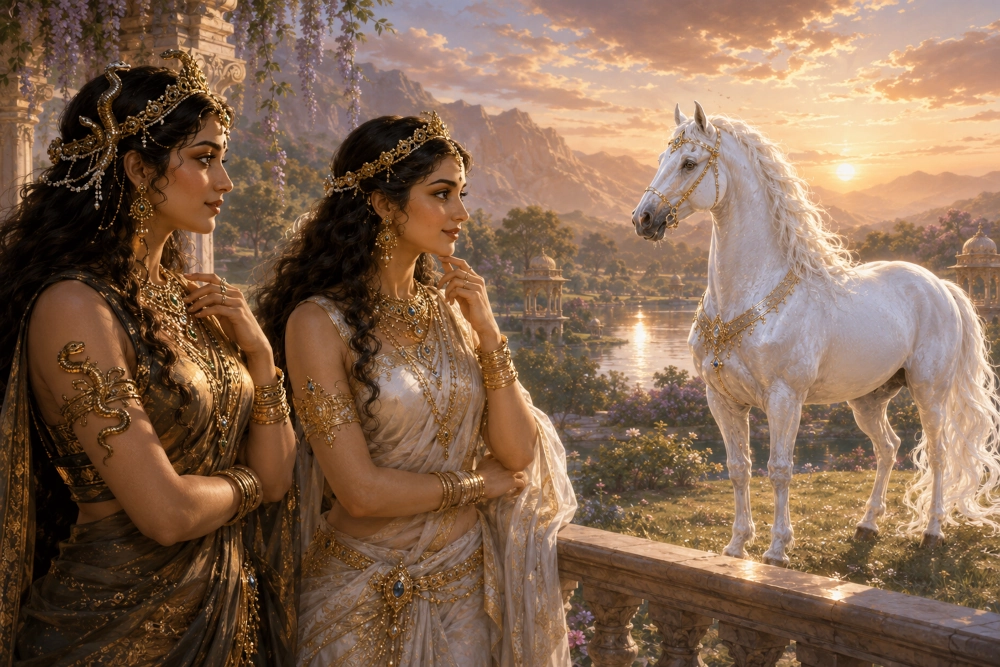
When the gods and the Asuras churned the great Ocean of Milk, the heavens witnessed wonders never before seen. The sea rose in silver mountains, clouds gathered over the horizon, and the waters glowed with the light of hidden treasures awakening from the depths.
From that radiant ocean emerged Uchchaihshravas, the celestial horse.
He was taller and more graceful than any earthly steed. His body shone like fresh moonlight, his mane flowed like a river of pearls, and every movement of his hooves seemed to awaken music in the sky. Neither dust nor darkness could cling to him. He appeared to have been shaped from the first white light of dawn.
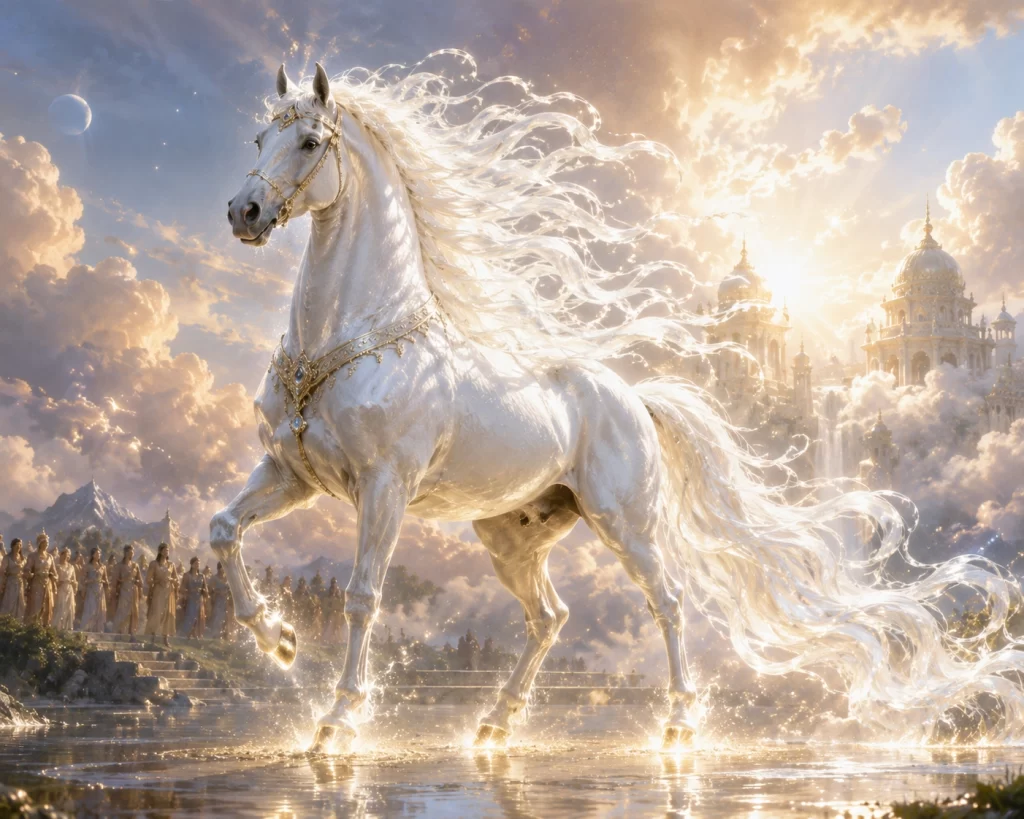
One evening, as the sun sank behind the distant mountains, the sisters Kadru and Vinata stood together upon a high terrace overlooking the celestial plains. Both were wives of the sage Kashyapa, yet their hearts were very different.
Vinata was gentle, patient and open in speech. Kadru was intelligent and strong-willed, but envy and cunning often clouded her judgement.
Far below them, Uchchaihshravas moved through the golden mist. The last rays of the setting sun fell across his magnificent body, making him appear almost transparent against the crimson sky.
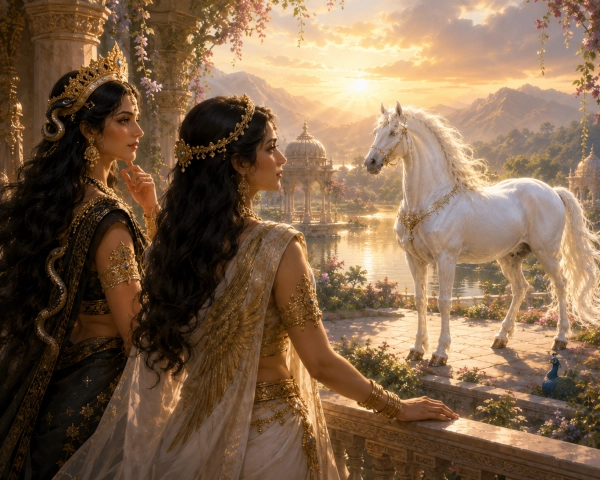
Kadru watched the horse closely.
“Sister,” she said, pointing towards him, “have you ever seen such a wondrous creature?”
“Never,” Vinata replied. “He is as pure and white as moonlight resting upon snow.”
Kadru narrowed her eyes.
“His body may be white,” she said, “but his tail is black.”
Vinata looked again. The horse was far away, and twilight had begun to soften every colour. Yet she was certain of what she had seen.
“No, Kadru. His tail is white like the rest of him.”
Kadru smiled, though there was little warmth in it.
“Then let us make a wager.”
Vinata hesitated. “What wager?”
“Tomorrow, when the sun rises, we shall go near Uchchaihshravas and examine his tail. Whoever is wrong must become the servant of the one who is right.”
The evening wind suddenly felt colder.
Vinata should have refused. Truth did not require a wager, and sisterhood should never have been placed against pride. But she trusted what her eyes had seen and believed Kadru would accept the result honourably.
“I agree,” she said.
That night, the sky darkened and the stars appeared above Kadru’s dwelling. Inside, thousands of her serpent sons rested in coiled silence, their scales glimmering beneath the lamps.
Kadru summoned them.
“My sons,” she said, “before sunrise, go to Uchchaihshravas. Make yourselves thin like strands of hair and cling to his tail. Cover its whiteness so that it appears black.”
The serpents stirred uneasily.
Some obeyed immediately, eager to please their mother. Others raised their heads in protest.
“This is deceit,” they said. “The horse’s tail is white. Why should we help you win through falsehood?”
Kadru’s face hardened. Pride had already carried her too far to turn back.
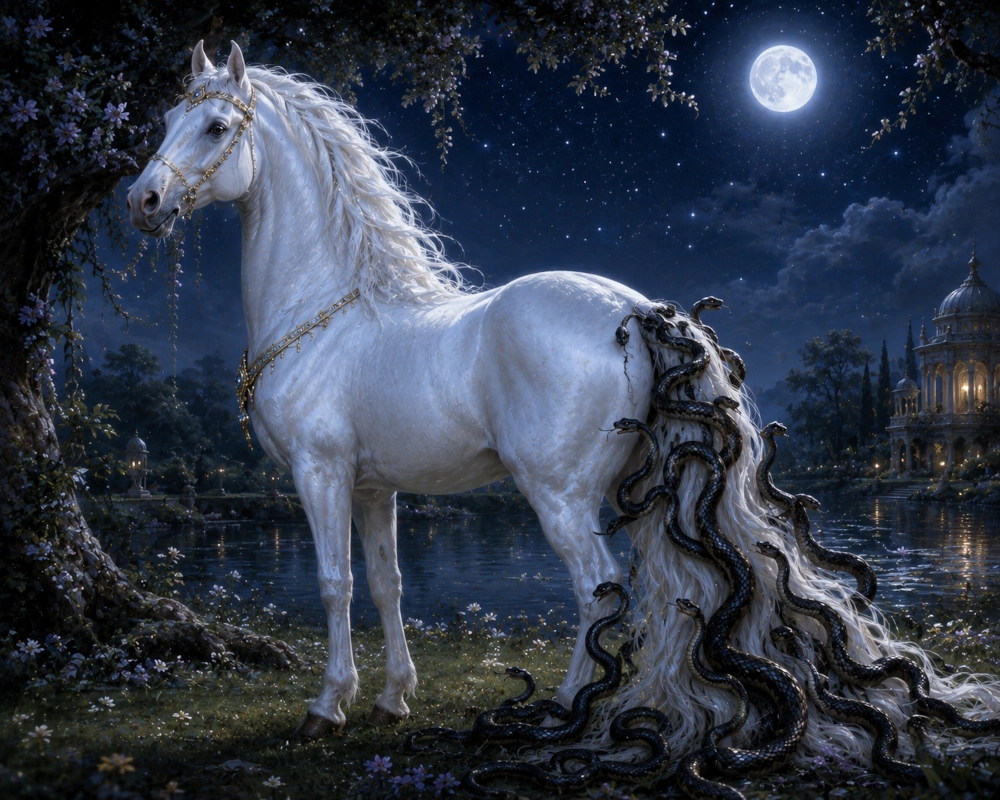
Those who resisted were cursed in her anger, while the obedient serpents slipped away into the night. Silent as shadows, they crossed the celestial plains and reached the place where Uchchaihshravas rested beneath a flowering tree.
The divine horse stood peacefully under the stars, unaware of the human passions gathering around him. The serpents climbed upon his tail and stretched themselves along its flowing hairs. Their dark bodies covered the shining whiteness until the entire tail seemed black.
At dawn, Kadru and Vinata travelled together to see the horse.
The eastern sky opened like a lotus of gold. Dew sparkled on the grass, birds sang from the branches, and Uchchaihshravas stood beside a clear lake whose waters reflected his luminous form.
Vinata smiled when she saw his white body.
But then her eyes fell upon his tail.
It was black.
For a moment she could not speak. She looked again and again, unable to understand how she could have been mistaken. The horse’s head, neck, body and legs were brilliant white, yet the long tail behind him appeared dark as a rain cloud.
Kadru turned towards her with triumph in her eyes.
“You have lost the wager, sister.”
Vinata lowered her head. She had given her word, and though the result had been obtained through deception, she did not yet know the truth.
From that day, Vinata became Kadru’s servant.
She carried out her sister’s commands and endured the pain of humiliation in silence. The open sky still stretched above her, but she no longer felt free beneath it. Each day reminded her that a single careless wager had placed her life in bondage.
Kadru had won, but her victory brought no true honour. It rested upon deception, fear and the obedience of those willing to hide the truth.
Yet destiny had not abandoned Vinata.
Her mighty son Garuda would one day rise with wings vast enough to darken the sky. For the sake of his mother’s freedom, he would challenge dangers feared by gods and serpents alike, and seek the nectar of immortality demanded as the price of her release.
Thus the false colour placed upon the tail of a celestial horse became the beginning of one of the greatest journeys in ancient tradition.
The Moral
The moral of the story is that victory gained through deceit is never a true triumph. Kadru won the wager, but she lost honour and planted the seeds of future suffering. Vinata’s mistake teaches us not to stake freedom, relationships or dignity upon pride and impulse. Truth may be hidden for a time, just as the white tail of Uchchaihshravas was concealed beneath dark serpents, but deception cannot change its real nature forever.
You may also like
-
Gnani AI Launches Nationwide Challenge Offering Up to 100 Paid AI Internships
-
NMMSS Scholarship Application Deadline Extended to October 31, 2026
-
DGCA Introduces Training Framework for Gyroplane Pilots in India
-
DRDO CASDIC Opens 30 Paid Internships for Engineering and Science Students
-
Duryodhana Wins Shalya Through Hospitality: Gifts, Obligation and Political Leverage Before the Kurukshetra War
