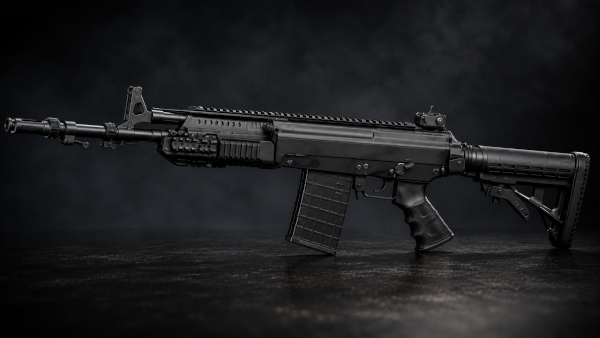
India’s indigenous small-arms ecosystem has achieved an important milestone with the UGRAM 7.62×51 mm assault rifle clearing key Army and Ministry of Home Affairs trials. Developed by the Armament Research and Development Establishment, a DRDO laboratory, in partnership with Hyderabad-based Dvipa Defence India Private Limited, UGRAM represents a major step in India’s effort to build modern infantry weapons through domestic design, private-sector manufacturing and rapid development.
The most striking feature of UGRAM’s development story is speed. The rifle was designed and built in just 100 days, making it one of India’s fastest indigenous small-arms development programmes. This rapid execution was made possible through the development-cum-production partner model, where DRDO’s design expertise and private industry’s manufacturing capability moved together from the early stage of the project.
UGRAM was formally unveiled in January 2024 as an indigenous assault rifle for the Armed Forces, paramilitary forces and state police organisations. At the time of launch, reports described it as a 7.62×51 mm calibre rifle, weighing less than four kilograms and offering an effective range of around 500 metres. The name “UGRAM” comes from Sanskrit and means ferocious, a fitting name for a weapon designed for high-intensity combat use.
The latest trial success is significant because the rifle has reportedly cleared the Indian Army’s General Staff Qualitative Requirement trials as well as Ministry of Home Affairs Board trials. GSQR trials are important because they test whether a system meets the Army’s operational and technical requirements. Reports also state that the rifle underwent extensive field evaluations across climatic conditions before reaching this stage.
UGRAM is chambered for the 7.62×51 mm NATO-standard cartridge, giving it greater range and stopping power compared with older 5.56 mm service rifles. This calibre is especially relevant for modern infantry and counter-terror operations where troops may require stronger terminal effect, better performance at distance and reliable engagement capability in varied terrain.
The rifle has been described as a modular and ergonomically designed weapon tailored for counter-insurgency and counter-terrorism operations. A PIB release on Dvipa’s UGRAM described it as a combat-ready 7.62×51 mm assault rifle designed for armed forces, paramilitary units and special forces. This gives the rifle a broad operational role across Army, Central Armed Police Forces and specialised security units.
According to technical details reported by Janes, UGRAM weighs around four kilograms, uses a 20-round magazine, can fire in single and full-auto modes, has a maximum length of about 1,000 mm, and a rate of fire of around 600 rounds per minute. The rifle is reported to use a gas-operated rotating bolt mechanism and can be fitted with iron and reflex sights.
The rifle’s under-four-kilogram weight is important for soldiers and security personnel who operate in demanding conditions. Infantry weapons must balance firepower, durability, accuracy, weight and ease of handling. A battle rifle chambered for 7.62×51 mm usually carries stronger recoil and heavier ammunition, so keeping the weapon compact and manageable is essential for field usability.
UGRAM also carries strategic importance because it is part of India’s effort to reduce dependence on imported small arms. India has historically relied on a mix of imported rifles, licensed production and domestic designs. The ageing INSAS 5.56 mm rifle, used by Indian security forces since the 1990s, has gradually needed replacement across several formations. UGRAM is being positioned as one of the domestic options in this transition toward more powerful and modern rifles.
The likely users of UGRAM include Central Armed Police Forces such as the CRPF, ITBP, SSB and NSG, according to reports. This is important because CAPFs operate in some of India’s most challenging internal security environments, including counter-insurgency zones, border areas, high-altitude regions, urban security duties and counter-terror operations. A reliable indigenous 7.62 mm rifle can strengthen their firepower while improving supply-chain independence.
The private-sector role in the programme is equally important. Dvipa Defence received its manufacturing licence in 2021 and established its facility near Hyderabad. Its partnership with ARDE shows how India’s defence ecosystem is changing. DRDO laboratories are increasingly working with private manufacturers to shorten development cycles, speed up production readiness and create equipment that can move faster from design table to trial field.
This model has wider implications for India’s defence manufacturing sector. Small arms are needed in large numbers, and India’s internal security architecture requires reliable rifles, carbines, machine guns and specialised weapons across multiple forces. If Indian private firms can build tested, user-compliant weapons at scale, the country can reduce imports, support domestic jobs, improve lifecycle support and customise weapons for Indian operational conditions.
UGRAM’s progress also fits into the larger Aatmanirbhar Bharat defence vision. A rifle may appear smaller than a missile, aircraft or warship, but for a soldier on the ground, it is the most immediate combat instrument. Indigenous development of a battle rifle strengthens the foundation of infantry modernisation, especially when combined with domestic optics, ammunition, accessories, maintenance systems and training support.
The weapon’s 100-day development timeline is also a message to the defence industry. It shows that India can move quickly when design agencies, private manufacturers and user requirements are aligned. The challenge ahead will be to convert this momentum into consistent quality, large-scale production, reliable spares, user feedback integration and long-term upgrades.
UGRAM’s success should therefore be seen as both a product milestone and an ecosystem milestone. The rifle’s clearance of key trials indicates that India’s indigenous small-arms capability is maturing. Its development in just 100 days demonstrates speed. Its 7.62×51 mm calibre gives it battlefield relevance. Its private-sector manufacturing base shows the growing role of Indian industry. Its expected use by CAPFs can strengthen internal security readiness.
As India modernises its infantry and internal security forces, UGRAM can become an important part of the country’s small-arms transformation. It is indigenous, fast-developed, trial-cleared and built around the needs of Indian forces. For a nation seeking self-reliance in defence, that makes UGRAM more than a rifle — it is a symbol of India’s growing confidence in designing and producing the weapons carried by its own soldiers.
You may also like
-
Russian Navy Delegation Visits Southern Naval Command and Indian Naval Academy
-
PRAHAAR: India’s First National Counter-Terrorism Policy and Strategy
-
Takshak Heavyweight Torpedo: How India’s Indigenous Submarine Weapon Compares With the World’s Leading Torpedoes
-
Embraer Builds Dual Aerospace Strategy in India Through C-390 Military and E175 Regional Aircraft Programmes
-
NextLeap Tests Indigenous Jet Engine for Long-Range Stryker Kamikaze UAV
