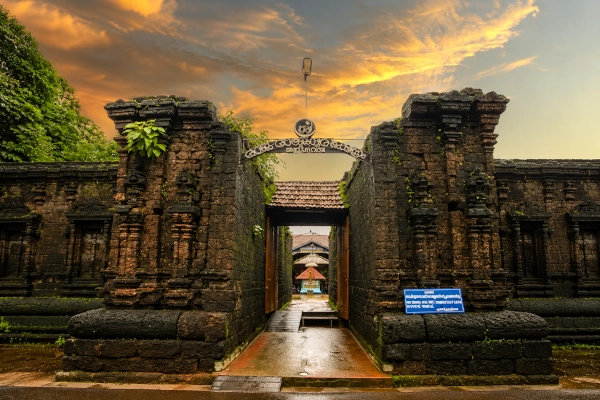
Rajarajeswara Temple at Taliparamba in Kannur district is one of the most revered Shiva temples of northern Kerala. Dedicated to Lord Shiva in the form of Rajarajeswara Perumal—the “Lord of Kings”—the temple is celebrated for its antiquity, distinctive ritual traditions, classical Kerala architecture and close association with the political and cultural history of the Malabar region. It stands about 25 kilometres from Kannur and forms part of Taliparamba’s important sacred landscape.
The shrine is traditionally counted among the 108 Shiva temples of Kerala believed to have been consecrated by Parasurama. The Taliparamba temple is also regarded in local tradition as one of the region’s most powerful centres of Shaiva worship.
Lord Rajarajeswara
The principal deity is Lord Shiva, worshipped as Rajarajeswara Perumal. The name may be understood as “the Lord of the king of kings,” expressing Shiva’s position as the supreme sovereign before whom earthly rulers themselves bowed.
Historically, the rulers of Kerala are said to have regarded Rajarajeswara as their Chakravarthi, or imperial lord. This royal association gave the temple a special status among the kingdoms and chieftaincies of northern Kerala. The temple tradition records that rulers, scholars, artists and political leaders visited Taliparamba to seek divine guidance and blessings.
The deity is represented by a Shiva linga within the sanctum sanctorum. Devotees approach Rajarajeswara as a source of authority, wisdom, protection, prosperity and fulfilment of sincere prayers.
The Legend of the Three Sacred Lingas
The temple’s traditional account begins with three sacred Shiva lingas associated with Goddess Parvati. According to the temple’s official narrative, the sage Maandhatha performed intense penance and received one of these lingas from Shiva. He was instructed to install it at a place untouched by a cremation ground.
After searching widely, Maandhatha identified Taliparamba as the sacred location and installed the linga there. The first linga later disappeared into the earth. His son Muchukunda subsequently obtained and installed a second linga, which also disappeared over time.
The third sacred linga eventually came into the possession of Satasoman, a ruler of the ancient Mushaka or Kolathunad dynasty. Acting on the guidance of Sage Agastya, the king prayed to Shiva and received the linga. Temple tradition holds that Parasurama consecrated it at the present site in a shrine constructed under Satasoman’s patronage.
These accounts belong to the temple’s sacred tradition rather than securely dated historical records, yet they remain central to the spiritual identity of Rajarajeswara Temple.
Connections With the Mushaka and Kolathunad Rulers
Taliparamba lay within the historical territory associated with the Mushaka dynasty and its later successor, the Kolathiri rulers of North Malabar. The temple’s importance grew under their patronage and became closely connected with royal authority in the region.
Later rulers, including the Zamorins of Kozhikode, are also remembered in temple tradition as devotees of Rajarajeswara. One account states that an especially devoted Zamorin entered the sanctum after years of worship and mystically merged with the deity.
The shrine therefore functioned as more than a local religious institution. It was a sacred centre where kingship, political legitimacy, scholarship and religious devotion converged.
Traditional Kerala Temple Architecture
Rajarajeswara Temple is an outstanding example of Kerala’s indigenous temple architecture. Its massive enclosure walls, broad courtyard and two-tiered sanctum give the complex a dignified and monumental character.
The sanctum sanctorum is rectangular and covered by a copper-sheeted roof. Kerala Tourism notes that the temple once possessed one of the tallest shikharas among the shrines of its period. The layered roof, timber construction, masonry walls and carefully proportioned interior spaces reflect architectural methods developed for Kerala’s heavy monsoon climate.
The temple is notable for the absence of a conventional flagstaff or kodimaram. The deity is traditionally never taken outside the temple complex in a ceremonial procession, and the temple does not follow the usual pattern of an annual flag-hoisting festival found at many other Kerala shrines.
Remnants of an older monumental entrance are still associated with the site. Temple tradition connects the destruction of the former gateway with the military campaigns of Tipu Sultan in Malabar.
The Sacred Namaskara Mandapam
A namaskara mandapam stands before the sanctum. According to local belief, Lord Rama worshipped Shiva from this platform while returning to Ayodhya after the war in Lanka.
Because of this sacred association, ordinary devotees traditionally refrain from using the mandapam for their own prostrations. The practice illustrates how legendary memory continues to shape the temple’s physical use and ritual etiquette.
Women’s Entry After the Athazha Puja
One of the temple’s most distinctive customs concerns the timing of women’s entry into the inner worship area. Women traditionally enter after the evening Athazha Puja, when Shiva is believed to be seated happily beside Goddess Parvati and especially receptive to their prayers.
Kerala Tourism lists the women’s darshan period as approximately 7:45 p.m. to 8:30 p.m., while the temple’s own information states that entry follows the Athazha Puja, which is generally held around 7 p.m. Timings can vary according to ritual requirements, and visitors should verify them before travelling.
This custom is rooted in the temple’s traditional ritual order and remains one of the most widely recognised features of Rajarajeswara worship.
Unusual Ritual Customs
Rajarajeswara Temple follows several practices that differ from those of many other Shiva temples.
Bilva leaves, commonly associated with Shiva worship, are traditionally not offered here. Instead, tulsi or holy basil is accepted, reflecting the temple’s unusual incorporation of certain Vaishnava elements into its Shaiva ritual system.
The temple also does not conduct some practices commonly seen elsewhere, and the deity is not taken beyond the temple enclosure. These distinctive observances preserve an independent ritual identity shaped by the shrine’s local traditions.
Among the well-known offerings are neyyamrithu, involving clarified butter, and neyvilakku, the lighting of ghee lamps. Devotees offer these in fulfilment of vows and in prayer for divine favour.
The Taliparamba Temple Triangle
Rajarajeswara Temple is connected with two other major shrines near Taliparamba: Trichambaram Sree Krishna Temple and Kanjirangad Vaidyanatha Temple.
A regional belief holds that worship at all three temples brings a combination of blessings. Rajarajeswara is associated with status and distinction, Krishna at Trichambaram with good character and intellectual qualities, and Vaidyanatha at Kanjirangad with health and long life.
This sacred circuit is particularly significant to families praying for the wellbeing and future of children.
Koodiyattam and Chakyar Koothu
Rajarajeswara Temple has played a major role in preserving Kerala’s classical Sanskrit theatre and temple-performance traditions. Koodiyattam and Chakyar Koothu have long been performed within the temple precincts.
Tradition holds that newly composed Koodiyattam productions were first presented before Rajarajeswara. The Mani family of Chakyars held a special hereditary connection with performances at the shrine.
The temple also conferred the prestigious Veerashringhala, or golden bracelet, on outstanding scholars and performers. The celebrated Koodiyattam master Mani Madhava Chakyar was among the distinguished artists honoured in this manner.
The shrine thus developed into an important cultural court where religious authority supported scholarship, theatre and artistic excellence.
Major Observances
The temple does not conduct a conventional annual festival centred on the raising of a ceremonial flag. Nevertheless, important Shaiva occasions are observed with considerable devotion.
Maha Shivaratri is among the most significant days at the temple. Devotees gather for special prayers, recitation, worship and cultural programmes.
Other important observances include Vishu, Karkidaka Sankramam and ritual occasions connected with the temple calendar. The exact schedule varies annually and should be confirmed with the temple administration.
Temple Timings
The temple’s official information lists the usual daily schedule as:
Morning: 5:00 a.m. to 12:00 noon
Evening: 5:00 p.m. to 8:30 p.m.
Principal rituals include the morning opening, Natravat Puja, Panthiradi Puja, Ucha Puja, evening Deeparadhana and Athazha Puja. Kerala tourism sources sometimes list opening from around 4:45 a.m., so visitors should confirm the current timing before arrival.
Traditional dress and respectful conduct are expected. Entry rules may apply according to temple custom.
How to Reach Rajarajeswara Temple
The temple is situated within Taliparamba municipality in Kannur district and is readily accessible by road.
By road: Taliparamba bus stand is approximately two kilometres from the temple. Regular buses connect Taliparamba with Kannur, Payyannur, Kasaragod and other towns of northern Kerala. Autorickshaws and taxis are available for the final journey.
By rail: Kannur Railway Station is the principal major railhead, about 24–25 kilometres away. Kannapuram and Payangadi stations may be closer for some regional services, depending on the train and route.
By air: Kannur International Airport is approximately 39 kilometres away according to the District Tourism Promotion Council. Taxis are available from the airport to Taliparamba.
Accommodation is available in Taliparamba, and the temple administration also states that a Devaswom guest house provides facilities for devotees.
A Monument of North Kerala’s Sacred Heritage
Rajarajeswara Temple is one of the defining spiritual institutions of North Malabar. Its importance comes from the combined force of ancient legend, royal patronage, exceptional ritual customs, classical architecture and support for Kerala’s performing arts.
The absence of a flagstaff, the evening entry tradition for women, the offering of tulsi in place of bilva leaves and the temple’s historic role in honouring scholars and artists all distinguish it from other major Shiva shrines.
For devotees, Rajarajeswara remains the supreme Lord of Taliparamba. For visitors interested in Kerala’s heritage, the temple offers a powerful insight into the region’s distinctive synthesis of kingship, faith, architecture and living tradition.
Reference
- Kerala Tourism, Government of Kerala.
“Rajarajeswara Temple, Taliparamba.”
https://www.keralatourism.org/temples/kannur/raja-rajeswara-taliparamba - Kerala Tourism, Government of Kerala.
“Rajarajeshwara Temple at Taliparamba in Kannur.”
https://www.keralatourism.org/malabar/rajarajeshwara-temple/134 - District Tourism Promotion Council, Kannur.
“Taliparamba Rajarajeswara Temple.”
https://www.dtpckannur.com/destination/taliparamba-rajarajeswara-temple - Sree Rajarajeswara Temple, Taliparamba.
“About Us.”
https://rajarajeswaratemple.com/about-us/ - Sree Rajarajeswara Temple, Taliparamba.
Official Website.
https://rajarajeswaratemple.com/ - Sree Rajarajeswara Temple, Taliparamba.
“Contact Us.”
https://rajarajeswaratemple.com/contact-us/ - Sree Rajarajeswara Temple, Taliparamba.
“Facilities.”
https://rajarajeswaratemple.com/facilities/
You may also like
-
Samatata — The Low-Lying Deltaic Realm of Southeastern Bengal
-
Tamralipta — The Maritime Gateway of the Lower Ganga
-
Suhma — The River-and-Forest Country of Southwestern Bengal
-
Gauda — The Western Bengal Country of the Bhagirathi and the Rise of Karnasuvarna
-
Pundra — The Northern Bengal Kingdom of the Karatoya and the Ancient City of Pundranagara
