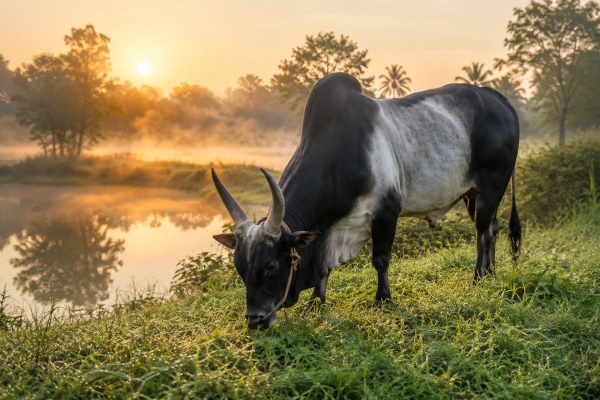
The Kangayam is one of Tamil Nadu’s most celebrated indigenous cattle breeds—a compact, muscular and remarkably hardy animal shaped by the hot, semi-arid landscape of the Kongu region.
Traditionally raised for ploughing, carting and transporting agricultural produce, Kangayam bullocks earned a reputation for endurance, sure-footed movement and the ability to work for long hours under difficult conditions. The breed is officially recognised by the ICAR–National Bureau of Animal Genetic Resources, with Tamil Nadu recorded as its home state.
Although tractors and motor vehicles have reduced the everyday use of draught cattle, Kangayam animals continue to hold agricultural, genetic and cultural importance. Their ability to survive on relatively modest feed, tolerate heat and remain useful over a long working life makes them particularly valuable in an era of climate uncertainty and rising livestock-production costs.
Origin in the Kongu Region
The breed takes its name from Kangayam taluk in Tiruppur district, which lies within the historic Kongu region of western Tamil Nadu. Its traditional breeding tract extends across parts of Tiruppur, Erode, Coimbatore, Karur, Dindigul and neighbouring districts.
Local selection over generations produced cattle suited to the region’s dry climate, limited rainfall, hard soils and livestock-based farming system.
Historical accounts credit N. Nallathambi Sarkarai Manradiar, the Pattagar of Palayakottai, and his family with systematically improving and stabilising the breed through selective breeding. Research on the history of the Kangayam pastoral system similarly associates its organised development with the Palayakottai Pattagar family during the nineteenth century, although Kangayam-type cattle appear to have existed before that organised breeding effort.
The objective of selection was practical rather than ornamental. Farmers wanted animals capable of pulling heavy carts, ploughing dry and compact soils, travelling long distances and surviving in a region where fodder and water could become scarce.
A Distinctive and Powerful Appearance
Kangayam cattle are generally medium-sized, with compact bodies, broad chests, strong limbs and hard black hooves.
Calves are usually reddish at birth. Their coat begins changing after two or three months and generally becomes grey by around six months of age.
Adult bulls are commonly grey, with darker grey or black shading over the head, neck, shoulders, hump and hindquarters. Cows tend to be lighter grey or white-grey, often with darker markings around the legs.
The head is proportionate and relatively short, with a broad forehead and prominent dark eyes surrounded by noticeable black rings. The muzzle is normally black.
One of the breed’s most recognisable features is its pair of long, strong horns. The horns extend outwards and backwards before turning upwards and inwards, sometimes approaching one another near the tips and creating a crescent or elliptical shape.
The neck is short and thick, while the chest is deep and wide. Bulls possess a well-developed hump, and the body is supported by medium-length, sturdy legs. The compact barrel, broad loins and muscular thighs reflect a breed selected primarily for physical work rather than very high milk production.
Superior Draught Ability
Kangayam cattle are classified principally as a draught breed, although cows also provide milk for household consumption.
Bullocks were historically used for nearly every major agricultural operation in their native tract. These included ploughing, land preparation, lifting water, transporting crops and pulling carts carrying sugarcane, grain and other produce.
TANUVAS describes Kangayam cattle as especially valued for superior draught qualities, adaptation to poor nutrition and longevity. Bullocks were used both for agricultural work and for transporting produce over considerable distances.
Their value lies not simply in maximum pulling force. An effective draught animal must combine strength with stamina, balance, discipline and efficient movement.
Kangayam bullocks are known for maintaining a steady pace while pulling carts and working in high temperatures. Their compact build and strong hooves help them operate over dry, uneven and hard surfaces.
Genetic research describing the legacy of South Indian draught breeds has characterised Kangayam cattle as powerful and sturdy, with an estimated work output of about 0.8 horsepower per pair of bullocks in referenced draught studies.
Adapted to Dry and Hot Conditions
The home tract of the breed experiences a generally hot climate and comparatively low rainfall. Official district information describes average annual rainfall in the traditional tract at around 650 millimetres, with much of it received during the monsoon months.
Kangayam cattle developed within this water-limited environment.
Their most important adaptations include:
- Capacity to remain productive under relatively poor feeding conditions
- Ability to graze dry pasture and utilise crop residues
- Tolerance of high temperatures
- Strong feet suited to hard ground
- Moderate maintenance requirements
- Long working life
A 2026 study comparing Kangayam and Jersey cattle under thermal stress examined cellular and immune responses associated with the indigenous breed’s heat resilience, reflecting growing scientific interest in the physiological mechanisms behind its adaptation.
Such traits are increasingly important as livestock systems face more frequent heat waves, irregular rainfall and rising expenditure on concentrated feed.
High-output exotic dairy cattle may perform well under intensive management but can require carefully controlled housing, nutrition, cooling and veterinary support. A breed such as Kangayam offers a different form of productivity—lower dependence on external inputs and greater ability to remain functional under challenging local conditions.
The Korangadu Pasture System
The history of Kangayam cattle is closely linked with the traditional Korangadu pasture system of western Tamil Nadu.
Korangadu is a privately managed dryland grazing system developed in semi-arid areas where conventional crop cultivation is difficult. These enclosed pasturelands combine grasses, fodder trees and thorny live fencing.
Three plants are particularly associated with the system:
- Kolukattai grass, generally belonging to the Cenchrus group
- Velvel, or Acacia leucophloea, which provides shade, pods and fodder
- Kiluvai or Mullu Kiluvai, identified as Commiphora berryi, used as a living fence
The live fence helps contain grazing animals, while grasses and trees supply forage during different periods of the year.
Korangadu represents more than a cattle-feeding arrangement. It is a complete dryland land-use system developed by farmers to combine pasture, livestock, soil protection and household income.
Studies of the Kangayam grassland describe it as a long-established form of sedentary pastoralism that helped farming communities cope with recurring drought. During favourable months, cattle graze within the enclosed pasture. Crop residues, stored fodder, bran and tree material are used during the lean summer period.
The Kangayam breed and Korangadu system evolved together. The pasture produced animals capable of surviving on dryland forage, while the cattle provided manure, draught power, calves and income that helped maintain the pasture.
The decline of either component threatens the other. When pasture is converted into buildings, industrial land or intensive crops, keeping Kangayam herds becomes more expensive. When cattle numbers decline, farmers may have less economic incentive to preserve Korangadu land.
Milk Production
Kangayam cows are not specialised high-yield dairy animals. Traditionally, they were maintained mainly to produce strong male calves that could be trained as draught bullocks.
Milk was often retained for the calf and the farming household rather than sold commercially. The udder is comparatively small, reflecting the breed’s selection for work rather than intensive milk production.
Nevertheless, Kangayam milk can make a meaningful contribution to household nutrition.
A field study of 60 Kangayam cattle owners in Karur district recorded lactation yields ranging from 342 to 1,455 litres. Because calves and farmers shared the milk, the measurements represented partial milk yield rather than the cow’s entire production.
The study recorded daily partial yields of approximately 3.8 litres in the first month and 4.1 litres in the second month, with production remaining around 3.9 litres during much of the first six months. Average milk fat was approximately 3.9%, while solids-not-fat averaged about 8.2%.
These figures show that individual performance can differ substantially depending on genetics, nutrition, lactation stage and management.
The breed’s economic value should therefore not be assessed solely by comparing its milk volume with specialised dairy cattle. Kangayam cows historically supported a broader farming system by producing calves, milk, manure and future working animals while surviving under relatively low-input conditions.
Reproductive and Calf Characteristics
A seven-year study conducted at the Kangayam Cattle Research Station in Sathyamangalam evaluated reproductive and neonatal characteristics in cows maintained under semi-intensive conditions.
The study reported an average gestation period of approximately 290 days and a mean calf birth weight of about 21 kilograms. The observed calves stood within roughly 15 to 60 minutes after birth, while the average time before beginning colostrum suckling was about 51 minutes.
Such baseline information is valuable for improving calving supervision, calf survival and management of conservation herds.
Maintaining reproductive performance is especially important in native breeds with reduced population numbers. Every healthy calf contributes to the continuation of a genetic line that may possess useful traits for heat tolerance, draught ability and adaptation to dry environments.
Role in Rural Life
For generations, Kangayam cattle formed part of the working capital of Kongu farming households.
A well-trained pair of bullocks could cultivate fields, transport produce and be sold when the farmer required money. Cows produced replacement animals, while dung supported soil fertility and could be used as household fuel.
Cattle fairs and weekly livestock markets became important centres of trade. Buyers traditionally examined body structure, hooves, horns, temperament, age and the position of hair whorls before purchasing an animal.
Kangayam bulls and bullocks also became associated with Rekla cart races and other traditional cattle events. Scientific studies of Tamil Nadu sporting cattle have included Kangayam bulls alongside Pulikulam and Umblachery animals, and recent research describes the breed’s continuing cultural importance in regional sporting traditions.
These activities help maintain public interest in the breed, but conservation cannot depend entirely on ceremonial or sporting value. A sustainable future requires economically useful roles for cows, calves and breeding herds as well.
Decline Following Agricultural Mechanisation
The spread of tractors, power tillers, lorries and motorised pumps sharply reduced demand for working bullocks.
Maintaining a bullock until it reaches full working age requires land, fodder, labour and veterinary care. When the same work can be completed rapidly by a rented tractor, farmers may find it difficult to justify keeping draught animals throughout the year.
Changes in land use have added further pressure. Industrialisation and urban expansion in western Tamil Nadu have reduced grazing areas, while fragmentation of farms has weakened traditional herd-management systems.
TANUVAS records a significant historical decline in the breed’s population. Official estimates cited by the university indicate a fall from approximately 11.74 lakh animals in 1990 to about 4.44 lakh in 2000.
A 2012 breed survey estimated 1,93,445 Kangayam-type animals, of which around 80,620 were classified as pure Kangayam and the remainder as graded animals. These figures are dated estimates rather than a current population count, but they illustrate the scale of the conservation concern that led to formal intervention.
Conservation and Scientific Breeding
The Government of Tamil Nadu established the Kangayam Cattle Research Station at Sathyamangalam under TANUVAS in 2017.
The station’s objectives include maintaining a nucleus herd, conserving the breed, supplying Kangayam calves to farmers and conducting research aimed at improving its productivity and management.
Conservation is being pursued through both living herds and stored genetic material.
ICAR–NBAGR lists Kangayam among the cattle breeds represented through cryopreserved semen in the National Livestock Gene Bank. TANUVAS has also reported ex-situ conservation, molecular characterisation and DNA-repository work involving Kangayam and other Tamil Nadu livestock breeds.
These methods serve complementary purposes.
In-situ conservation keeps animals within their traditional farming environment, allowing the breed to continue adapting through natural and farmer-guided selection.
Ex-situ conservation preserves semen, embryos or DNA outside the live population, providing genetic insurance against severe population loss.
The strongest strategy combines both approaches while ensuring that farmers receive practical benefits from maintaining purebred animals.
New Economic Roles for Kangayam Cattle
The survival of the breed will depend on making Kangayam husbandry economically relevant to present-day farmers.
Possible opportunities include:
- Certified breeding-stock production
- Conservation-linked pasture farming
- Organic and low-input agriculture
- Farm tourism and breed exhibitions
- Selective use of bullocks on small and specialised farms
- Scientific marketing of milk and dung-based products
- Payments or incentives for maintaining indigenous genetic resources
Care is required when promoting commercial claims concerning indigenous cattle products. The breed’s genuine strengths—hardiness, draught ability, adaptation and cultural importance—are sufficient reasons for conservation without relying on exaggerated or scientifically unsupported health claims.
The most durable conservation model will reward farmers for preserving pure bloodlines, maintaining healthy animals and protecting the Korangadu landscape.
Importance in a Changing Climate
Modern livestock breeding has often prioritised maximum production under favourable conditions. Climate change is increasing the value of a different set of traits: heat tolerance, disease resilience, efficient use of poor-quality feed and the ability to remain productive during environmental stress.
Kangayam cattle represent generations of adaptation to precisely these conditions.
They may not match specialised dairy breeds in milk volume, but they possess a combination of strength, survival ability and relatively low-input management that could prove increasingly useful.
Native breeds also contain genetic variation that cannot easily be recreated once lost. Preserving Kangayam cattle safeguards biological options for future breeding and research.
Conclusion
Kangayam cattle are a living product of Tamil Nadu’s dryland ecology, agricultural knowledge and selective breeding traditions.
Their compact bodies, strong legs, hard hooves and muscular frames made them dependable partners in ploughing and transport. Their capacity to endure heat, limited rainfall and modest nutrition allowed farming communities to maintain livestock in landscapes where more demanding animals could struggle.
The breed’s decline reflects the transformation of rural India from animal-powered agriculture to mechanised farming. Yet the qualities that once made Kangayam cattle indispensable have not lost their value.
As India confronts climate stress, shrinking pasture, rising input costs and erosion of livestock diversity, the Kangayam offers an important lesson: agricultural productivity is not measured only by maximum output. It is also measured by endurance, adaptability and the ability to remain useful in the environment where an animal was developed.
Conserving the Kangayam therefore means protecting more than a cattle breed. It means preserving Tamil Nadu’s pastoral heritage, the Korangadu dryland system and a valuable genetic resource created through generations of knowledge and careful selection.
References
ICAR–National Bureau of Animal Genetic Resources
Official listing of Kangayam among India’s recognised cattle breeds and the National Livestock Gene Bank.
Tamil Nadu Veterinary and Animal Sciences University
Kangayam Cattle Research Station, Sathyamangalam: breed status, draught qualities and conservation programme.
Tiruppur District Administration, Government of Tamil Nadu
Official breed history, physical characteristics, climate, management and traditional uses of Kangayam cattle.
The Indian Journal of Animal Sciences
“Productivity Performance of Kangayam Cattle.”
The Indian Journal of Animal Sciences
“Peripartum and Postpartum Reproductive and Neonatal Traits of Kangayam Cattle.”
Pastoralism
“Evolution of Sedentary Pastoralism in South India: Case Study of the Kangayam Grassland.”
PLOS ONE
“Legacy of Draught Cattle Breeds of South India: Insights into Population Structure, Genetic Admixture and Maternal Origin.”
You may also like
-
ZSI Scientists Identify New Fish Species Bathymyrus perplexus From the Bay of Bengal
-
Rare Afro-Asian Sand Snake Rediscovered in Kutch After More Than 150 Years
-
Indravati Tiger Reserve to Reopen for Wildlife Safaris After Four Decades
-
Tiny 3.3-mm Parasitic Wasp Discovered in Assam Marks First Record of Its Genus in India
-
How India Brought the Greater One-Horned Rhinoceros Back From the Brink
