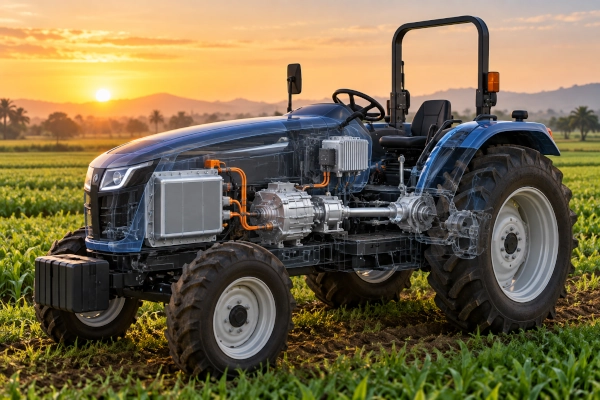
Bengaluru-based Mecwin Technologies has developed an indigenous electric powertrain for tractors in the 40–55 HP category, taking an important step toward electrifying one of the most widely used classes of agricultural machinery in India.
Developed over roughly three years, the new system is built around a 30-kW-class electric drive operating at approximately 400 volts. Mecwin says the platform has already completed more than 500 hours of field testing and is now being offered to tractor manufacturers for integration into their own vehicles rather than being launched as a complete Mecwin-branded tractor.
This approach makes the development particularly interesting from a manufacturing perspective. Mecwin is positioning itself as a supplier of the complete propulsion architecture that an established tractor OEM could adapt to an existing or newly designed electric vehicle.
The current platform combines the electric motor with an eight-forward and four-reverse multi-speed transmission, differential, final drive, driven rear axle, motor controller and CAN-based vehicle-control interfaces. Mecwin can modify several elements, including the final-drive ratio, packaging, software calibration and interfaces for the tractor’s power take-off and hydraulic systems.
That is important because electrifying a tractor presents a different engineering problem from electrifying a passenger car.
Agricultural tractors spend long periods operating at relatively low speeds while producing large amounts of torque. Their workload can change dramatically depending on whether they are ploughing hard soil, pulling a trailer, operating a rotavator or powering equipment through the PTO. Wheel slip, soil condition, implement resistance and operating speed can all affect the power required from the drivetrain.
Mecwin says it therefore begins powertrain development at what it calls the tyre-soil interface. Engineers calculate factors such as tractive force, wheel torque, implement resistance, ground speed and expected wheel slip before defining the motor’s torque-speed characteristics, transmission ratios, inverter loading and thermal-management requirements.
This system-level approach also explains why the platform is described as belonging to the 45-HP class even though its electric motor is rated at around 30 kW. Tractor classifications developed around diesel-engine horsepower do not translate directly into electric motor nameplate ratings because usable wheel torque, transmission ratios, operating duty cycle and electric-motor torque characteristics all influence actual field performance.
The eight-forward/four-reverse transmission gives Mecwin another tool for matching the electric motor to agricultural tasks. Electric motors provide strong torque from low rotational speeds, but a multi-speed drivetrain can keep the motor closer to an efficient operating range while supplying the very different wheel speeds required for field work, transport and implement operation.
According to Mecwin, the powertrain will not be sold as a universal one-size-fits-all package. Instead, it can be adapted around an OEM’s tractor chassis, tyre dimensions, implements, working speeds and intended duty cycle.
The next stage is therefore expected to involve direct cooperation with tractor manufacturers. Mecwin envisages a process beginning with vehicle definition and simulation, followed by packaging, prototype integration, calibration, field validation and eventually production industrialisation.
This supplier-led strategy could lower one of the barriers facing established tractor manufacturers considering electric models. Rather than developing every propulsion component internally, an OEM could integrate a pre-engineered electric drivetrain while retaining its own chassis, hydraulics, implements, cabin and vehicle architecture.
Mecwin already has an industrial base supporting such work. The company operates manufacturing facilities in Bengaluru North, where its activities include assembly and manufacturing of EV motors and industrial motors, alongside separate capabilities in aerospace and defence motors and new-product development.
Its wider portfolio includes electric motors, controllers and power-electronics systems, giving it experience across several of the technologies needed to build an integrated electric agricultural drivetrain.
Electric tractors potentially offer several advantages in Indian farming. Electric motors produce high torque from very low speeds, have fewer moving parts than diesel engines and eliminate tailpipe emissions during operation. They can also reduce dependence on diesel where reliable and economical electricity or renewable-energy charging is available.
However, agricultural electrification also creates difficult engineering and economic challenges.
Battery capacity must be sufficient for long working periods without making the tractor excessively heavy or expensive. Charging infrastructure may be limited in rural areas, while intensive operations such as deep tillage can demand high continuous power. Batteries, inverters and motors must also survive dust, water, vibration, high ambient temperatures and repeated mechanical shocks.
For this reason, 500-plus hours of field operation is an important milestone for the Mecwin programme. It indicates that the drivetrain has moved beyond a laboratory or demonstration prototype and is being evaluated under practical operating conditions. It does not by itself represent certification for mass production, and Mecwin still needs OEM-level prototype integration, extended validation and industrialisation before tractors using the system can enter large-scale manufacture.
The company has also not yet disclosed the battery capacity, charging time, operating duration per charge, maximum drawbar performance or final production cost of a tractor equipped with the system. Those figures will ultimately determine whether an electric machine can compete economically with diesel tractors in demanding agricultural applications.
The most significant aspect of the development is therefore not that Mecwin has created another electric vehicle prototype. It has developed an Indian electric tractor propulsion system intended to become a component platform for multiple tractor manufacturers.
After three years of engineering and more than 500 hours in the field, thIf an established OEM adopts the technology, the 30-kW platform could provide a route for bringing electric propulsion into India’s large 40–55 HP tractor segment without requiring Mecwin itself to become a tractor manufacturer.e programme is now approaching its more important test: converting a working indigenous powertrain into an OEM-integrated, production-ready electric tractor.
That could make Mecwin’s Bengaluru-developed system an important building block in the gradual electrification of Indian agricultural machinery.
You may also like
-
Mankind Pharma to Acquire 70% Stake in Belgian CAR-T Cancer Therapy Developer for €48 Million
-
India Ranks Third Globally in Contracted Clean Hydrogen Volumes, Secures 3 Lakh Tonnes Annually
-
Government Finalises Airfare Pricing Rules to Protect Passengers from Excessive Ticket Charges
-
India’s Inland Waterway Cargo Movement Reaches 218 Million Tonnes, Surpasses 2030 Target Four Years Early
-
SberIndia Partners with Space 1 to Develop Russian-Indian Cooperation Center in New Delhi
