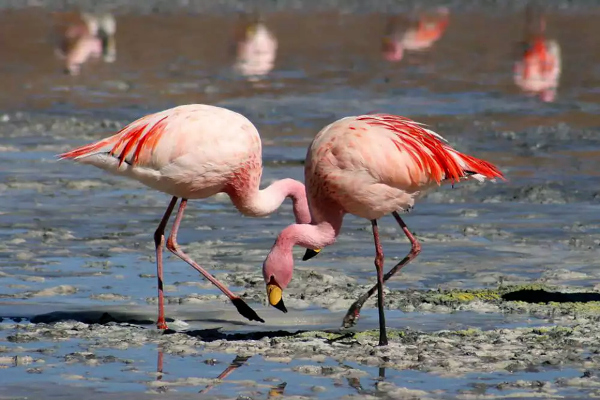
Tamil Nadu’s southern coast has begun welcoming one of its most spectacular seasonal visitors, with thousands of flamingos gathering across the salt pans along Thoothukudi’s East Coast Road as the annual migratory-bird season gets underway.
The large flocks have spread across the shallow saltwater reservoirs and evaporation ponds that form part of Thoothukudi’s extensive salt-producing landscape. Their arrival has transformed sections of the otherwise pale coastal terrain into stretches of pink, drawing birdwatchers, photographers and local residents to the area. The latest sightings were reported on September 4, 2026.
Thoothukudi’s salt pans are more than industrial landscapes. Their shallow saline waters can provide productive feeding and resting habitat for waterbirds. The combination of open water, exposed mud, microorganisms and other aquatic food resources creates conditions that attract flamingos and numerous smaller migratory species during their seasonal movements.
Tamil Nadu’s official wetland records include the Greater Flamingo (Phoenicopterus roseus) among the state’s wetland birds. The latest field reports from Thoothukudi, however, describe the arriving birds simply as flamingos and do not provide a species-by-species count of the present flock. No precise census figure beyond “thousands” has yet been released for this particular arrival.
The flamingo spectacle is only one part of a wider migration now unfolding across Thoothukudi district. Nearby Perungulam wetland has also begun receiving substantial numbers of migratory waterbirds unusually early in the season. Birds have reportedly been appearing since around mid-August, including godwits, sand plovers, common sandpipers and wood sandpipers, along with other small waders.
Bird researcher Thomas Mathibalan, who has studied the wetland extensively, says Perungulam differs from many other Tamil Nadu water bodies because its active bird season begins much earlier. While many wetlands see migration intensify around October, Perungulam starts attracting significant numbers from around July, making the July–October period particularly important for the site.
Its present importance has been amplified by local water conditions. Several surrounding tanks have dried considerably, while Perungulam continues to retain water. This has effectively turned it into a refuge, concentrating birds that would otherwise be distributed across a much wider network of wetlands in Thoothukudi and neighbouring districts.
Perungulam’s ecological importance is also supported by recent scientific work. A 2026 study specifically examined the wetland’s seasonal bird diversity and conservation significance after conducting observations from July 2023 to June 2024, highlighting the value of such unprotected wetlands for sustaining avian biodiversity.
Yet the early influx of birds has also drawn attention to problems around the wetland.
Researchers have raised concerns about deterioration of the shoreline and feeding edges at Perungulam. Small wading birds depend heavily on shallow margins and exposed wet sediment where they can probe for insects, worms, molluscs and other food. Damage to these gently sloping banks can therefore reduce the amount of usable feeding habitat even when plenty of water remains in the wetland.
Mathibalan has consequently called for greater government attention to Perungulam, while conservationists have also highlighted threats including pollution, encroachment and disturbance. Protecting the water body itself without maintaining its shoreline, vegetation and shallow feeding zones would leave only part of the habitat intact.
The situation illustrates why apparen52tly ordinary salt pans, tanks and seasonal wetlands can be as important for migratory birds as formally protected sanctuaries. Tamil Nadu contains an extensive mosaic of such habitats. State Wetlands Authority data record 47 salt-pan wetland complexes covering about 22,889 hectares, alongside thousands of tanks, ponds, lagoons, mudflats, marshes and other wetlands.
Thoothukudi is particularly valuable because coastal salt pans and inland freshwater or brackish wetlands occur relatively close together. Migratory birds can therefore use different habitats according to their feeding requirements, water conditions and stage of migration.
The flamingos make this ecological network highly visible. Their size, colour and tendency to gather in large flocks naturally attract attention, but the same landscape also supports much smaller birds whose arrival can easily go unnoticed. Sandpipers, plovers and godwits may depend even more heavily on narrow strips of undisturbed shoreline and shallow water.
That makes this year’s migration both a spectacle and a conservation reminder. Thousands of flamingos returning to Thoothukudi demonstrate that the district’s salt pans remain capable of supporting major concentrations of migratory wildlife, while the simultaneous pressure on Perungulam shows how quickly suitable habitat can become concentrated when other wetlands lose water or deteriorate.
For now, the arrival has once again painted the Thoothukudi salt pans pink. But preserving that annual scene will depend not only on protecting the flamingos themselves, but also on safeguarding the interconnected salt pans, tanks, shorelines and wetlands that allow an entire community of migratory birds to rest and feed along Tamil Nadu’s southern coast.
You may also like
-
Himachal Pradesh Achieves Major Success in Rare Cheer Pheasant Conservation
-
Blackbucks to Return to Chhattisgarh’s Gomarda Wildlife Sanctuary After Five Decades
-
Asiatic Lions Return to Barda Wildlife Sanctuary After 144 Years as Scientific Study Confirms Habitat’s Conservation Potential
-
India’s Ramsar Sites Reach 103 as Sukhna Wetland and Sauj Jheel Receive International Recognition
-
India Expands Global Big Cat Conservation as International Big Cat Alliance Opens New Headquarters
