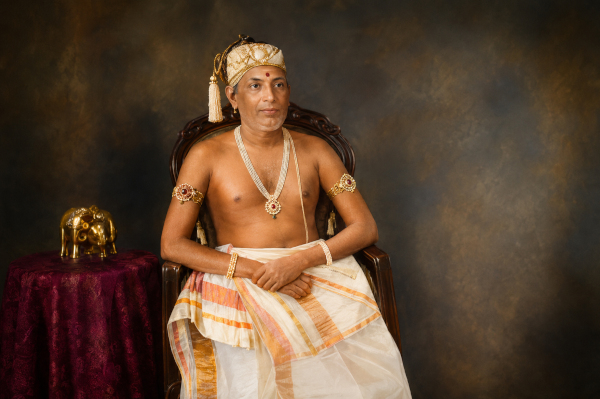
Kerala Varma V, also known as Veera Kerala Varma, belongs to that phase of Kochi history when kingship had begun to change under the pressure of colonial administration. The old world of temple authority, royal ritual, palace influence and regional diplomacy still existed, but it now operated within the framework of British paramountcy, resident supervision and modern bureaucratic systems. Kerala Varma V ruled from 1888 to 1895, a short reign of seven years, yet his life reflects an important transition in the Kingdom of Kochi: the movement from personal kingship to structured administration.
He came to the throne after the long reign of his elder brother Rama Varma XIV, who ruled from 1864 to 1888. Even before Kerala Varma V became the ruler, he had already gained experience in matters of governance. His elder brother suffered from physical disabilities, and this allowed Kerala Varma, as Elaya Raja, to participate in decision-making. This early exposure made him familiar with the demands of statecraft before he formally ascended the throne. It also gave him an administrative identity rather than merely a ceremonial one.
Kerala Varma V was educated and proficient in English, which was significant in the political climate of nineteenth-century Kochi. A ruler under British influence needed more than traditional legitimacy. He needed the ability to understand colonial correspondence, communicate with officials, follow institutional procedure and work through a growing administrative machinery. English education gave Kerala Varma V a practical advantage in dealing with the British authorities and the modern departments of the state.
The British regarded him with esteem and honoured him with the title KCIE while he was still Elaya Raja. This recognition shows that he was viewed as a capable and reliable figure within the princely-state system. Such honours were part of the colonial order, but they also reflected the political value of a ruler who could maintain stability, cooperate with administrative structures and preserve the dignity of the state while working under imperial constraints.
His reign came during a period when the Dewan had become central to the functioning of Kochi. The Maharaja remained the symbolic and sovereign head of the state, but day-to-day administration increasingly depended on trained officials, revenue systems, legal departments and bureaucratic decision-making. During Kerala Varma V’s reign, Dewan Govinda Menon retired. Thiruvenkitachariar then served as Dewan for three years, followed by Subramaniya Pillai. This sequence shows the growing importance of professional administrators in the governance of Kochi.
Kerala Varma V’s period should be understood as one of continuity rather than dramatic conquest or expansion. The great era of Sakthan Thampuran had already shaped Kochi’s internal strength and urban development. The later nineteenth century was about consolidation, administrative discipline and adaptation to colonial systems. Kerala Varma V inherited a state that had already passed through Dutch influence, British protectorate arrangements and bureaucratic reform. His role was to keep the machinery stable during a delicate time.
The Kochi of his time was no longer a small coastal principality surviving through old alliances alone. It was a princely state connected to wider trade, colonial law, education, revenue administration and public institutions. Ernakulam, Thrippunithura, Mattancherry and Fort Kochi were part of a changing political and economic landscape. The court had to balance royal tradition with modern administration. Kerala Varma V stood at the centre of this balancing act.
His reign also represents the changing nature of authority in Kerala’s princely states. Earlier kings were remembered for battles, alliances, temple patronage, punishments, palace intrigues or territorial struggles. Nineteenth-century rulers were increasingly judged by their ability to maintain order, support reform, manage officials and respond to colonial expectations. Kerala Varma V belonged to this second category. His importance lies in administration, continuity and adjustment.
The presence of experienced Dewans during his reign helped preserve institutional stability. Govinda Menon had continued the reformist administrative tradition of his family, while later Dewans carried forward the professionalisation of the state. Kerala Varma V’s rule therefore functioned within a partnership between palace authority and bureaucratic execution. This was the model through which many princely states survived during the colonial period.
His personal character appears to have been marked by education, moderation and official respectability. He was not remembered as a warrior-king or a flamboyant ruler. He was remembered as a ruler who understood administration and had already taken part in governance before occupying the throne. In history, such rulers are often overshadowed by more dramatic figures, yet their role is important. They keep institutions steady between major phases of reform.
Kerala Varma V also made a tour of India in 1895. This journey is meaningful because it suggests curiosity about the wider subcontinent at a time when Indian princely states were increasingly observing one another’s systems, public works, education models and administrative practices. Travel allowed rulers and officials to see how other regions were responding to modernity, British pressure and public demands. Soon after his return, however, he fell ill and never recovered.
He died in 1895 in the Malayalam month of Chingam, which gave him the remembered name Chingamasathil Theeppetta Thampuran. In Kerala’s royal memory, such names often preserved the month, place or circumstance of a ruler’s death. They became part of oral history and family tradition, linking the ruler to the cultural memory of the people.
The legacy of Kerala Varma V lies in the quiet administrative transition of Kochi. He ruled during a period when the state was becoming more bureaucratic, more legally structured and more connected to modern institutions. His reign did not produce a single dramatic monument that dominates public memory, but it formed part of the slow transformation that prepared Kochi for the reforms of the late nineteenth and early twentieth centuries.
After him came Rama Varma XV, popularly known as Rajarshi, under whom railways, revenue reforms and other major developments gained prominence. Kerala Varma V therefore stands at the doorway between two moments: the consolidation of nineteenth-century administration and the more visible modernisation that followed. His reign helped maintain the stability needed for later reforms to take shape.
Kerala Varma V deserves to be remembered as a ruler of transition. He carried the dignity of the old Kochi throne while working within the realities of colonial administration. He understood governance before becoming king, earned the respect of British authorities, worked through capable Dewans and kept the state steady during a changing age. His story reminds us that history is shaped not only by conquerors and reformers, but also by rulers who preserve order, absorb change and pass a functioning state to the next generation.
You may also like
-
Yavana in the Mahabharata: Greek Connections, Pandava Campaigns and the Warriors of Kurukshetra
-
India and Sri Lanka Launch SAMHiTA Manuscript Digitisation Project to Preserve Ancient Buddhist Heritage
-
ASI Uses Ground-Penetrating Radar to Investigate Ancient Buddhist Stupa at Ujjain After Nearly 90 Years
-
Pahlava: The Parthian World Beyond India’s Northwestern Frontiers in the Mahabharata
-
Namami Gange in 2026: 368 Projects Completed, 4,339 MLD Sewage Treatment Capacity Created as Ganga Rejuvenation Advances
