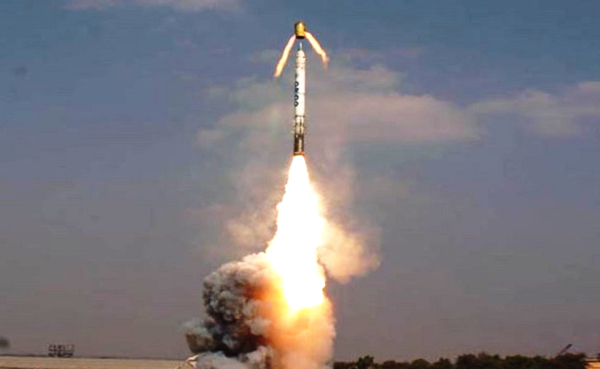
India’s K-15 Sagarika missile is one of the most important weapons in the country’s sea-based nuclear deterrent. It is a submarine-launched ballistic missile built for launch from India’s indigenous nuclear-powered ballistic missile submarines. Its role is simple, serious and strategic: give India the ability to retaliate from under the sea after absorbing a nuclear attack. In India’s nuclear doctrine, this matters because the country follows credible minimum deterrence and No First Use. The sea-based leg gives that doctrine survival, depth and credibility.
The K-15 is also known as Sagarika, B-05 or PJ-08. It belongs to India’s K-series family of underwater-launched missiles. It was developed by DRDO as part of the long effort to complete India’s nuclear triad: land-based missiles, air-delivered weapons and sea-based missiles. The land and air legs give India visible deterrence. The sea leg gives India hidden deterrence. A submarine carrying ballistic missiles can remain concealed beneath the ocean, making it harder for an enemy to destroy India’s retaliatory capability in a first strike.
This is the heart of the K-15’s value. A nuclear deterrent works when the adversary believes retaliation is certain. Land-based missile sites can be watched. Air bases can be targeted. Mobile launchers can be tracked with difficulty, yet they still operate on land. A ballistic missile submarine changes the problem. It hides in the ocean. It moves quietly. It keeps the retaliatory weapon away from the enemy’s first strike plan. The K-15 gives India’s SSBN force a working undersea weapon for this mission.
The missile’s reported range is around 700 to 750 kilometres. This places it in the short-range SLBM category. That range shapes its role. The K-15 is useful for regional deterrence, especially from patrol areas that place hostile targets within reach. It is especially relevant in the Pakistan-focused deterrence frame because Pakistani strategic and military centres can be brought within range from suitable maritime zones. Against China, the K-15’s limited range reduces flexibility and pushes the submarine closer to contested waters. That is why longer-range systems like K-4, and future K-series missiles, become essential for wider strategic reach.
The K-15 uses solid fuel, which is important for submarine operations. A submarine-launched missile must be compact, reliable and quick to fire under demanding conditions. The launch sequence itself is complex. The missile has to leave a submerged launch tube, travel through water, breach the surface and then ignite its rocket motor in a stable flight path. This requires underwater launch engineering, pressure resistance, gas-ejection systems, guidance reliability and submarine crew training. Every successful launch validates a chain of technologies, not merely the missile body.
INS Arihant proved the operational importance of this system. When Arihant completed its first deterrence patrol in 2018, India announced that the country’s survivable nuclear triad had been established. In 2022, Arihant carried out a successful SLBM launch, proving crew competency and validating the SSBN programme. This event showed that India’s undersea deterrent had moved beyond symbolism. It had entered the space of trained crews, working submarines and launch-capable missile systems.
INS Aridhaman takes this story forward. Open-source reports describe Aridhaman as India’s third Arihant-class nuclear-powered ballistic missile submarine and a larger, more capable platform than Arihant and Arighaat. The reported increase in displacement and missile-tube capacity gives it greater strategic value. Arihant and Arighaat are commonly reported to carry up to 12 K-15 missiles or 4 K-4 missiles. Aridhaman is reported to have a larger loadout, with some reports saying it can carry up to 24 K-15 Sagarika missiles or a larger number of longer-range K-series missiles. This larger missile capacity makes Aridhaman a more powerful deterrent platform.
The use of K-15 on Aridhaman would give India a dense short-range undersea strike package. A larger number of K-15 missiles means more launch options, more target coverage inside regional range and stronger retaliatory capacity in a Pakistan-focused scenario. It also gives the Strategic Forces Command flexibility in loadout planning. A submarine can carry a larger number of shorter-range missiles for regional deterrence or fewer longer-range missiles for wider strategic reach. Aridhaman’s value comes from this flexibility.
K-15 also plays a bridging role in India’s nuclear submarine journey. It gave India the first practical undersea ballistic missile capability. It allowed the Navy, DRDO and Strategic Forces Command to master underwater launch procedures, crew drills, fire-control integration, submarine-missile compatibility and command-chain validation. These lessons directly support the deployment of longer-range missiles. In that sense, K-15 is not merely a weapon. It is the foundation stone of India’s operational SLBM ecosystem.
The missile’s limitation is also clear. A 700 to 750 kilometre range demands careful patrol positioning. A submarine carrying K-15 must operate closer to the theatre of interest than a submarine carrying a 3,500 kilometre missile. This affects survivability, route planning, escort environment and maritime domain awareness. The stronger long-term solution is a mix of K-15 for regional deterrence and K-4 or future K-series missiles for greater standoff distance. Aridhaman, with its reported larger missile capacity, appears designed for that transition.
The strategic importance of Aridhaman lies in patrol availability. A credible sea-based deterrent needs more than one submarine. One SSBN may be on patrol, another may be in maintenance, and another may be preparing for deployment. With Arihant, Arighaat and Aridhaman, India moves closer to a more reliable at-sea deterrent cycle. This matters because deterrence depends on continuity. A hidden retaliatory force must be available when needed, not merely present on paper.
For India, the K-15-Aridhaman combination strengthens deterrence in the Indian Ocean Region. It gives India an undersea nuclear force that is indigenous, survivable and increasingly mature. It also shows the growth of the Advanced Technology Vessel programme, one of the most complex defence projects ever undertaken by India. Nuclear propulsion, submarine stealth, missile integration, underwater launch systems and strategic command control all come together inside this programme.
K-15 Sagarika should be understood as the first operational spear of India’s underwater nuclear deterrent. It gives India a proven submarine-launched missile, validates the SSBN fleet and supports the doctrine of assured retaliation. Aridhaman gives that spear a larger and stronger platform. Together, they represent India’s quiet movement from possessing nuclear weapons to fielding a survivable, sea-based deterrent force.
The message is strategic and direct. India’s nuclear posture is built around restraint, survivability and retaliation. The K-15 gives the sea leg its working edge. Aridhaman expands the undersea platform strength. The combination tells any adversary that India’s retaliatory capability can survive beneath the ocean, away from the first blow, ready to preserve deterrence through silence, concealment and assured response.
You may also like
-
Zen Technologies Introduces Indigenous Hyper-Strike Falcon AI-Guided Counter-Drone Interceptor
-
L&T and Germany’s SCHOTTEL Expand Partnership for Controllable Pitch Propeller Systems in Indian Shipbuilding
-
India to Train 60,000 Civil Defence Volunteers Across 12 States and UTs with Indian Army Support
-
Indian Army’s Northern Command Opens 75-Day Defence Technology Internship Programme for Young Innovators
-
India Emerges as Major Arms Supplier to Europe, Defence Secretary Highlights Surge in Ammunition Exports
