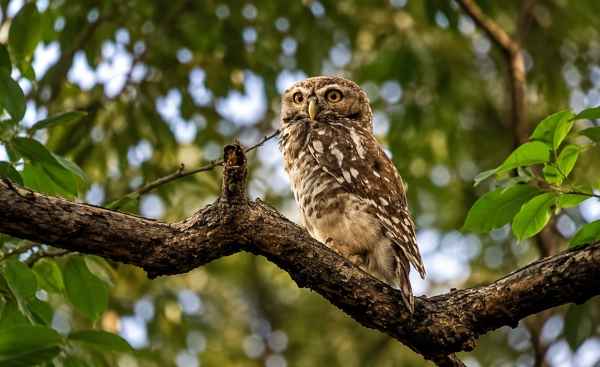
Hidden within the dry deciduous forests of central and west-central India survives one of the country’s most extraordinary endemic birds—the Forest Owlet (Athene blewitti).
Small, stocky and unusually active during daylight, the Forest Owlet was once feared to have disappeared forever. After going unrecorded for 113 years, it was dramatically rediscovered in northern Maharashtra in 1997. Subsequent surveys have established surviving populations in parts of Maharashtra, Madhya Pradesh and Gujarat, but its distribution remains highly fragmented and restricted.
Today the Forest Owlet is classified as Endangered on the IUCN Red List and remains among India’s most conservation-sensitive birds. It is also protected under Schedule I of India’s Wildlife (Protection) Act.
Scientific Classification
Common name: Forest Owlet
Scientific name: Athene blewitti
Older scientific name: Heteroglaux blewitti
Family: Strigidae
Order: Strigiformes
Distribution: Central and west-central India
Principal states: Maharashtra, Madhya Pradesh and Gujarat
Habitat: Dry deciduous woodland, especially teak-dominated forest
Global conservation status: Endangered
Indian legal protection: Schedule I
Modern genetic research has helped settle a long-running taxonomic debate. The species was traditionally placed in the separate genus Heteroglaux, but molecular analysis found it nested firmly within the genus Athene, supporting the scientific name Athene blewitti increasingly used today.
A Bird Thought Lost Forever
The Forest Owlet was first scientifically described in the nineteenth century, but after a handful of early specimens were collected, confirmed observations suddenly ceased.
For more than a century, ornithologists searched without success.
The bird was consequently widely suspected to be extinct.
Then, on 25 November 1997, ornithologists Pamela Rasmussen and Ben King rediscovered the species near Shahada in Nandurbar district, Maharashtra. The confirmed observation ended an extraordinary 113-year absence from the ornithological record.
Its return immediately triggered new surveys across central India.
Researchers subsequently located Forest Owlets in areas including Toranmal, Melghat and other forests of Maharashtra, as well as populations in Madhya Pradesh and later Gujarat.
The rediscovery remains one of the most celebrated episodes in modern Indian ornithology.
Why Did Such a Distinctive Bird Remain Undetected?
One reason may have been confusion with the much more common Spotted Owlet (Athene brama).
Both are small Indian owls and can superficially resemble each other, particularly when viewed briefly in woodland.
Early research following the rediscovery noted that confusion with the Spotted Owlet could have contributed to the Forest Owlet escaping detection for so many decades.
Its restricted distribution compounded the problem.
This was never a bird occurring uniformly across India’s forests. Its populations appear concentrated in isolated pockets of suitable habitat, making systematic surveys essential.
Modern surveys using recorded calls and acoustic monitoring have consequently proved much more effective at locating the species than conventional visual searches alone.
What Does the Forest Owlet Look Like?
The Forest Owlet is a small but strongly built owl, with a disproportionately large head and powerful appearance.
Its upperparts are predominantly grey-brown, while the wings carry distinct white markings.
The lower body is largely whitish, with brown markings concentrated particularly around the upper breast.
Perhaps its most striking feature is the pair of prominent white eyebrows above brilliant yellow eyes, producing an intense, almost stern expression.
Unlike the more heavily spotted Spotted Owlet, the Forest Owlet generally appears cleaner and more solidly patterned.
Its relatively short tail, broad body and powerful feet also contribute to its distinctive appearance.
Cornell’s eBird describes it as an extremely localised owl of west-central India, characterised by grey-brown plumage, a white belly and conspicuous pale eyebrows.
An Owl That Likes Daylight
One of the Forest Owlet’s most interesting characteristics is that it is strongly diurnal and crepuscular compared with many other owls.
It can often be observed perched openly during daylight, particularly during the morning and late afternoon.
This behaviour gives the species a somewhat different ecological lifestyle from stereotypically nocturnal owls.
Forest Owlets frequently use exposed branches as observation posts from which they scan the surrounding forest floor and vegetation.
Its calls are also often given during daylight.
This has made vocal surveys particularly useful for conservationists attempting to determine whether the species survives within a particular forest patch.
The Dry Forests of Central India
Despite its name, the Forest Owlet is not principally a bird of dense tropical rainforest.
Its preferred environment appears to be open dry deciduous forest, frequently containing teak and interspersed with clearings or agricultural land. WCS India describes the species as favouring open, dry deciduous broad-leaved forests mixed with agricultural openings.
eBird records its known sites mainly in lowland forest between roughly 200 and 600 metres elevation, with a particular association with teak woodland.
This habitat preference is extremely important for conservation.
Protecting the Forest Owlet therefore does not simply mean preserving the densest untouched forest available.
The species requires a particular woodland structure containing suitable mature trees, cavities for nesting, feeding areas and relatively open hunting habitat.
Melghat: One of Its Most Important Strongholds
Among the best-known Forest Owlet landscapes is Melghat Tiger Reserve in Maharashtra.
Early surveys after the species’ rediscovery located significant numbers there. A major survey conducted between 2001 and 2004 recorded 98 Forest Owlets across surveyed Maharashtra sites, including 79 individuals in Melghat Tiger Reserve.
The region remains an important conservation area for the species.
Recent observations continue to confirm Forest Owlets in the Melghat landscape, demonstrating that the reserve has retained suitable habitat decades after the rediscovery.
This also demonstrates the wider ecological value of tiger reserves.
Although created primarily around large mammals and their ecosystems, such protected landscapes can simultaneously conserve rare birds, reptiles, insects and plants occupying the same forests.
The Forest Owlet in Madhya Pradesh
Important populations have also been identified in Madhya Pradesh, including parts of the central Indian highlands.
Surveys after 1997 discovered the species in areas where it had not previously been recognised, including the Khaknar forest range.
Later research focused on Forest Owlet populations in areas such as Khandwa district, examining population ecology, habitat use and movements.
The presence of populations across Maharashtra and Madhya Pradesh shows that the species belongs to a broader central Indian forest landscape rather than a single isolated sanctuary.
However, surviving populations remain separated by substantial areas of altered habitat.
Gujarat Reveals Another Important Population
One of the most encouraging developments following the rediscovery has been the identification of Forest Owlets in the Dang region of southern Gujarat.
Modern surveys have documented the species at several locations where older ornithological studies had failed to detect it.
Researchers have investigated whether the apparent expansion reflects genuine changes in distribution or simply improved detection resulting from modern techniques such as playback-assisted surveys and acoustic monitoring.
Recent eBird records also document Forest Owlets in Dang, including observations from 2023, 2024 and 2025.
This reinforces the conservation importance of the forests along the northern Western Ghats and adjoining central Indian landscapes.
What Does the Forest Owlet Eat?
The Forest Owlet is a predator.
Studies indicate that it takes a variety of prey available in dry deciduous woodland, including small vertebrates and invertebrates.
Its strong feet and relatively powerful build allow it to tackle prey from exposed hunting perches.
Like other small owls, it performs an important ecological function by controlling populations of small animals within its forest habitat.
The species therefore occupies the role of a relatively small but significant woodland predator.
Its disappearance could affect ecological relationships far beyond the loss of a single attractive bird.
Nesting Inside Old Trees
Forest Owlets depend heavily upon tree cavities for nesting.
This creates one of the clearest links between mature trees and survival of the species.
Research conducted after the rediscovery recorded four nests and provided some of the first detailed information about its breeding biology.
Incubation lasted approximately 30 days, with the female performing most incubation while the male supplied food.
Observed broods contained two chicks. Young birds fledged at roughly 40 days, but continued depending upon their parents for food and protection for approximately another 45 days.
These findings underline why simply maintaining general tree cover is insufficient.
A forest can appear green on satellite imagery yet still lose ecological value if old cavity-bearing trees are removed.
For Forest Owlets, individual mature trees can literally determine whether a breeding territory remains usable.
Forest Fragmentation Is the Central Threat
Habitat loss and fragmentation remain among the major challenges confronting the species.
Its surviving populations occur within a landscape heavily influenced by agriculture, roads, settlements, timber extraction and other forms of land-use change.
Recent research in Gujarat detected significant landscape changes including loss of native forest, increasing agriculture and changes in climatic variables across the broader Dang landscape.
The problem becomes particularly serious for a range-restricted species.
Common birds may survive habitat loss by moving into other suitable forests.
The Forest Owlet does not have that luxury.
When one isolated habitat patch disappears, an entire local population can potentially disappear with it.
Loss of Nest Trees Can Be Especially Damaging
Removal of large trees creates another threat.
Forest Owlets require cavities for breeding, yet such cavities are generally found in older trees.
Timber extraction or excessive removal of mature trees can therefore reduce nesting opportunities even when some forest remains.
Earlier ecological research suggested that very low population densities could partly reflect degraded and fragmented habitat and scarcity of suitable nesting sites.
Conservation programmes have consequently placed emphasis on protecting known nesting trees and maintaining mature woodland.
The survival of a rare owl can sometimes depend upon something as specific as ensuring that one old tree remains standing.
Conservation Through Local Communities
Long-term Forest Owlet protection cannot be achieved through protected areas alone.
Some populations occur in reserved forests or landscapes containing villages and agricultural land.
That makes local participation crucial.
Conservation organisations have worked with communities to identify owl territories, protect nesting trees and increase awareness of the bird’s extraordinary rarity.
WCS India’s Forest Owlet programme in Gujarat focuses specifically on understanding its population, distribution and breeding biology while promoting the species as a flagship for conservation of the wider Dang forest ecosystem.
This approach has a major advantage.
Protecting the Forest Owlet also protects the woodland required by many less famous species sharing the same landscape.
Modern Technology Is Helping Find a Bird Once Considered Extinct
The Forest Owlet story is increasingly becoming an example of how technology can transform wildlife conservation.
Recorded-call surveys allow researchers to stimulate territorial responses.
Automated acoustic recorders can remain in forests for extended periods and capture calls even when observers are absent.
Satellite imagery can measure changes in forest cover and land use.
Radio telemetry can provide information about movements and home ranges.
And genetic analysis has even resolved the species’ taxonomic position within the owl family.
The contrast is remarkable.
A bird that disappeared from scientific records for more than a century is now being studied using molecular genetics, satellite data and automated acoustic monitoring.
From Critically Endangered to Endangered
There has also been a cautiously encouraging change in conservation assessment.
The Forest Owlet was previously classified as Critically Endangered, when the known population appeared exceptionally tiny.
As additional populations were discovered and knowledge improved, the species was downlisted to Endangered on the IUCN Red List in 2018. Recent scientific work explicitly notes that improved knowledge and new records contributed to this reassessment.
This should not be interpreted as meaning the bird is safe.
The estimated global population remains small, its distribution fragmented and its habitat threatened.
Rather, the change reflects the fact that scientists now know the species survives at more locations than were recognised immediately after its rediscovery.
It remains one of India’s rarest endemic owls.
A Bird Found Nowhere Else on Earth
Perhaps the strongest reason for protecting the Forest Owlet is simple:
Athene blewitti is endemic to India.
Its entire natural global population occurs within India.
If Maharashtra, Madhya Pradesh and Gujarat lose the Forest Owlet, the world loses the species.
There is no reserve population hidden in Southeast Asia, Africa or another part of the subcontinent.
That gives India complete responsibility—and a unique opportunity—for ensuring its survival.
The Forest Owlet’s Extraordinary Second Chance
Few Indian birds have experienced a history quite like the Forest Owlet.
It entered science in the nineteenth century.
Then it vanished.
Generation after generation of ornithologists passed without a confirmed sighting.
For 113 years, the species seemed to belong increasingly to museums rather than living forests.
Then, in 1997, a tiny owl sitting in the forests of northern Maharashtra proved otherwise.
The subsequent discovery of populations across Maharashtra, Madhya Pradesh and Gujarat transformed the story from one of presumed extinction into one of cautious recovery and renewed scientific attention.
But rediscovery is not the same as rescue.
The Forest Owlet’s future depends upon protecting the dry deciduous forests, old cavity-bearing trees and connected woodland landscapes of central India on which its remaining populations depend.
Its survival carries a broader lesson for Indian conservation.
Sometimes a species can disappear from human knowledge without disappearing from nature.
The forests may hold on to it quietly for decades.
When science is fortunate enough to find such a species again, that rediscovery represents something exceptionally rare—a second chance.
For the Forest Owlet, India received that second chance in 1997. The task now is to ensure that this remarkable little bird never has to be rediscovered again.
References:
- Wildlife Conservation Society India – Forest Owlet Conservation
https://india.wcs.org/Themes/Agroforest-Biodiversity/Forest-Owlet - PubMed – Research on the Distribution and Conservation Status of the Forest Owlet
https://pubmed.ncbi.nlm.nih.gov/39544393/ - PLOS ONE – Molecular Phylogeny and Taxonomic Position of the Forest Owlet (Athene blewitti)
https://journals.plos.org/plosone/article?id=10.1371/journal.pone.0192359 - eBird – Forest Owlet (Athene blewitti) Species Information
https://ebird.org/species/forowl1 - eBird – Forest Owlet Records from Nandurbar, Maharashtra
https://ebird.org/region/IN-MH-NB/bird-list - Wiley / Ibis – Ecology, Breeding Biology and Conservation of the Forest Owlet
https://onlinelibrary.wiley.com/doi/full/10.1111/j.1474-919x.2004.00389.x - PubMed Central – Forest Owlet Distribution, Habitat Change and Conservation in India
https://pmc.ncbi.nlm.nih.gov/articles/PMC11563693/ - WCS India – Agroforest Biodiversity and Forest Owlet Programme in Gujarat
https://india.wcs.org/Themes/Agroforest-Biodiversity/Forest-Owlet - Raptors Research & Conservation Foundation – Forest Owlet Research and Technical Reports
https://www.raptors.org.in/technical-reports.html - ResearchGate – Further Information on the Status and Distribution of the Forest Owlet in India
https://www.researchgate.net/publication/237632932_Further_information_on_the_status_and_distribution_of_the_Forest_Owlet_Athene_blewitti_in_India - ResearchGate – Ecological Studies of the Forest Owlet
https://www.researchgate.net/publication/346934651_Ecological_studies_of_the_Forest_Spotted_Owlet_Athene_Heteroglaux_blewitti - Uttar Pradesh Journal of Zoology – Recent Observations of Forest Owlet in the Melghat Landscape
https://mbimph.com/index.php/UPJOZ/article/view/4877
You may also like
-
Chhattisgarh Plans Innovative Tree Surgery to Save Over 500 Damaged Trees in Udanti Sitanadi Tiger Reserve
-
Kerala’s Peechi Wildlife Survey Records 395 Species, Adds 36 New Entries to Biodiversity Checklists
-
Tiger Returns to Maharashtra’s Beed Forests After Nearly 100 Years, Highlights Importance of Wildlife Corridors
-
Himachal Pradesh Achieves Major Success in Rare Cheer Pheasant Conservation
-
Blackbucks to Return to Chhattisgarh’s Gomarda Wildlife Sanctuary After Five Decades
