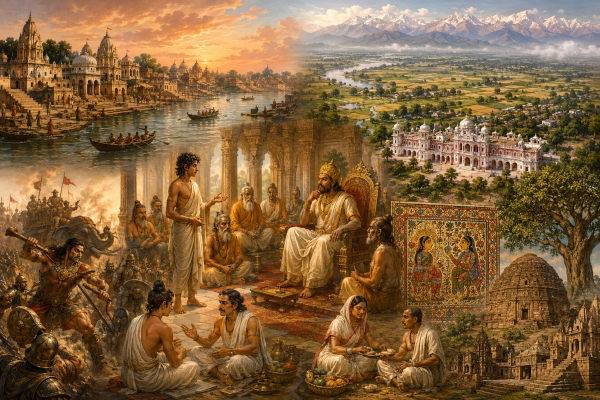
The Mahabharata remembers Videha, also closely associated with Mithila, as one of the important kingdoms of eastern Bharat. Its geographical heart lay in the fertile plains north of the Ganga, extending across what is today northern Bihar in India and the adjoining Terai of Nepal. The epic identifies a ruler named Janaka as king of the Videhas, and records his defeat by Bhima during the eastern campaign undertaken before Yudhishthira’s Rajasuya.
Yet Videha occupies a place in Indian civilisational memory that goes far beyond military or political history. Mithila was remembered as the kingdom of Janaka and Sita in the Ramayana, as a centre of philosophical debate and learning in Vedic and Upanishadic tradition, and again in the Mahabharata as a land where questions of dharma, renunciation, kingship and liberation were explored through some of the epic’s most remarkable narratives.
The continuity is extraordinary. The same geographical region remembered as the homeland of Sita and the court of the philosopher-king Janaka appears generations later in the political geography of the Mahabharata.
Videha at a Glance
| Feature | Description |
|---|---|
| Ancient Kingdom | Videha / Mithila |
| Royal Capital traditionally associated with it | Mithila, strongly identified in later tradition with Janakpur |
| Modern Location | Northern Bihar and adjoining Terai/Madhesh region of Nepal |
| Countries Today | India and Nepal |
| Royal Tradition | Janaka / Videha rulers |
| Ramayana Association | King Janaka and Sita |
| Mahabharata-era Ruler | Janaka, king of the Videhas |
| Rajasuya Period | Defeated by Bhima during his eastern campaign |
| Earlier Kuru Connection | Videhas are also remembered as having been subdued by Karna for Duryodhana |
| Kurukshetra Alignment | Videha warriors appear among forces fighting against Arjuna on the Kaurava side |
| Intellectual Association | Janaka, Yajnavalkya, Ashtavakra, Shuka, Sulabha and traditions of philosophical debate |
| Cultural Continuity Today | Maithili language, Mithila painting, Janakpur pilgrimage tradition and shared India-Nepal heritage |
The Land of Videha
Videha belonged to the eastern Gangetic world. Ancient literary traditions place the Videhas east of the land of Kosala, while the later geographical identity of Mithila became firmly associated with Tirhut and northern Bihar, extending northward into the Nepalese Terai. A classical description preserved in the tradition of the Shatapatha Brahmana associates the expansion of Videha with the region east of the Sadanira, commonly identified with the Gandak river.
The geographical continuity remains remarkably visible.
The Government of Bihar associates the ancient kingdom of Videha with the present regions of Muzaffarpur, Sitamarhi, Samastipur, Madhubani and Darbhanga. Across the international border, Nepal Tourism Board describes the Terai districts of present-day Madhesh Pradesh as forming part of the northern cultural region of ancient Mithila.
In broad modern geographical terms, Videha-Mithila can therefore be represented approximately as:
Darbhanga – Madhubani – Sitamarhi – northern Bihar → Janakpur and adjoining Madhesh/Terai → India and Nepal
Ancient kingdoms did not possess borders resembling modern state and district lines, so this should be treated as a broad cultural-geographical reconstruction rather than an exact political boundary.
Videha and Mithila: Two Names of the Same Civilisational Region
The terms Videha and Mithila are deeply intertwined but are not always used in exactly the same manner in ancient literature.
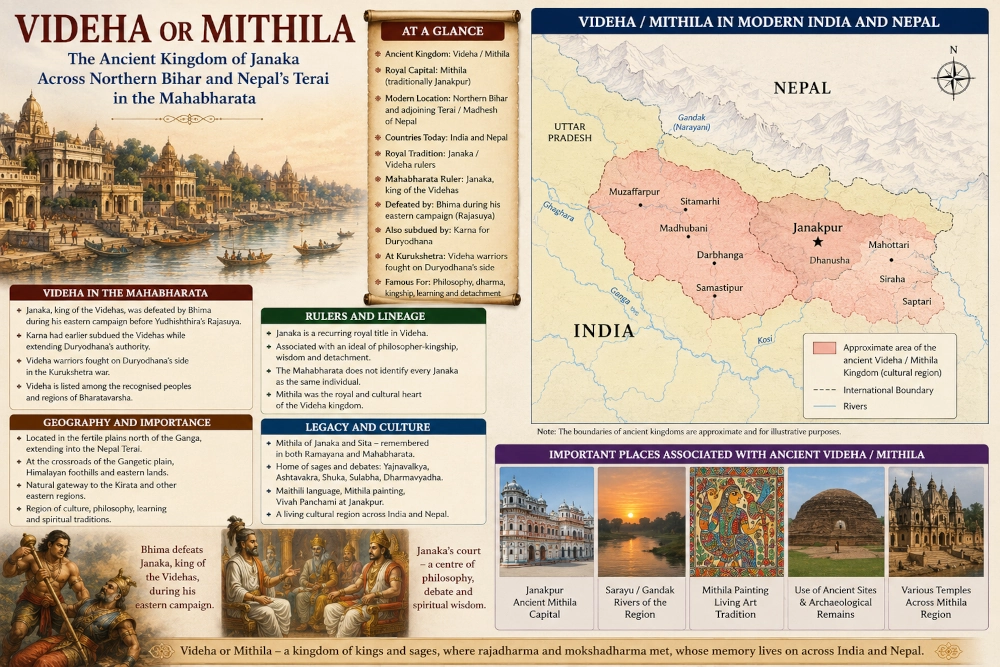
Videha generally describes the kingdom, people or political territory, while Mithila is repeatedly presented as its great royal city and eventually became the wider cultural name of the region.
The Mahabharata itself illustrates this relationship.
It describes Janaka as the king of the Videhas, while elsewhere referring to the king of Mithila and to Mithila as the capital of the Videhas.
Thus a useful geographical understanding is:
Videha → the ancient kingdom
Mithila → its royal and cultural heart
Over time, however, Mithila became the more enduring cultural identity, surviving long after the ancient monarchy itself had disappeared.
Janakpur and the Memory of Ancient Mithila
The strongest surviving northern centre of the Mithila tradition is Janakpur in Nepal.
Nepal Tourism Board identifies Janakpur as the ancient capital traditionally associated with the Kingdom of Mithila and as the cultural centre connected with King Janaka and Sita. The city remains one of the most important pilgrimage centres of the Terai.
Janakpur today lies in Dhanusha district of Nepal’s Madhesh region.
Its great Janaki Mandir preserves the tradition of Sita, while the surrounding landscape contains sites associated with the Ramayana narrative, including Dhanushadham and numerous sacred ponds. Nepal’s official Videha-Mithila tourism body itself describes Janakpur as the ancient capital of Mithila and a major centre of spirituality and philosophical learning.
The modern India-Nepal frontier therefore divides a cultural geography that is much older than the political border.
Mithila and Sita
Long before the events surrounding the Kurukshetra War, Mithila had acquired enormous prestige through the story of King Janaka and Sita.
The Ramayana presents Janaka as ruler of Videha and Mithila as his royal city. Sita therefore receives such names as Vaidehi, meaning the princess or woman of Videha, and Maithili, linking her directly to Mithila.
Significantly, the Mahabharata itself preserves this earlier tradition.
During the Ramopakhyana of the Vana Parva, the epic explicitly recalls that Janaka was king of Videha and Sita his daughter. Elsewhere Sita is repeatedly described as the princess of Mithila.
Videha therefore provides another example of the continuity between India’s two great epics.
The Mahabharata does not treat Mithila as an unknown eastern kingdom. It inherits an already ancient memory of the land of Janaka and Sita.
The Janakas of Mithila
One distinction is important.
Every reference to a ruler called Janaka need not necessarily refer to the same individual who appears as Sita’s father in the Ramayana.
The Mahabharata contains several narratives involving kings named Janaka, especially in the Shanti Parva. Modern scholarship consequently treats Janaka as a recurring royal identity associated with Videha and with a particular ideal of philosophical kingship rather than assuming that every Janaka passage concerns one historical ruler.
This is particularly important when reading the Sabha Parva.
The Janaka defeated by Bhima belongs to the political world surrounding Yudhishthira’s Rajasuya.
The Mahabharata calls him:
Janaka, king of the Videhas.
The text does not require us to identify this ruler directly with Sita’s father.
Instead, it demonstrates that the Janaka royal tradition remained attached to Videha in the political memory preserved by the epic.
Bhima Marches into Videha
Before Yudhishthira could perform the Rajasuya Yajna, the Pandavas sought recognition of his imperial authority from kingdoms throughout Bharat.
Each of the Pandava brothers undertook campaigns in different directions.
Bhima marched east.
His route carried him through a succession of kingdoms across the Gangetic plains before he eventually reached Videha.
The Sabha Parva records that Bhima defeated Janaka, lord of the Videhas, before continuing his operations farther toward the territories of the Kiratas.
This brief passage is extremely important for reconstructing the political geography of the Mahabharata.
It establishes Videha as a recognised kingdom in its own right.
It possessed a ruler.
It occupied an important position on the eastern route.
And its submission was significant enough to be mentioned individually during Bhima’s campaign.
Videha and Yudhishthira’s Eastern Imperial Sphere
Bhima’s campaign was not simply a raid for territorial annexation.
The Digvijaya formed part of the political process through which Yudhishthira established the authority necessary to perform the Rajasuya as an imperial sovereign.
After defeating the ruler of Videha, Bhima used the region as a base for further expeditions. The Mahabharata specifically says that expeditions were sent from Videha against rulers of the Kirata country near the Indra mountain.
Videha was therefore geographically important.
Standing close to the Himalayan foothills and the routes leading into the eastern and northeastern regions of the subcontinent, it provided a natural gateway between the Gangetic plain and the mountain territories beyond.
Its position helps explain why it appears prominently in Bhima’s eastern campaign.
Karna Had Also Subdued the Videhas
Videha appears in another revealing episode concerning the geopolitical rivalry surrounding Hastinapura.
In the Drona Parva, Bhishma recalls earlier military achievements of Karna and states that, among other peoples and kingdoms, the Videhas had been vanquished by him while he was extending Duryodhana’s authority.
The passage is important because it shows that Videha was caught within the competing spheres of the two Kuru factions.
At one point the region appears within the political orbit created by Karna on behalf of Duryodhana.
Later Bhima defeats Janaka during Yudhishthira’s Rajasuya campaign.
The Mahabharata does not provide enough information to reconstruct the precise chronology or political arrangements of these episodes, nor does it tell us whether the same individual ruler was involved in both.
But together the passages reveal something more important.
Videha mattered to both sides of the Kuru political world.
Videha Warriors at Kurukshetra
When the rivalry finally became open war, warriors from Videha appear on the battlefield.
During the Bhishma Parva, the Mahabharata describes Duryodhana rallying his forces against Arjuna. Among the contingents attacking the Pandava warrior were combatants belonging to the Videhas, alongside Kalingas and warriors from several other regions.
The passage places at least a substantial Videha contingent within the forces fighting on Duryodhana’s side.
This creates a political pattern similar to that seen elsewhere in the Mahabharata.
Bhima’s earlier victory during the Rajasuya did not necessarily determine a kingdom’s allegiance years later during the succession struggle.
Ancient interstate relationships could shift according to dynastic relationships, political obligations, military pressure and changing regional interests.
Videha had submitted to Yudhishthira’s imperial campaign.
Yet Videha warriors later appear fighting against Arjuna.
Videha in the Mahabharata’s Geography of Bharatavarsha
The Mahabharata also lists the Videhas among the recognised peoples and regions of Bharatavarsha.
The geographical catalogue of the Bhishma Parva places the Videhas alongside other eastern kingdoms such as the Magadhas, Angas, Vangas and Kalingas.
This corresponds remarkably well with Videha’s known geographical setting.
To its west lay the lands associated with Kosala.
To its south and southeast lay the expanding political sphere of Magadha and other eastern Gangetic kingdoms.
To the north rose the Himalayan foothills and the lands of the Kiratas.
Videha therefore stood at a geographical crossroads between:
the Gangetic plain, the Himalayan foothills and the eastern regions of Bharat.
Its location made the kingdom important not merely culturally but strategically.
Mithila Was Also a City of Learning
Military history tells only a small part of Mithila’s story.
The Mahabharata repeatedly portrays Mithila as a place where profound intellectual and spiritual questions were discussed.
One of the most striking examples occurs in the story of Ashtavakra.
The young sage travels to the sacrifice of King Janaka, where scholars have gathered for philosophical debate. He challenges the celebrated controversialist Vandin and eventually defeats him before Janaka’s court.
The episode presents Mithila not simply as the residence of a king but as an intellectual capital.
Janaka’s court attracts scholars.
Debates are held publicly.
Knowledge establishes status.
And even a young Ashtavakra can challenge established scholars if his wisdom is sufficient.
This image closely parallels the much older philosophical reputation of Videha preserved in the Brahmanas and Upanishads.
Janaka and Yajnavalkya
The intellectual reputation of Mithila was already deeply established in Vedic literature.
The court of Janaka of Videha became particularly associated with the sage Yajnavalkya and with philosophical discussions concerning the Atman, Brahman and the nature of ultimate reality.
Oxford scholarship notes the importance of the philosophical contests conducted at Janaka’s court, particularly in the Brihadaranyaka Upanishad, where Yajnavalkya emerges as the central participant.
Mithila consequently became associated with a remarkable Indian political ideal:
the philosopher-king.
The ruler was not expected merely to command armies, collect tribute and administer territory.
He could also seek knowledge.
He could question sages.
And in some traditions he could himself become a teacher of philosophy.
Shuka Goes to the King of Mithila
The Mahabharata carries this philosophical reputation even further.
In the Shanti Parva, Vyasa sends his son Shuka to Janaka because the ruler of Videha is renowned for his understanding of liberation.
Vyasa tells Shuka to go to Mithila and seek instruction from its king concerning the path to emancipation. Shuka accordingly travels to the capital of the Videhas and presents his philosophical questions before Janaka.
The symbolism is striking.
A son of Vyasa travels to a king for spiritual instruction.
Royal authority and philosophical wisdom are therefore brought together in the figure of Janaka.
Mithila becomes almost a royal university of dharma and moksha within the narrative imagination of the epic.
Janaka and Sulabha
Another celebrated Mahabharata episode takes place in the court of a ruler of Mithila called Dharmadhvaja Janaka.
The wandering yogini Sulabha, having heard of the king’s reputation for knowledge and renunciation, travels to Mithila to test whether his celebrated detachment is genuine.
The resulting dialogue becomes one of the Mahabharata’s sophisticated discussions concerning identity, kingship, attachment and liberation.
The story reinforces a recurring theme.
Mithila’s kings are remembered not only as rulers of territory but as participants in philosophical inquiry.
Few kingdoms in the Mahabharata possess such a consistently intellectual royal identity.
The Dharmavyadha of Mithila
Perhaps the most remarkable Mithila story in the Mahabharata concerns neither a king nor a warrior.
In the Vana Parva, the Brahmana Kaushika is directed to travel to Mithila and seek instruction from a Dharmavyadha, a righteous fowler or meat-seller renowned for understanding dharma.
Kaushika journeys across forests, villages and towns until he reaches Mithila.
The epic describes the city as prosperous, fortified, filled with buildings, busy streets, shops, horses, elephants and celebrations. It is explicitly said to be ruled by Janaka.
There Kaushika learns that dharma is not determined merely by outward profession or social appearance.
The Dharmavyadha teaches him about truth, self-control, duty and especially service to one’s parents.
The episode gives Mithila another extraordinary civilisational identity.
It is not simply the city where sages instruct kings.
It is also a city where a Brahmana may discover profound dharma from an ordinary householder faithfully performing his responsibilities.
Janaka and the Ideal of Detachment
The Shanti Parva repeatedly returns to the Janakas of Videha when discussing the relationship between political power and spiritual detachment.
One famous tradition attributes to Janaka the idea that even if Mithila itself were consumed by fire, he would lose nothing because he had overcome attachment to possessions.
The teaching does not demand abandonment of kingship.
That is precisely what makes the Janaka tradition distinctive.
The ruler continues governing.
He possesses wealth.
He commands authority.
Yet internally he remains detached from both.
The Mahabharata repeatedly employs the Janaka tradition to explore whether a person can fulfil worldly responsibilities while remaining spiritually free. Modern scholarship has consequently described the Mahabharata’s Janakas as central figures in its conception of philosophical sovereignty and renunciation within kingship.
A Kingdom Where Rajadharma and Mokshadharma Met
Videha’s place in the Mahabharata is therefore unusually broad.
Kosala is remembered strongly through dynastic kingship.
Panchala becomes central to the politics surrounding Draupadi and the Pandavas.
Magadha emerges as a major centre of political and military power.
But Mithila acquires another dimension.
Here Rajadharma and Mokshadharma intersect.
Its kings wage wars and participate in interstate politics.
Yet the same royal tradition is repeatedly invoked when the epic asks some of its deepest questions:
Can a king possess a kingdom without being possessed by it?
Can political responsibility coexist with spiritual freedom?
Is wisdom dependent upon social rank?
What constitutes genuine dharma?
Can a ruler govern without attachment?
The Mahabharata repeatedly answers these questions through stories connected with Janaka and Mithila.
Videha on the Modern Map of India and Nepal
For our modern geographical series, Videha or Mithila can therefore be represented approximately as:
Videha / Mithila → northern Bihar + adjoining Madhesh/eastern Terai → India and Nepal
On the Indian side, the core historical-cultural zone may be centred around:
Darbhanga – Madhubani – Sitamarhi – Muzaffarpur – Samastipur
On the Nepalese side, the Mithila cultural landscape continues through Janakpur and the surrounding Terai districts, particularly the Dhanusha-Mahottari-Siraha-Saptari belt within modern Madhesh Pradesh. Bihar government material associates several north Bihar districts with ancient Videha, while Nepal Tourism Board explicitly describes the southern Terai region of Madhesh as part of the ancient Mithila cultural geography.
Modern Identification
| Ancient Geography | Modern Geography |
|---|---|
| Videha | Northern Bihar and adjoining Nepal Terai |
| Mithila | Cross-border Maithili cultural region |
| Traditional royal centre | Mithila / Janakpur |
| Indian heartland | Darbhanga, Madhubani, Sitamarhi and adjoining north Bihar |
| Nepalese heartland | Janakpur and adjoining Madhesh/Terai |
| Modern Countries | India and Nepal |
The precise ancient frontier should remain approximate. The cultural landscape survived and shifted over centuries, while modern international, state and district boundaries are comparatively recent.
Mithila as a Living Civilisation
Unlike many ancient kingdoms that survive principally in texts and archaeology, Mithila remains a powerful living cultural identity.
The Maithili language continues on both sides of the India-Nepal border.
Mithila painting remains one of South Asia’s most recognisable artistic traditions. India’s Indira Gandhi National Centre for the Arts describes Mithila as comprising the Gangetic plains of north Bihar and the Terai of Nepal, while Nepal Tourism Board likewise treats Mithila art as a continuing tradition shared across Nepal and India.
Janakpur continues to celebrate Vivah Panchami, commemorating the marriage of Rama and Sita, drawing pilgrims across the border.
The modern boundary between India and Nepal therefore passes through what was historically a connected civilisation rather than separating two unrelated cultural worlds.
Videha’s Place in the Mahabharata
Videha occupies one of the richest positions in the Mahabharata’s geography.
Politically, it was an identifiable eastern kingdom ruled by Janaka.
Bhima subdued its king during Yudhishthira’s Rajasuya campaign.
The epic also remembers Karna as having defeated the Videhas while extending Duryodhana’s influence.
And when the armies finally assembled at Kurukshetra, warriors of Videha appear among the forces fighting against Arjuna.
But Mithila’s deeper contribution to the epic is intellectual.
It is the city of Janaka’s great assemblies.
The setting of Ashtavakra’s triumph.
The destination of Shuka in his search for liberation.
The kingdom visited by Sulabha in her examination of philosophical kingship.
And the city where the Dharmavyadha teaches that true dharma may reside in the faithful performance of one’s duties rather than in outward status.
Videha therefore represents far more than another territory on the Mahabharata map.
It was one of ancient Bharat’s great meeting grounds of political power and philosophical thought.
And perhaps more remarkably than almost any other Mahabharata kingdom, its identity remains visible today.
From Darbhanga and Madhubani to Sitamarhi and Janakpur, Mithila continues across the India-Nepal border through language, festivals, art, pilgrimage and collective civilisational memory.
Reference
Mahabharata — Sabha Parva, Digvijaya / Jarasandha-badha Parva, Section XXIX
Bhima defeats Janaka, king of the Videhas, during his eastern campaign and subsequently launches expeditions from Videha toward the Kirata territories.
Mahabharata — Bhishma Parva, Jambu-khanda Nirmana Parva
Videha is included among the recognised peoples and geographical regions of Bharatavarsha.
Mahabharata — Bhishma Parva
Videha warriors appear among contingents attacking Arjuna while fighting with Duryodhana’s army.
Mahabharata — Drona Parva, Section IV
Bhishma recalls Karna’s earlier victories and includes the Videhas among the peoples he had subdued.
Mahabharata — Vana Parva, Tirtha-yatra Parva, Sections CXXXII–CXXXIV
The story of Ashtavakra and Vandin unfolds around the sacrifice and intellectual assembly of King Janaka.
Mahabharata — Vana Parva, Markandeya-Samasya Parva, Sections CCV–CCXIV
Kaushika travels to Mithila and receives instruction concerning dharma from the Dharmavyadha.
Mahabharata — Shanti Parva, Mokshadharma Parva
Several narratives concerning Janaka explore detachment, liberation and philosophical kingship, including the traditions of Janaka and Shuka and Janaka and Sulabha.
Shatapatha Brahmana tradition
Preserves early traditions concerning Videgha Mathava, the Sadanira and the eastward emergence of Videha.
Government of Bihar
Associates the ancient Videha kingdom with the present north Bihar districts including Muzaffarpur, Sitamarhi, Samastipur, Madhubani and Darbhanga.
Nepal Tourism Board
Identifies Janakpur with ancient Mithila and describes the Terai/Madhesh region as part of the continuing Mithila cultural landscape.
Indira Gandhi National Centre for the Arts
Describes Mithila as comprising the Gangetic plains of north Bihar and the Terai region of Nepal and documents its continuing cultural traditions.
You may also like
-
Kekaya or Kaikeya: The Western Punjab Kingdom Divided by the Kurukshetra War
-
Madra: The Ancient Punjab Kingdom of Shalya and Madri in the Mahabharata
-
BRICS Theatre Festival 2026 Opens in New Delhi, Bringing Together Nine Nations to Strengthen Cultural Cooperation
-
Sauvira: The Indus Realm Linked With Jayadratha in the Mahabharata
-
Sindhu: The Indus Kingdom of Jayadratha in the Mahabharata
