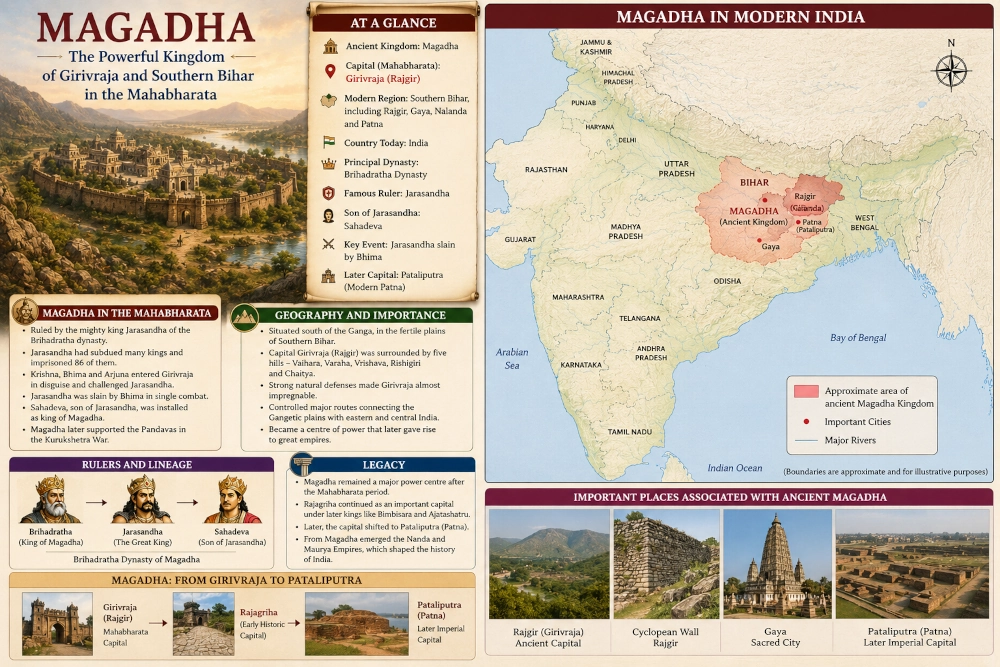
Among the kingdoms that dominate the political landscape of the Mahabharata, few possessed the military power, strategic importance and imperial ambition of Magadha. Centred in what is now southern Bihar, the kingdom broadly corresponds to the region around Rajgir, Gaya, Nalanda and Patna, although the political centre described in the Mahabharata is specifically Girivraja, generally identified with modern Rajgir.
Magadha’s most formidable Mahabharata ruler was Jarasandha, son of Brihadratha. His strength was so great that Krishna regarded him as the principal obstacle to Yudhishthira’s proposed Rajasuya. Jarasandha had subdued numerous kings, constructed a powerful network of allies and transformed Magadha into one of the dominant powers of eastern Bharat. His eventual death in single combat with Bhima changed the political balance of the subcontinent and opened the way for Yudhishthira’s imperial sacrifice.
Magadha therefore occupies an exceptional position in the epic. It was not simply another kingdom conquered during a Pandava digvijaya. It was already an imperial power in its own right.
Magadha at a Glance
| Feature | Description |
|---|---|
| Ancient Kingdom | Magadha |
| Mahabharata Capital | Girivraja |
| Modern Identification of Girivraja | Rajgir, Bihar |
| Broader Modern Region | Southern Bihar, including Rajgir, Gaya, Nalanda and Patna regions |
| Country Today | India |
| Principal Epic Dynasty | Brihadratha dynasty |
| Major Mahabharata Ruler | Jarasandha |
| Father of Jarasandha | Brihadratha |
| Successor after Jarasandha | Sahadeva, son of Jarasandha |
| Major Pandava Connection | Jarasandha slain by Bhima |
| Krishna Connection | Principal political opponent of Jarasandha |
| Rajasuya Importance | Jarasandha had to be eliminated before Yudhishthira could realistically claim imperial supremacy |
| Kurukshetra Connection | Jarasandha’s successor aligned with the Pandavas; other Magadhan warriors also appear in the war |
| Later Historical Capitals | Rajagriha and eventually Pataliputra |
| Modern Pataliputra | Patna |
The Geography of Ancient Magadha
The heart of Magadha lay south of the Ganga, in the fertile plains, river valleys and hill country of what is today southern Bihar.
The Mahabharata provides unusually vivid geographical details about the journey to Magadha. Krishna, Bhima and Arjuna travel east from the Kuru country, passing through Eastern Kosala and Mithila before crossing the Ganga and the Son and entering Magadha. Their destination is the fortified capital of Girivraja.
This places epic Magadha firmly within southern Bihar.
In modern geographical terms, the cultural and political heartland may broadly be visualised around:
Rajgir – Nalanda – Gaya – Patna and the adjoining southern Gangetic plains.
The boundaries of ancient kingdoms naturally changed over time and should not be treated like modern administrative borders.
Girivraja: The Mountain-Protected Capital
The Mahabharata’s description of Girivraja is particularly remarkable.
As Krishna approaches the city with Bhima and Arjuna, he points out five great hills surrounding it — Vaihara, Varaha, Vrishava, Rishigiri and Chaitya — portraying the mountains as natural guardians of the Magadhan capital. The city possessed plentiful water, cattle, forests and prosperous settlements.
Girivraja was therefore not an ordinary plains capital.
Its location among hills gave it formidable natural defences.
The epic describes it as virtually impregnable, prosperous and filled with well-fed inhabitants, markets and public activity.
This description fits the landscape of modern Rajgir, where hills still surround the ancient settlement.
The Bihar Tourism Department identifies Rajgir, ancient Rajagriha, as an early capital of Magadha and preserves the remains of an enormous ancient stone fortification known as the Cyclopean Wall around the hills.
The Brihadratha Dynasty
The Mahabharata associates Magadha with the Brihadratha dynasty.
Brihadratha was the father of Jarasandha, and the epic presents the royal house as already possessing considerable prestige before Jarasandha’s rise.
The Government of Bihar’s account of the state’s ancient history likewise preserves the traditional association of Brihadratha and Jarasandha with early Magadha.
Under Jarasandha, however, Magadha’s power reached an entirely different level.
He became not merely the ruler of a prosperous eastern kingdom but one of the strongest contenders for supremacy over the kings of Bharat.
The Extraordinary Birth of Jarasandha
Jarasandha’s very birth is one of the Mahabharata’s most famous royal legends.
King Brihadratha had received a boon intended to provide him with a son. Because the king had two queens, the substance associated with the boon was divided between them.
Each queen subsequently gave birth to only half of a child.
The two halves were discarded.
A being named Jara discovered them and joined them together. The moment the two halves were united, they became a living child.
Because he had been joined by Jara, the prince received the name Jarasandha.
The child grew into an exceptionally powerful warrior and eventually inherited the throne of Magadha.
The Mahabharata’s Sanskrit tradition describes Brihadratha installing Jarasandha as ruler before withdrawing into the forest.
Jarasandha Builds an Eastern Power Centre
Jarasandha did not remain merely king of Magadha.
He expanded his influence over numerous surrounding rulers and built an extensive political coalition.
When Krishna explains the geopolitical situation to Yudhishthira, Jarasandha is portrayed as having acquired such power that many royal houses could no longer oppose him. Important rulers had either submitted to him or entered his political orbit.
Among the rulers connected with his wider alliance were figures associated with Chedi, Karusha, Pragjyotisha and other eastern and central kingdoms.
Magadha had consequently become the nucleus of a major anti-Yadava political bloc.
The rise of Jarasandha demonstrates that political power in the Mahabharata world was not concentrated only in the Kuru-Panchala region.
Eastern Bharat possessed its own imperial centre — Magadha.
Jarasandha and Krishna
The rivalry between Jarasandha and Krishna is essential for understanding Magadha’s role in the epic.
Jarasandha developed intense hostility toward Krishna and the Yadavas following the death of Kamsa. The political relationship was reinforced by marriage ties: Kamsa had married daughters of Jarasandha.
The Mahabharata remembers Jarasandha as repeatedly threatening the Yadava position around Mathura. Krishna explains that the pressure exerted by Jarasandha contributed to the Yadavas shifting their centre westward to the strongly fortified city associated with Dvaraka.
The conflict therefore stretched across northern India:
Magadha in the east versus the Yadava power first centred around Mathura and subsequently Dvaraka in the west.
Jarasandha had become a geopolitical problem far larger than Magadha itself.
Why Jarasandha Stood in the Way of the Rajasuya
When Yudhishthira considered performing the Rajasuya Yajna, Krishna pointed out a fundamental political difficulty.
Yudhishthira could hardly claim imperial authority while Jarasandha remained undefeated.
The Magadhan ruler had already brought large numbers of kings under his power. The Mahabharata presents him as an effective rival claimant to paramount kingship.
According to the epic, Jarasandha had imprisoned eighty-six kings, intending eventually to accumulate one hundred captives.
Removing Jarasandha was therefore both a military and political prerequisite for the Rajasuya.
A conventional invasion of Magadha, however, would have been enormously difficult.
Girivraja was heavily protected.
Jarasandha commanded powerful forces.
And defeating him in a normal battle was uncertain.
Krishna therefore proposed another solution.
Krishna, Bhima and Arjuna Enter Magadha
Instead of marching against Girivraja with a huge army, Krishna, Bhima and Arjuna travelled secretly into Magadha.
They approached the city dressed as Snataka Brahmanas.
Their route, described in considerable geographical detail by the Sabha Parva, took them through the Gangetic world before they crossed the Ganga and Son and reached the hills surrounding Girivraja.
Krishna’s strategy was simple but audacious.
Jarasandha’s greatest strength was his army and fortified kingdom.
Rather than fighting Magadha, they would challenge Jarasandha himself.
Krishna believed Bhima possessed the physical strength necessary for the task.
Bhima Versus Jarasandha
When confronted, Jarasandha accepted the Kshatriya challenge.
Given the choice of his opponent, he selected Bhima.
The two warriors therefore fought without conventional weapons, relying upon physical strength and wrestling.
The contest became one of the Mahabharata’s great personal combats.
Both were extraordinarily powerful.
Jarasandha had ruled through military supremacy for years.
Bhima, however, was probably the only Pandava capable of matching him physically.
The struggle eventually ended with Jarasandha’s death.
With the Magadhan emperor gone, the greatest single political obstacle to Yudhishthira’s Rajasuya had disappeared.
The Captive Kings Are Freed
The consequences were immediate.
Krishna released the rulers who had been held captive by Jarasandha.
The fall of Magadha’s dominant king therefore transformed the political map of Bharat.
Kings who had previously lived under the threat of Jarasandha were suddenly free.
More importantly, Krishna and the Pandavas did not destroy the kingdom of Magadha.
They changed its ruler.
This distinction is important.
Sahadeva Becomes King of Magadha
After Jarasandha’s death, his son Sahadeva approached Krishna, Bhima and Arjuna.
Krishna reassured him and installed him as the new sovereign of Magadha. Sahadeva then entered his father’s capital as king.
This was an astute political settlement.
Magadha was not annexed to Indraprastha.
Its dynasty was not eliminated.
Instead, a powerful hostile kingdom became a friendly allied monarchy.
Jarasandha’s personal imperial system had been dismantled, while Magadha itself continued under his son.
Bhima Returns to Magadha During the Eastern Digvijaya
After Jarasandha had been removed, the Pandavas began their formal campaigns for Yudhishthira’s Rajasuya.
Bhima was assigned the east.
During this campaign he returned to the Magadhan sphere.
The Sabha Parva states that Bhima approached Girivraja and brought the son of Jarasandha under Yudhishthira’s authority through conciliation, receiving tribute before continuing farther east.
This passage demonstrates the new political order.
Magadha remained autonomous under its king, but acknowledged Yudhishthira’s imperial position for the purposes of the Rajasuya.
The transformation had been dramatic:
Jarasandha’s Magadha — rival imperial power
became
Sahadeva’s Magadha — allied kingdom within Yudhishthira’s political sphere.
Magadha Supports the Pandavas at Kurukshetra
The political settlement created after Jarasandha’s death appears to have endured.
As preparations for the Kurukshetra War intensified, the Udyoga Parva records that the son of Jarasandha, king of Magadha, joined the Pandava camp with an entire Akshauhini of troops.
This was a major military contribution.
An Akshauhini represented one of the great field formations used by the Mahabharata to describe the enormous armies assembled at Kurukshetra.
Thus the dynasty that had once been one of Krishna’s greatest enemies eventually supplied troops to the Pandava alliance.
Magadha’s political orientation had been completely reshaped by the death of Jarasandha.
Magadha’s Royal House at Kurukshetra
The picture is nevertheless somewhat more complex.
The Karna Parva also mentions Jayatsena, a son of Jarasandha and prince of the Magadhas, among warriors killed in battle, and elsewhere Magadhan troops appear among major eastern contingents.
This may indicate that different branches or contingents associated with Magadha participated on different sides, a phenomenon seen repeatedly in the Mahabharata.
Ancient kingdoms were not always politically monolithic.
Dynastic relatives, subordinate rulers and military contingents could support opposing alliances.
What remains clear is that the Magadhan ruler who succeeded Jarasandha entered the principal Pandava coalition.
Magadha in the Geography of Bharatavarsha
The Bhishma Parva’s geographical description of Bharatavarsha explicitly lists the Magadhas among its recognised peoples and territories, alongside Videha, Anga, Vanga, Kalinga and other eastern regions.
This placement reflects Magadha’s position at the centre of an increasingly important eastern political world.
To its north lay the Ganga and the territories extending toward Videha.
To the east lay Anga and the regions leading toward Bengal.
To the west lay territories connecting Magadha with Kosala and the central Gangetic basin.
To the south lay uplands and routes toward central and eastern India.
Magadha’s location allowed it to command the intersection of major river corridors and overland routes.
The Natural Fortress of Rajgir
Among all Mahabharata kingdoms, Magadha possessed one of the most defensible capitals.
Modern Rajgir remains surrounded by hills, preserving the fundamental geography described in the Sabha Parva.
Even today, extensive remains of the Cyclopean Wall run through the Rajgir landscape. Bihar Tourism describes the ancient defensive system as extending for tens of kilometres around the old city.
The landscape helps explain Jarasandha’s strength.
An enemy attempting to conquer Magadha by direct invasion would have had to penetrate a fortified city protected by mountainous terrain.
Krishna’s decision to bypass Magadha’s military defences and remove its king through personal combat therefore appears within the epic as an exercise in strategy rather than brute-force invasion.
From Girivraja to Pataliputra
An important chronological distinction should be maintained.
Pataliputra — modern Patna — was not the capital of Jarasandha in the Mahabharata.
The epic’s Magadhan capital is Girivraja, identified with Rajgir.
Pataliputra became the great political centre of Magadha considerably later in historical tradition.
Bihar government sources identify Rajgir/Rajagriha as the earlier capital of Magadha under rulers such as Bimbisara and Ajatashatru, while Pataliputra subsequently emerged as the capital and remained the centre of several great dynasties.
That distinction is especially important when placing Mahabharata Magadha on a modern map.
The kingdom may broadly cover southern Bihar, including the modern Patna region, but the epic’s royal centre should be marked at Rajgir rather than Patna.
Magadha on the Modern Map
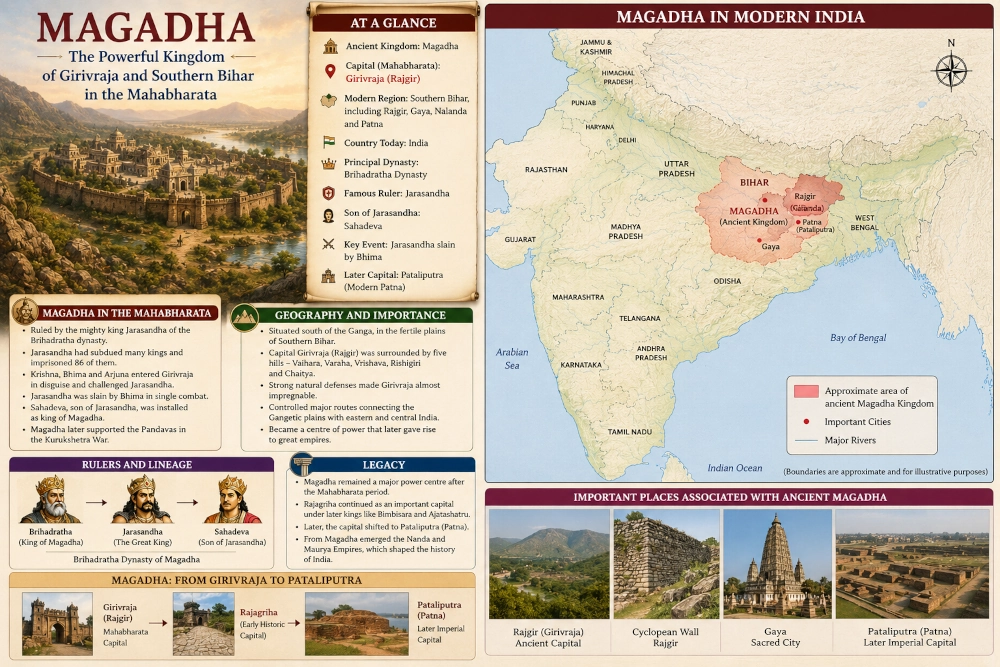
In our modern geographical series, ancient Magadha can broadly be represented as:
Magadha → southern Bihar → Rajgir, Nalanda, Gaya and the Patna region → India
Modern Identification
| Ancient Geography | Modern Identification |
|---|---|
| Magadha | Southern Bihar |
| Girivraja / Rajagriha | Rajgir |
| Mahabharata Capital | Girivraja |
| Later Imperial Capital | Pataliputra |
| Pataliputra Today | Patna |
| Major Modern Regions | Rajgir, Nalanda, Gaya and Patna |
| Modern State | Bihar |
| Country | India |
The shaded territory on any reconstructed map should be marked as approximate, since the political frontiers of Magadha changed dramatically over different periods.
From Mahabharata Kingdom to Historical Empire
Magadha’s story did not end with the Mahabharata tradition.
In later historically documented centuries, the same southern Bihar heartland became the base of some of the most powerful states in Indian history.
Rajagriha remained important under rulers such as Bimbisara and Ajatashatru, while the political centre later shifted toward Pataliputra.
From this region eventually emerged the Nanda and Maurya empires, followed later by other major dynastic centres associated with Pataliputra. Bihar Tourism identifies ancient Pataliputra with modern Patna and notes its long history as the capital of Magadha-based imperial states.
It would be incorrect to collapse all of these periods into the Mahabharata age.
Yet the continuity of geography is striking.
The hill-protected Magadha of Jarasandha eventually became the Gangetic imperial heartland from which some of India’s largest historical empires were governed.
Magadha’s Place in the Mahabharata
Magadha is one of the clearest examples of genuine great-power politics within the Mahabharata.
Under Jarasandha, it possessed:
a heavily protected capital, a powerful army, subordinate kings, distant alliances, influence across eastern and central Bharat, and ambitions approaching imperial supremacy.
It was powerful enough to threaten Krishna and the Yadavas.
It was influential enough that Yudhishthira’s Rajasuya could not proceed while Jarasandha remained undefeated.
And it was strategically difficult enough that Krishna chose infiltration and individual combat rather than a conventional military invasion.
The death of Jarasandha therefore represents far more than Bhima defeating another famous warrior.
It was a geopolitical turning point.
With Jarasandha dead, captive rulers were freed, Sahadeva was placed on the Magadhan throne, Magadha entered the Pandava sphere, and the path to Yudhishthira’s Rajasuya opened.
Later, when Bharat divided into the two enormous coalitions that fought at Kurukshetra, Jarasandha’s successor stood among the rulers supporting the Pandavas.
Magadha thus moved from being one of the Pandavas’ greatest strategic obstacles to becoming one of their important eastern allies.
And unlike many kingdoms remembered principally through epic tradition, the geography of Magadha remains extraordinarily tangible.
The hills still rise around Rajgir.
The remains of ancient fortifications still cross the landscape.
The Ganga and Son still frame southern Bihar.
And farther north-west within the later Magadhan sphere stands Patna — ancient Pataliputra — the city that would eventually inherit the political importance once centred in the mountain fortress of Girivraja.
References
Mahabharata — Sabha Parva, Rajasuyarambha Parva
Krishna explains Jarasandha’s enormous political power, his alliances and the obstacle he presents to Yudhishthira’s Rajasuya.
Mahabharata — Sabha Parva, Jarasandha-badha Parva
Describes Krishna, Bhima and Arjuna’s journey to Magadha, Girivraja’s surrounding hills, the challenge to Jarasandha, his combat with Bhima and the installation of his son Sahadeva.
Mahabharata — Sabha Parva, Bhima’s Eastern Digvijaya
Records Bhima’s return to Girivraja and the submission and tribute of Jarasandha’s son during the Rajasuya campaign.
Mahabharata — Udyoga Parva
Records Jarasandha’s son, king of Magadha, joining the Pandava forces with an Akshauhini.
Mahabharata — Bhishma Parva
Lists the Magadhas among the recognised peoples of Bharatavarsha.
Government of Bihar — Bihar Tourism and State Historical Resources
Identify Rajgir/Rajagriha with the early capital of Magadha, document the ancient defensive remains around Rajgir and identify Pataliputra with modern Patna.
You may also like
-
Videha or Mithila in the Mahabharata: The Ancient Kingdom of Janaka Across Northern Bihar and Nepal’s Terai
-
India Expands Cultural Diplomacy Across 98 Countries, Taking Its Civilisational Heritage to the World
-
Dakshina Kosala in the Mahabharata: The Ancient Kingdom of Chhattisgarh and Western Odisha
-
Kosala in the Mahabharata: The Ancient Kingdom of Ayodhya and the Sarayu
-
Kashi in the Mahabharata: The Ancient Kingdom of Varanasi and Its Role in the Kurukshetra Age
