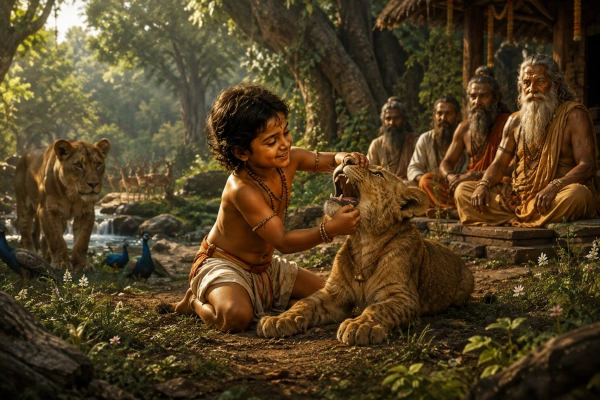
The childhood of Bharata, the son of Shakuntala and King Dushyanta, is one of the most striking episodes connected with the early generations of the Mahabharata. Long before Bharata became a celebrated emperor, the boy grew up in the forest hermitage of Rishi Kanva, surrounded not by palace guards and royal tutors, but by sages, deer, elephants, tigers and lions. Even as a small child, he displayed such extraordinary strength and fearlessness that the ascetics of the hermitage gave him the name Sarvadamana, meaning “the one who subdues all.”
The popular image of the young Bharata forcing open the mouth of a lion cub and counting its teeth has become closely associated with this childhood. A textual distinction, however, is worth preserving. The Mahabharata describes Bharata overpowering lions, tigers, elephants, buffaloes and other wild animals and even binding them to trees, while the specific scene in which he attempts to count the teeth of a lion cub appears more explicitly in Kalidasa’s later drama Abhijnanashakuntalam. Kalidasa’s scene is therefore a vivid dramatic development of the extraordinary childhood already described in the Mahabharata.
The Son Born in Kanva’s Forest
After King Dushyanta departed from Kanva’s hermitage, Shakuntala continued to live under the protection of the sage. In that secluded forest settlement she gave birth to a son who, from his earliest years, showed qualities that distinguished him from ordinary children.
The hermitage in which Bharata grew up stood in a world where human settlement merged naturally into wilderness. The huts of the ascetics were surrounded by trees, streams and open forest, while deer wandered near the sacrificial enclosures and powerful wild animals inhabited the deeper woodland beyond. Bharata therefore grew up in direct contact with nature rather than within the protected surroundings of a royal palace.
The Mahabharata describes him as developing with extraordinary speed and possessing unusual physical power even while still very young. His body bore auspicious marks, his appearance was radiant, and his strength soon became impossible for the inhabitants of the hermitage to ignore.
By the time the boy was around six years old, the forest itself had effectively become his playground.
A Child Who Treated Lions as Playmates
For the other residents of the hermitage, the appearance of a lion or tiger would have been a matter requiring caution. Bharata viewed such animals very differently.
When he encountered powerful creatures in the forest, he did not run from them. Instead, he pursued them, caught them and attempted to bring them under his control. The Mahabharata says that the young boy seized lions, tigers, wild boars, buffaloes and elephants, sometimes dragging them toward the hermitage and tying them to trees.
One can imagine the astonishment this must have caused among Kanva’s disciples. A sage emerging from his hut might discover that the young prince had returned from another adventure with a wild animal in tow. Somewhere nearby a lion might be struggling against the restraint placed upon it, while an elephant or buffalo that would normally terrify an adult warrior had become another object of Bharata’s childhood curiosity.
The extraordinary element in the story is not merely Bharata’s strength. It is the complete absence of fear with which he approached these animals.
To him, the wilderness did not seem threatening. Its most powerful creatures became companions in contests of strength.
Why He Was Called Sarvadamana
The ascetics eventually gave the boy a name that reflected what they were witnessing.
They called him Sarvadamana.
The Sanskrit expression carries the sense of one who restrains, subdues or brings everything under control. The name arose because the child was capable of overpowering animals that even grown men would normally avoid.
The Mahabharata specifically associates the name with his ability to restrain the powerful creatures of the forest.
Sarvadamana was therefore not merely an affectionate childhood nickname. It was an early recognition of the boy’s extraordinary nature and, in retrospect, an indication of the imperial destiny that awaited him.
The child who could subdue the animals of the forest would one day become a ruler capable of bringing powerful kings under his authority.
The Famous Lion-Cub Episode
The most charming version of Bharata’s childhood appears later in Kalidasa’s Abhijnanashakuntalam.
In the drama, King Dushyanta encounters a fearless child near the hermitage without initially realising that the boy is his own son. Bharata is playing with a lion cub and handling it with such complete confidence that the adults around him become alarmed.
The child has dragged the cub away and refuses to release it despite repeated warnings.
He then wants the cub to open its mouth because he wishes to count its teeth.
The scene captures Bharata’s temperament beautifully. He is not trying to prove his courage because he does not appear to realise that courage is required. To him, the lion cub is simply another creature with which he wishes to play.
The adults understand the danger because they know that the lioness may be nearby and that even a young lion possesses considerable strength. Bharata, however, treats the entire situation with the innocence of a child combined with the fearlessness of a warrior.
Although the exact teeth-counting episode belongs to Kalidasa’s dramatic retelling, it is entirely consistent with the personality attributed to Sarvadamana in the Mahabharata.
The Forest Becomes Bharata’s First Training Ground
Bharata’s unusual childhood is significant because his earliest experiences occur completely outside the world of royal power.
He has no palace, no army and no formal military command. He does not yet know that he is the son of one of the great kings of the Puru lineage.
Instead, the forest becomes his first arena.
The lion tests his courage, the tiger tests his speed, the buffalo tests his physical strength and the elephant tests his ability to dominate an animal far larger than himself.
The Mahabharata later recalls these childhood exploits when describing Bharata’s greatness. His ability to overpower powerful animals becomes one of the signs that the boy was destined for exceptional kingship.
There is also an important symbolic dimension to the story. Ancient Indian royal literature frequently portrays the ability to control powerful animals as an indication of sovereignty. The ruler is expected to possess enough strength to restrain disorder without being overcome by it.
The name Sarvadamana therefore anticipates the adult Bharata.
Kanva Recognises the Boy’s Royal Destiny
Rishi Kanva eventually understood that the boy could not remain indefinitely within the hermitage.
Bharata possessed qualities appropriate to a ruler, and his father was King Dushyanta. The time had therefore come for the boy’s royal identity to be acknowledged.
Shakuntala was consequently instructed to take her son to Dushyanta’s court.
For Bharata, the journey represented a profound change. Until then, his life had been shaped by the silence of the forest, the discipline of the sages and the presence of wild animals. He was now being taken into the very different world of kingship, dynastic legitimacy and court politics.
The fearless child who had wrestled with the creatures of the wilderness was about to confront a problem that physical strength alone could not solve.
His own father would initially refuse to recognise him.
Shakuntala Brings Bharata Before Dushyanta
When Shakuntala entered Dushyanta’s court with her son, she reminded the king of their earlier union and presented the boy as his legitimate heir.
The child standing beside her was already remarkable in appearance and strength. Yet recognition of his royal status depended upon Dushyanta publicly accepting his paternity.
The king initially refused.
The Mahabharata presents the resulting confrontation largely through Shakuntala’s powerful defence of truth, marriage, motherhood and the responsibilities of a father toward his son.
She reminds Dushyanta that a son represents the continuation of his father and that rejecting one’s own child is not merely a personal failure but a violation of dharma.
The situation creates a striking contrast with Bharata’s childhood.
The boy who could physically overcome lions and elephants now stood powerless before a question of social recognition. He could conquer an animal through strength, but he could not establish his lineage simply by force.
That responsibility belonged to the adults around him.
Divine Intervention Establishes Bharata’s Identity
The dispute is finally resolved when a celestial proclamation confirms that Shakuntala has spoken the truth and that the boy is indeed Dushyanta’s son.
Dushyanta then acknowledges Shakuntala and accepts the child.
The boy who had been known in the hermitage as Sarvadamana now enters the royal lineage as Bharata.
The Mahabharata subsequently presents him as the legitimate heir and later as a ruler of extraordinary stature.
The transition is symbolically important. Sarvadamana represents the child whose power reveals itself naturally in the forest, while Bharata becomes the recognised prince whose strength will eventually be exercised within the political world.
From the Child of the Forest to a Chakravartin
Bharata eventually grew into one of the great monarchs remembered in the epic tradition.
The Mahabharata describes him as a powerful ruler who extended his authority widely, defeated rival kings and performed important royal sacrifices. He came to be remembered as a Chakravartin, an imperial sovereign whose authority extended across a vast political sphere.
His childhood therefore appears almost prophetic.
When Bharata seized lions and bound powerful animals to trees, he was unknowingly demonstrating the same quality that would later define his kingship: the ability to confront formidable power without hesitation and bring it under control.
The scale changed, but the underlying character remained the same.
As a child, he subdued the wilderness. As a king, he subdued rival rulers.
The Lion and the Future Emperor
The enduring appeal of the lion-cub episode lies in the contrast between Bharata’s age and his complete absence of fear.
A young child sits beside one of the most powerful animals of the forest and is fascinated not by the danger it represents, but by something as innocent as the number of teeth inside its mouth.
The scene captures Bharata before kingship, warfare and imperial ambition entered his life.
He is simply curious.
Yet his curiosity is combined with extraordinary physical confidence.
The cub struggles, the adults worry and the boy continues examining the animal as though nothing unusual is happening.
Kalidasa turned that quality into a memorable dramatic scene, but the foundation was already present in the Mahabharata’s portrayal of Sarvadamana.
The epic’s Bharata was a child who could capture lions, overpower tigers, restrain buffaloes and confront elephants while still living in Kanva’s hermitage.
The sages therefore called him Sarvadamana because even the strongest creatures of the forest seemed unable to intimidate him.
That childhood image eventually became an appropriate beginning for the life of Bharata, the emperor whose fame would become deeply woven into the civilisational memory of Bharatavarsha.
The Deeper Meaning of Bharata’s Childhood
The story is not simply an account of supernatural childhood strength.
It establishes Bharata’s character before he acquires political power.
He is courageous before anyone crowns him, powerful before anyone commands him and naturally dominant before he even understands what kingship means.
His greatness therefore does not originate in the throne.
The throne merely gives political expression to qualities that were already visible when he was a child in the forest.
This is what makes the image of young Bharata among the lions so powerful.
Before he was surrounded by ministers, warriors and royal banners, he was surrounded by trees, hermits and wild animals. Before rival kings learned the power of his arms, the lions and elephants of Kanva’s forest had already encountered the fearless child who would one day become one of the legendary sovereigns of ancient Bharat.
You may also like
-
Ayush Patent Filings Rise Eightfold as India Records 4,077 Applications and 711 Grants in 12 Years
-
DRDO Announces Paid Research Internships at Gwalior for Science and Engineering Students
-
PM-SETU: Government Approves ₹1,194.92 Crore to Modernise 25 ITIs Across Maharashtra, Odisha and Jammu & Kashmir
-
Indian Railways Announces 3,548 NTPC Graduate Vacancies, Applications Open Until November 6, 2026
-
Durga versus Mahishasura: Weapons, Battlefield Tactics and the Triumph of Shakti
