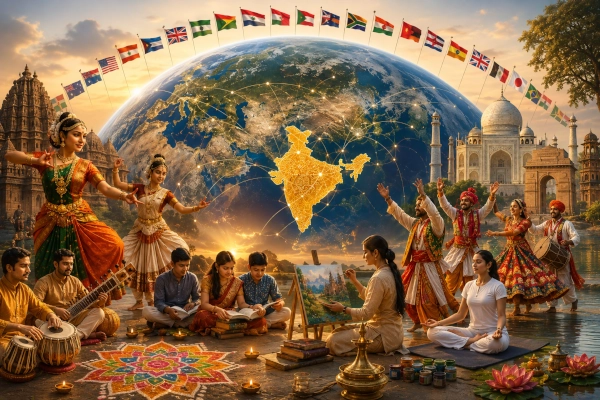
India is increasingly placing culture at the centre of its engagement with the world, using its civilisational heritage, performing arts, traditional knowledge systems and contemporary creative industries to build stronger people-to-people relations with countries across the globe. According to DD News, India’s cultural outreach now extends across 98 countries, reflecting the growing importance of cultural diplomacy alongside conventional political and economic engagement.
The approach goes beyond organising occasional cultural performances overseas. Through institutions such as the Indian Council for Cultural Relations (ICCR), India supports cultural exchanges, festivals, artistic delegations, academic interaction and programmes aimed at creating greater international understanding of the country. ICCR itself describes fostering cultural relations and mutual understanding between India and other countries as one of its central objectives.
Indian classical music and dance, folk traditions, theatre and contemporary performing arts form an important part of this outreach. ICCR says that, in recent years, more than 160 Indian cultural groups have travelled abroad annually, with artists representing different regions of the country participating in festivals, Cultural Exchange Programmes and other international events. Thousands of Indian cultural troupes have travelled overseas during the organisation’s seven-decade history.
India’s cultural diplomacy increasingly presents the country not merely as the custodian of an ancient civilisation but as a society where heritage and modernity coexist. Yoga, Ayurveda, Indian languages, literature, classical and folk arts, cinema, cuisine, handicrafts and India’s expanding creative economy have become different channels through which global audiences encounter the country.
Major international platforms are also being used to reinforce this message. At Expo 2025 Osaka, for example, India’s Bharat Mandap combined representations of ancient knowledge systems and cultural traditions with displays relating to innovation, Ayurveda, ISRO and sustainability. DD News described the pavilion as an example of India’s cultural diplomacy, built around the idea of presenting both India’s heritage and its modern aspirations to an international audience.
This strategy gives India an important form of soft power. Diplomatic relationships are normally associated with governments, treaties and strategic interests, but cultural connections can establish familiarity and goodwill at the level of ordinary people. A foreign audience encountering Bharatanatyam, Hindustani or Carnatic music, Yoga, Indian cinema or an Indian festival can develop a connection with India independent of formal diplomatic negotiations.
The growing cultural outreach also reflects India’s broader effort to project itself internationally as a civilisational state. The ICCR has emphasised that changing global political and economic balances are increasingly being accompanied by what it describes as a cultural rebalancing, creating greater space for India’s own ideas and traditions on the world stage.
The significance of India’s engagement with 98 countries therefore extends beyond cultural promotion alone. It represents an attempt to turn India’s extraordinary diversity—its languages, philosophies, art forms, traditions and creative talent—into a durable bridge connecting India with societies across continents.
As India’s economic and strategic weight grows, cultural diplomacy is emerging as another important pillar of its global presence. Rather than relying entirely on the instruments of conventional power, New Delhi is increasingly allowing India’s civilisation, artists, knowledge traditions and contemporary creators to speak directly to the world.
You may also like
-
US Double Standards in Foreign Policy: 16 Recent Cases Involving India, Russia, China and Global Trade
-
Indian Navy Vice Chief Inspects Japan’s Mogami-Class Stealth Frigate as India-Japan Shipbuilding Cooperation Expands
-
Sindhu: The Indus Kingdom of Jayadratha in the Mahabharata
-
INS Trishul Arrives in UK for Exercise KONKAN 2026 as India and Royal Navy Expand Maritime Cooperation
-
INS Sahyadri Arrives in Russia for Exercise INDRA 2026 to Strengthen India-Russia Naval Cooperation
