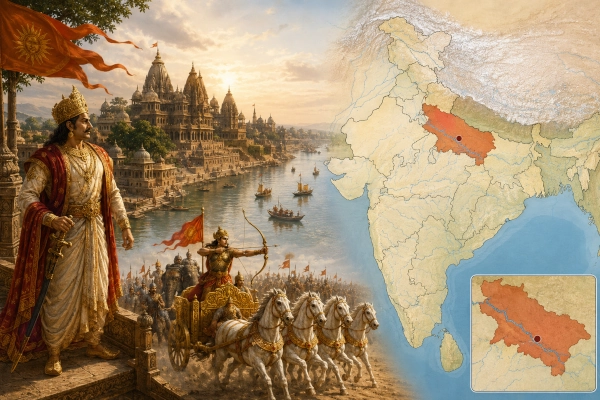
Among the great kingdoms remembered in the Mahabharata, Kosala carried a prestige that reached far beyond its political power. Centred in the Sarayu river region of present-day Uttar Pradesh and traditionally associated with Ayodhya, Kosala was already one of the most celebrated royal lands of ancient Bharat.
Its fame was inseparable from the Ikshvaku or Solar dynasty and the memory of Bhagwan Rama. Yet Kosala did not disappear from the political landscape after the age represented by the Ramayana. The Mahabharata shows the kingdom still functioning as an important monarchy generations later, interacting with the Pandavas, participating in Yudhishthira’s imperial campaigns and eventually sending its ruler into the great war at Kurukshetra.
The Mahabharata-era ruler most clearly associated with Kosala is King Brihadbala — Vrihadvala in some translations. He was defeated by Bhima during the Pandavas’ campaigns before the Rajasuya, but later fought on the side of Duryodhana in the Kurukshetra War.
His final battle brought together two of India’s most celebrated royal traditions: the king of ancient Kosala faced Abhimanyu, the young son of Arjuna, inside the terrible battle formation of the thirteenth day.
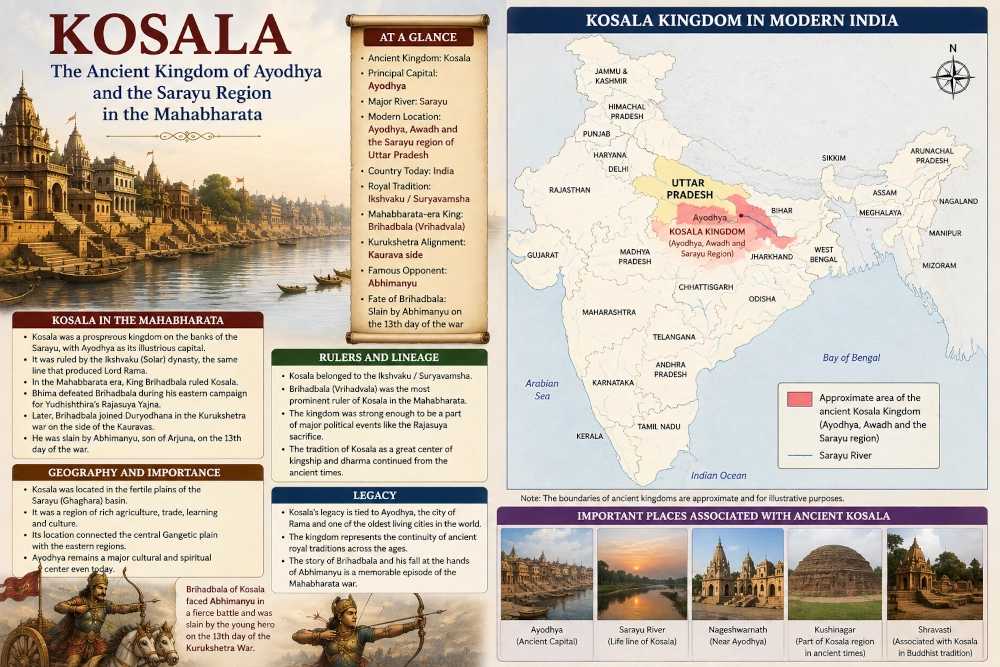
Kosala at a Glance
| Feature | Description |
|---|---|
| Ancient Kingdom | Kosala |
| Principal Capital traditionally associated with it | Ayodhya |
| Major River | Sarayu |
| Modern Location | Ayodhya, Awadh and adjoining Sarayu region of Uttar Pradesh |
| Country Today | India |
| Royal Tradition | Ikshvaku / Suryavamsha |
| Mahabharata-era King | Brihadbala or Vrihadvala |
| Rajasuya Period | Defeated by Bhima during his eastern campaign |
| Kurukshetra Alignment | Kaurava side |
| Famous Opponent | Abhimanyu |
| Fate of Brihadbala | Slain by Abhimanyu on the thirteenth day |
The Land of Kosala
Kosala occupied an important part of the middle Gangetic plain, with the Sarayu forming the geographical and cultural heart of the kingdom.
Ayodhya stands today on the banks of the Sarayu in Uttar Pradesh. The official Ayodhya district administration itself describes the city as the ancient capital of the Kosala Kingdom.
In broad modern geographical terms, the ancient Kosala heartland may therefore be associated with:
Ayodhya → Awadh → the Sarayu-Ghaghara basin of eastern-central Uttar Pradesh
The ancient kingdom should not, however, be drawn as though its boundaries followed modern district lines. Political territories changed repeatedly, and the Mahabharata itself makes distinctions between Kosala, Ayodhya and northern Kosala in some passages.
This is an important point when reconstructing the geography of the epic.
Kosala, Ayodhya and Northern Kosala in the Mahabharata
One of the most interesting geographical passages occurs during Bhima’s eastern campaign before Yudhishthira’s Rajasuya sacrifice.
Bhima first defeated Brihadbala, king of Kosala.
The text then separately says that he defeated Dirghayaghna of Ayodhya, and afterwards subdued the northern Kosalas.
This suggests that by the political world represented in the Mahabharata, the broader region associated with ancient Kosala may have contained more than one royal or territorial division.
Therefore, identifying every Mahabharata reference to Kosala simply with a single fixed state centred on Ayodhya would be too simplistic.
The larger Sarayu-Awadh cultural region, however, remains the best modern geographical reference for the northern Kosala tradition.
Ayodhya: The Ancient Heart of Kosala
No city is more closely associated with Kosala than Ayodhya.
Long before the Kurukshetra generation, Ayodhya had become one of the great cities of Indian civilisational memory.
The city was the centre of the royal tradition of:
- Ikshvaku
- Sagara
- Bhagiratha
- Raghu
- Dasharatha
- Bhagwan Rama
The Mahabharata therefore inherited a world in which Kosala and Ayodhya already possessed immense antiquity.
The importance of Kosala in the Mahabharata must be understood against this background.
The kingdom appearing in the Kurukshetra narrative was the later political heir of one of the most celebrated royal traditions known to ancient India.
Brihadbala: King of Kosala
The most important Kosala ruler of the Kurukshetra period was Brihadbala, frequently rendered Vrihadvala in the Kisari Mohan Ganguli translation.
Later genealogical traditions place Brihadbala in the Ikshvaku-Suryavamsha succession associated with Rama. The Government of Uttar Pradesh’s Basti district history similarly preserves the tradition of Brihadbala as a later ruler of the Ikshvaku line who fell in the Mahabharata War.
Within the Mahabharata itself, what is particularly secure is his political identity:
Brihadbala was the ruler of Kosala.
And he was powerful enough to appear repeatedly in the political and military narrative.
Bhima Conquers Kosala
Before Yudhishthira could perform the Rajasuya Yajna, the Pandavas had to establish their political supremacy over neighbouring kingdoms.
The four younger Pandava brothers therefore undertook campaigns in different directions.
Bhima was entrusted with the east.
During this campaign he reached Kosala.
The Sabha Parva states that Bhima defeated:
Brihadbala, the king of Kosala.
He subsequently defeated Dirghayaghna of Ayodhya and brought the northern Kosalas under his authority.
The episode establishes several things about Kosala.
It was still an independent and militarily capable kingdom.
It possessed its own ruler.
And its submission mattered to Yudhishthira’s claim to imperial authority.
Kosala and Yudhishthira’s Rajasuya
Having been brought within Yudhishthira’s sphere of authority, rulers from across Bharat gathered for the Rajasuya.
Brihadbala appears among the many kings attending Yudhishthira’s great imperial sacrifice.
This was characteristic of ancient Indian interstate politics as portrayed in the epic.
Military defeat did not necessarily mean destruction of a kingdom.
A defeated monarch could continue ruling his territory while acknowledging the superior political status of another king and providing tribute.
Kosala therefore retained its royal identity even after Bhima’s campaign.
From Yudhishthira’s Rajasuya to Duryodhana’s Alliance
One of the striking features of the Mahabharata is how dramatically political alliances changed between the Rajasuya and the Kurukshetra War.
Although Brihadbala had earlier submitted to Bhima and participated in Yudhishthira’s imperial order, he later entered the Kurukshetra conflict on the Kaurava side.
Before the battle, Bhishma listed Brihadbala among the powerful rulers and commanders prepared to fight for Duryodhana.
The Kosala king appears alongside warriors such as:
- Drona
- Kripa
- Ashwatthama
- Kritavarma
- Bhagadatta
- the rulers of Trigarta
- Vinda and Anuvinda of Avanti
- and other major allies of the Kauravas.
Thus Kosala entered the great conflict as one of the recognised royal contingents supporting Hastinapura under Duryodhana.
Why Did Kosala Fight for the Kauravas?
The Mahabharata does not provide a detailed diplomatic explanation for Brihadbala’s decision.
It would therefore be speculative to attribute his alliance to a single cause.
The political world of the epic was built from a complicated network of:
- dynastic marriages;
- previous military campaigns;
- personal friendships;
- rivalries;
- obligations;
- regional interests;
- and relations with the Kuru court.
A ruler who had acknowledged Yudhishthira during the Rajasuya could still choose Duryodhana when the Kuru succession dispute became an open war.
Kosala demonstrates how fluid the interstate politics of the Mahabharata could be.
Kosala on the Battlefield of Kurukshetra
Brihadbala was not merely a king who contributed troops while remaining away from danger.
He personally fought at Kurukshetra as a chariot warrior.
His name appears repeatedly in descriptions of the Kaurava army.
But his most famous appearance came during the thirteenth day of the war.
That was the day Drona organised the formidable battle formation into which Abhimanyu, the young son of Arjuna and Subhadra, entered.
It would become one of the most tragic and heroic episodes of the entire Mahabharata.
Brihadbala Faces Abhimanyu
After penetrating deep into the Kaurava formation, Abhimanyu became isolated from the other Pandava warriors.
He was surrounded by some of the greatest warriors of Duryodhana’s army.
Among them were:
Drona, Kripa, Karna, Ashwatthama, Kritavarma and Brihadbala of Kosala.
Despite being vastly outnumbered, Abhimanyu continued attacking the surrounding forces.
Brihadbala entered into direct combat with him.
The Kosala king struck Abhimanyu in the chest with a powerful arrow.
Abhimanyu responded immediately.
He destroyed Brihadbala’s horses, standard, bow and charioteer, leaving the king without his chariot.
The Last Charge of the King of Kosala
Brihadbala did not withdraw.
Deprived of his chariot and bow, the king drew his sword and attempted to close upon Abhimanyu.
The young warrior struck first.
Abhimanyu fired a powerful arrow into the chest of the ruler of Kosala.
Brihadbala fell on the battlefield.
The Drona Parva explicitly records the death of the ruler of the Kosalas at the hands of Abhimanyu.
The death is especially memorable because Abhimanyu himself would soon be surrounded and killed after one of the most extraordinary individual stands in the war.
Brihadbala therefore became one of the prominent kings slain during Abhimanyu’s final battle.
Two Great Royal Traditions Meet at Kurukshetra
The encounter possesses a remarkable symbolic character when viewed through India’s larger epic tradition.
On one side stood Brihadbala of Kosala, connected by later genealogical tradition with the ancient Solar dynasty and the royal inheritance of Ayodhya.
On the other stood Abhimanyu, grandson of the Pandava and Yadava houses through Arjuna and Subhadra.
Their battle represents the extraordinary scale of Kurukshetra.
The war was not merely a dispute involving one royal family around Hastinapura.
Kings from across Bharat entered the struggle, bringing some of the subcontinent’s oldest dynastic traditions onto the same battlefield.
Kosala in the Mahabharata’s Political Geography
Geographically, Kosala occupied an important position.
The Sarayu region lay between the great political centres of the western and eastern Gangetic plains.
To the west were territories associated with:
- Kuru
- Panchala
- Matsya
Farther east lay:
- Kashi
- Videha
- Magadha
- Anga
Kosala therefore occupied an important zone connecting different parts of northern India.
Its fertile plains, river systems and established settlements would have made the region important agriculturally as well as strategically.
The Sarayu and the larger Ganga river system provided natural corridors for movement, commerce and cultural exchange.
The Sarayu: River of Kosala
The Sarayu forms the central geographical feature of the Kosala tradition.
Ayodhya developed beside this river, and the surrounding plains became one of the most important cultural landscapes of northern India.
Even today the association survives almost unchanged.
Modern Ayodhya continues to stand beside the Sarayu, providing an unusually strong geographic link between ancient literary tradition and the landscape of present-day India.
For a modern map of the Mahabharata kingdoms, Kosala should therefore be located primarily around the Ayodhya–Sarayu–Awadh region of Uttar Pradesh.
Kosala Was Larger Than Modern Ayodhya District
The ancient kingdom should not be reduced to the boundaries of today’s Ayodhya district.
Its broader cultural and political sphere likely incorporated portions of the surrounding Sarayu-Ghaghara basin.
The history page of the modern Basti district, for example, records that the Basti region was considered part of ancient Kosala.
A cautious modern representation can therefore place Kosala across a broader zone incorporating Ayodhya and parts of the neighbouring Awadh and eastern Uttar Pradesh landscape.
The exact borders should remain approximate.
Kosala and the Tradition of Kingship
Kosala also appears in the Mahabharata outside the immediate Kurukshetra narrative.
In the Shanti Parva, Bhishma recounts the story of Vasumanas, a king of Kosala, who approaches the sage Brihaspati seeking instruction about kingship and the welfare of his people.
The episode becomes the setting for a discussion on royal authority, social order and responsible governance.
This is significant because Kosala appears not merely as a military kingdom but also within the Mahabharata’s extensive discussions of Rajadharma — the duties of kingship.
Such passages preserve the older reputation of Kosala as a land associated with royal government and dharmic kingship.
The Memory of Rama Behind Mahabharata-Era Kosala
Any discussion of Kosala inevitably leads back to Rama.
But it is useful to distinguish the two epic settings.
The Ramayana presents Kosala at the centre of its story, with Ayodhya as the royal city of Dasharatha and Rama.
The Mahabharata portrays a much later political world in which Kosala remains an identifiable kingdom but is now one among many powerful states competing across Bharatavarsha.
This continuity is one of the fascinating features of the Indian epics.
Kingdoms remembered from one great narrative continue appearing within another.
Ayodhya’s district administration still identifies the city as the ancient capital of Kosala, while official history material from neighbouring Basti preserves the traditional connection between Brihadbala and the Mahabharata War.
Kosala on the Modern Map of India
For our modern geographical series, Kosala can be represented approximately as:
Kosala → Ayodhya, Awadh and the Sarayu region → Uttar Pradesh → India
The centre should be placed at Ayodhya.
The highlighted region can extend through the adjoining Sarayu-Ghaghara plains while remaining clearly labelled as an approximate ancient geographical zone rather than an exact political boundary.
Modern Identification
| Ancient Geography | Modern Geography |
|---|---|
| Kosala | Ayodhya and Awadh region |
| Royal centre | Ayodhya |
| River system | Sarayu/Ghaghara |
| Modern State | Uttar Pradesh |
| Modern Country | India |
Kosala’s Place in the Mahabharata
Kosala occupies a fascinating position within the Mahabharata because it connects two different ages of India’s epic memory.
It was the land whose name was already inseparable from Ayodhya and the Solar royal tradition.
Yet in the Mahabharata age, Kosala was still a living political power.
Its king Brihadbala faced Bhima during the Pandavas’ imperial expansion.
He participated in the political world surrounding Yudhishthira’s Rajasuya.
When the great conflict finally divided Bharat, he chose Duryodhana.
And on the thirteenth day at Kurukshetra, the ruler of Kosala entered one of the fiercest battles of the entire war and fell before Abhimanyu.
Kosala therefore represents something larger than another kingdom on the Mahabharata map.
It demonstrates the continuity of India’s epic geography.
The kingdoms changed, alliances shifted and generations passed, but Ayodhya, Kosala and the Sarayu remained part of the civilisational landscape remembered across India’s great epics.
Today that ancient geography survives in modern India as the Ayodhya and Awadh region of Uttar Pradesh, where the Sarayu continues to flow beside one of the most celebrated cities of Bharat.
Reference
Mahabharata — Sabha Parva, Digvijaya Parva, Section XXIX
Bhima defeats Brihadbala of Kosala, Dirghayaghna of Ayodhya and the northern Kosalas during his eastern campaign.
Mahabharata — Bhishma Parva / Bhagavad-Gita Parva
Brihadbala, ruler of Kosala, is listed among the principal warriors prepared to fight for Duryodhana.
Mahabharata — Drona Parva, Abhimanyu-badha Parva, Section XLV
Abhimanyu fights and kills Brihadbala, ruler of the Kosalas.
Mahabharata — Shanti Parva, Rajadharmanusasana Parva
Story of the Kosala king Vasumanas and Brihaspati’s discourse concerning kingship and social order.
District Ayodhya, Government of Uttar Pradesh
Official district history identifying Ayodhya as the ancient capital of Kosala.
District Basti, Government of Uttar Pradesh
Historical account connecting the Basti region with ancient Kosala and preserving the tradition of Brihadbala’s participation in the Mahabharata War.
You may also like
-
Kapisa: The Ancient Kingdom North of Kabul at the Gateway of the Hindu Kush
-
Lampaka: The Mountain Kingdom of Laghman on the Kabul River Frontier
-
Navaratri and Ayurveda: The Nine Divine Medicinal Plants Associated with Navadurga
-
Bahlika: The Ancient Bactrian Realm of Balkh in the Mahabharata
-
Kamboja: The Horse-Breeding Frontier Kingdom of the Hindu Kush in the Mahabharata
