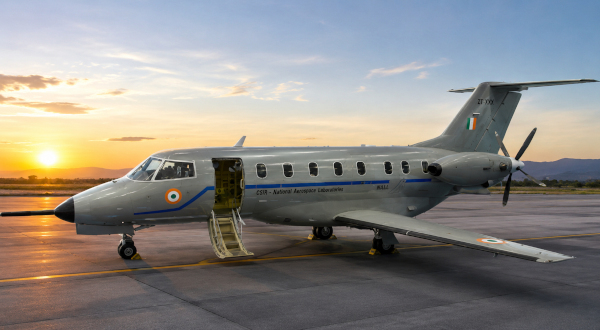
India’s indigenous civil aviation programme has reached an important milestone, with CSIR-National Aerospace Laboratories completing the design phase of the 19-seater Saras Mk-II light transport aircraft. The development brings the aircraft closer to prototype manufacturing, ground validation and future flight trials, marking a major step in India’s effort to build its own small passenger aircraft for regional connectivity.
The Saras Mk-II is being developed by CSIR-NAL, Bengaluru, as a multi-role light transport aircraft suited for short regional routes, smaller airports and difficult operating environments. It is expected to support passenger movement, air taxi services, air ambulance operations, executive transport, light cargo, border patrol and other community services.
The latest development is significant because the programme has now moved from design work toward manufacturing preparation. According to CSIR-NAL Chief Scientist Mohan Naik C., the design has been frozen, and the focus is now on manufacturing, assembly, integration and partnerships. CSIR-NAL has in-house capability for composite structures, while the programme is looking for partners for metallic structures and broader aircraft production support.
Union Science and Technology Minister Dr. Jitendra Singh described the completion of the Saras Mk-II design phase as a milestone for India’s aviation sector. He said the aircraft reflects India’s growing strength in indigenous aircraft development and supports the Atmanirbhar Bharat mission. Civil Aviation Minister Ram Mohan Naidu also welcomed the development, saying the aircraft can help advance the UDAN vision by connecting remote and high-altitude airfields with made-in-India technology.
The aircraft is designed to serve India’s regional connectivity needs. Many smaller towns, remote regions and high-altitude locations require aircraft that can operate from shorter runways and limited infrastructure. A 19-seat aircraft like Saras Mk-II can fit into a hub-and-spoke aviation model, linking smaller centres to larger airports and improving last-mile air connectivity.
The aircraft’s planned features include a pressurised cabin, digital avionics, glass cockpit, autopilot, and modern flight-control systems. The NAL brochure lists Saras Mk-II as a 19-seat multi-role aircraft designed for UDAN-type commuter connectivity, with full glass cockpit displays, terrain warning, traffic collision avoidance, flight management system, autopilot and weather radar.
Performance targets listed by CSIR-NAL include a maximum cruise speed of around 485 km/h, endurance of six hours, a maximum range of 750 km with 19 passengers, and a ferry range of 2,400 km. The aircraft is powered by two Pratt & Whitney Canada PT6A-67A turboprop engines, each flat-rated to 1,200 shaft horsepower.
Saras Mk-II is also intended to operate from semi-prepared runways and hot-and-high airfields. This gives the aircraft relevance for India’s geography, especially in regions where conventional large aircraft are unsuitable. Such capability can be useful in the Northeast, Himalayan states, island territories, remote districts and emergency response missions.
The programme has already crossed earlier development steps such as wind tunnel testing and preliminary design of major systems. In November 2025, the government also highlighted the inauguration of the Saras Mk-II Iron Bird facility at CSIR-NAL. This facility supports full-system integration, ground testing and validation of key aircraft subsystems, helping engineers reduce risks before flight trials.
The move toward prototype manufacturing is therefore a crucial transition. In aircraft development, design freeze means the configuration is mature enough to proceed toward physical prototype build-up. The next stages will involve component manufacturing, structural assembly, integration of avionics and systems, ground tests, engine and systems validation, taxi trials and eventually flight testing.
For India, Saras Mk-II is more than a 19-seat aircraft. It represents an attempt to build domestic capability in civil aircraft design, composite structures, avionics integration, certification processes and regional aircraft manufacturing. India has become one of the world’s fastest-growing aviation markets, but the country still depends heavily on foreign aircraft platforms. Saras Mk-II can help build the foundation for a wider indigenous civil aircraft ecosystem.
The aircraft also has strategic relevance. Earlier government communication described Saras Mk-II as a light transport aircraft being developed for both civilian and military operations. Its roles can potentially include light logistics, personnel movement, medical evacuation, border support and special mission variants.
The challenge now will be execution. Prototype manufacturing requires a strong supply chain, precision production, certification discipline, funding continuity and industrial partners capable of delivering aviation-grade structures. The programme will also need to meet safety and certification standards before it can enter operational service.
If CSIR-NAL can successfully move from design freeze to prototype flight and certification, Saras Mk-II could become a landmark aircraft for India’s aviation sector. It would support regional connectivity, reduce dependence on imported small aircraft and give India valuable experience in building future passenger aircraft.
The completion of the design phase and the shift toward prototype manufacturing show that India’s indigenous civil aviation dream is entering a decisive stage. Saras Mk-II now stands at the point where design ambition must turn into flying hardware.
References:
- CSIR-National Aerospace Laboratories (CSIR-NAL) – SARAS Mk-II Brochure
https://www.nal.res.in/sites/default/files/inline-files/SARAS%20MK2%20brochure.pdf - Press Information Bureau, Government of India – Minister Launches SARAS Mk-2 Iron Bird Facility / CSIR-NAL’s 19-Seater SARAS Mk-2
https://www.pib.gov.in/PressReleaseDetail.aspx?PRID=2196361&lang=1®=3 - Press Information Bureau, Government of India – Indigenous Technology in Aerospace & Defence Production / SARAS Mk-II Iron Bird Facility
https://www.pib.gov.in/PressReleasePage.aspx?PRID=2196373 - CSIR-NAL – Work Package Contract for 19-Seat SARAS Mk2 Aircraft Project
https://www.nal.res.in/en/node/2519
You may also like
-
EON Space Labs and Dhruva Space Advance Indian Space Hardware on Transporter-18 Mission
-
SatLeo Labs’ TAPAS-1 Reaches Orbit, Advancing India’s Private Thermal-Imaging Capability
-
TakeMe2Space’s MOI-1A Reaches Space on Falcon 9 Transporter-18 Mission
-
Bank of Baroda Enters Pension Fund Management After PFRDA Appointment
-
PRAHAAR: India’s First National Counter-Terrorism Policy and Strategy
