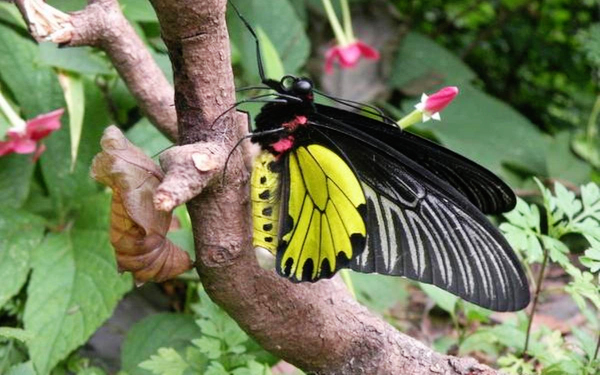
The Zoological Survey of India has completed a landmark 12-year scientific project to catalogue the country’s butterflies and moths, producing the first comprehensive and updated inventory of India’s Lepidoptera.
Published across 22 volumes, the Catalogue of Lepidoptera of India records 13,703 species belonging to 3,705 genera, 240 subfamilies, 102 families and 31 superfamilies. The documented Indian species represent approximately 8.25% of the known Lepidoptera diversity of the world.
The project brings together taxonomic information that had remained scattered across museum collections, historical publications, scientific journals, regional surveys and records produced over more than a century. Its completion provides India with a standardised national reference for one of the largest and most ecologically important orders of insects.
What Are Lepidoptera?
Lepidoptera is the scientific order that includes butterflies and moths. The name is derived from Greek words referring to “scale” and “wing,” reflecting the microscopic scales that cover the wings and bodies of these insects.
Although butterflies are more familiar because of their daytime activity and colourful appearance, moths account for the overwhelming majority of Lepidoptera diversity. They range from large and brightly patterned silk moths to tiny species that may measure only a few millimetres.
Butterflies and moths occupy almost every major terrestrial ecosystem in India, including the Himalayas, the Western Ghats, the northeastern forests, the Thar Desert, the Deccan Plateau, coastal habitats and the Andaman and Nicobar Islands.
They perform important ecological functions as pollinators, herbivores and decomposers. Their caterpillars and adults also form an essential part of the food web for birds, bats, reptiles, amphibians, spiders and other insect-eating animals. Some species are economically important because of their relationships with agricultural crops, plantations and forest vegetation.
Twelve Years of Taxonomic Research
The catalogue was prepared principally by ZSI taxonomists Dr Navneet Singh and Dr Rahul Joshi. The researchers assembled the inventory through field surveys, examination of museum specimens and detailed verification of published scientific literature.
Both scientists specialise in the taxonomy of moths. Dr Navneet Singh’s work has included the description of new genera and species, the documentation of new records for India and research into the role of moths in pollination. Dr Rahul Joshi has worked extensively on moth groups such as Noctuoidea, Pyraloidea, Arctiinae and Nolidae.
The project required the researchers to compare historic names, type specimens, geographical records and changing systems of classification. Species described under different names had to be examined to determine whether they represented separate organisms or were synonyms referring to the same species.
Records from India also had to be evaluated carefully. Some old references lacked adequate descriptions, precise locations or preserved specimens, making their identification uncertain.
The result is therefore more than a simple list. It is a taxonomic framework that organises India’s known butterfly and moth diversity according to updated scientific classification.
Final Volume Completes the National Inventory
The concluding monograph, titled A Catalogue of Selected, Recently Uncatalogued Lepidoptera (Insecta) from India, with Updates to Existing Knowledge, was published in the international taxonomic journal Zootaxa on July 17, 2026.
Authored by Rahul Joshi and Navneet Singh, the 262-page publication catalogues 1,689 species distributed across 506 genera, 108 subfamilies, 65 families and 25 superfamilies. It provides newly prepared catalogues for 41 families and revised information for another 24 families. Existing catalogues for the remaining 37 families were considered sufficiently current and were incorporated through updated summary counts.
The final publication brought the recognised Lepidoptera fauna of India to:
- 13,703 species
- 3,705 genera
- 240 subfamilies
- 102 families
- 31 superfamilies
The work also established one generic synonym and two species synonyms. It identified 64 species as doubtful records from India and classified 36 names as nomina nuda—scientific names published without descriptions or other information adequate to make them formally valid under zoological nomenclature.
These corrections are important because inaccurate or duplicated names can distort estimates of biodiversity and create confusion in scientific research, conservation planning and ecological monitoring.
India Holds Over Eight Percent of Global Lepidoptera Diversity
The catalogue indicates that India supports around 8.25% of the butterfly and moth species known globally. This is a remarkable share for a single country and reflects India’s extraordinary variety of climates, landscapes and ecological regions.
India lies at the meeting point of several major biogeographic zones. Its Lepidoptera fauna includes species associated with the Palearctic regions of the high Himalayas, the Oriental forests of the Northeast and Western Ghats, the dry landscapes of western India and the island ecosystems of the Bay of Bengal.
Mountain ranges create isolated habitats in which species can evolve independently. Tropical rainforests support highly specialised plant–insect relationships, while deserts, grasslands and wetlands contain their own distinctive Lepidoptera communities.
The national total is also expected to change as researchers discover new species, record known species in India for the first time and revise classifications using morphological and genetic evidence.
Major Diversity Recorded in Geometroidea
One of the major components of the catalogue concerns Geometroidea, a large superfamily of moths that includes the well-known geometrid or “inchworm” moths.
India has 2,205 recorded Geometroidea species belonging to 479 genera, 13 subfamilies and four families. This represents approximately 8.8% of the known global species diversity of the group.
Geometridae is the largest family within the group in India, with approximately 2,100 species belonging to 445 genera. The other recorded families include Uraniidae, Epicopeiidae and Pseudobistonidae.
The caterpillars of many geometrid moths are commonly called inchworms because of their distinctive looping movement. They possess fewer pairs of abdominal prolegs than many other caterpillars, causing them to arch their bodies while moving.
The diversity of this single superfamily demonstrates how much of India’s Lepidoptera wealth consists of moths that remain relatively unfamiliar to the general public.
Clearing More Than a Century of Scattered Records
Before the completion of the project, information about Indian butterflies and moths was distributed across numerous scientific works produced during different historical periods.
Many early records appeared in publications prepared during the colonial era. Later discoveries and taxonomic revisions were published in specialised journals, institutional reports, regional checklists and monographs.
Names and classifications changed as scientists obtained better specimens and developed more accurate methods of comparing species. A moth recorded under one genus in an older publication may have subsequently been transferred to another genus or merged with another species.
The new catalogue consolidates this dispersed information into a structured reference. It gives researchers a clearer understanding of which species are currently accepted, how they are classified and which historical records require further investigation.
Importance for Biodiversity Conservation
Conservation begins with knowing which species exist and where they have been recorded. Without a reliable baseline, it becomes difficult to determine whether a species is declining, expanding its range or disappearing from a region.
The catalogue can help researchers and conservation agencies identify areas with unusually high Lepidoptera diversity, concentrations of endemic species or communities that may be vulnerable to habitat destruction.
It can also support environmental impact assessments for infrastructure, mining, forestry and urban-development projects. Surveys conducted in a proposed project area can be compared against the catalogue to determine the significance of the species recorded.
Repeated monitoring can reveal changes associated with deforestation, pesticide use, urbanisation, invasive plants, changing rainfall patterns and rising temperatures.
Because many butterflies and moths respond rapidly to changes in vegetation and climate, they can serve as useful indicators of ecosystem health.
Supporting Climate-Change Research
Butterflies and moths are particularly valuable for studying the biological effects of climate change.
Changes in temperature and rainfall can alter when adults emerge, when caterpillars feed and when host plants produce leaves or flowers. Species may also move towards higher elevations or cooler latitudes as their traditional habitats become warmer.
A verified national catalogue provides the taxonomic foundation needed to compare past and present distribution records.
Researchers can use the dataset to examine whether Himalayan species are moving upwards, whether tropical species are expanding into new areas or whether seasonal activity is changing.
Such studies would be unreliable without consistent species names and accurate historical records.
Relevance to Agriculture and Forestry
Lepidoptera include both beneficial pollinators and species whose larvae feed on economically important plants.
Several moth caterpillars affect food crops, cotton, fruit trees, stored products and forest plantations. Accurate identification is essential because closely related species may differ significantly in their host plants, behaviour and response to pest-control measures.
The catalogue can assist agricultural universities, forest departments and plant-protection agencies in correctly identifying species encountered during field investigations.
At the same time, the inventory can improve recognition of beneficial moths and butterflies that contribute to pollination and healthy food webs.
It therefore provides a scientific foundation for developing more targeted and ecologically informed approaches to pest management.
Museum Collections Remain Crucial
Natural-history collections played an important role in preparing the catalogue. Preserved specimens allow taxonomists to compare newly collected insects with material gathered decades or even centuries earlier.
The ZSI’s Lepidoptera Section maintains a major scientific collection and provides identification and advisory services to research institutions. Its holdings include specimens and type material that form an essential reference for determining the identity of species.
A type specimen is the physical specimen to which the scientific name of a species is formally attached. Examining such material is often necessary when resolving disputed identities, synonyms or unclear historical descriptions.
Museum collections also preserve evidence of earlier species distributions, allowing researchers to determine whether particular insects once occurred in areas from which they have subsequently disappeared.
Digital Access Expands Scientific Use
ZSI has also developed an online Catalogue of Indian Lepidoptera, providing a digital platform through which researchers and interested members of the public can access information on Indian butterflies and moths.
The portal was developed by Navneet Singh, Rahul Joshi and ZSI Director Dhriti Banerjee and was described by the institution as the first digital platform dedicated to cataloguing Indian Lepidoptera.
Digital access can make the catalogue useful to a much wider community, including students, citizen scientists, wildlife photographers, forest officials and conservation organisations.
Observations contributed through carefully verified citizen-science projects may eventually help researchers update distribution maps and identify regions requiring more intensive surveys.
A Foundation for Future Discoveries
The completion of the 22-volume catalogue does not mean that every butterfly and moth species in India has been discovered.
Many habitats remain insufficiently surveyed, particularly remote mountain valleys, forest canopies, small islands and regions that are difficult to access during the monsoon. Numerous micro-moths are also easily overlooked because of their small size and specialised habits.
Future studies combining traditional taxonomy with DNA barcoding, genomic analysis, high-resolution imaging and ecological observations are likely to reveal additional species and resolve remaining uncertainties.
The catalogue provides the organised baseline against which these discoveries can be assessed. New species can be added, doubtful records investigated and distribution information updated without returning to the fragmented system that existed earlier.
A Landmark for Indian Taxonomy
The Catalogue of Lepidoptera of India represents one of the most significant recent achievements in the documentation of the country’s animal diversity.
By consolidating more than a century of records and establishing an updated inventory of 13,703 species, the Zoological Survey of India has created an important resource for taxonomy, conservation, agriculture, forestry, climate research and environmental planning.
The project also highlights the importance of long-term taxonomic work. While new technologies can accelerate species identification, the foundation of biodiversity science continues to depend on field surveys, museum collections, scientific literature and the expertise of trained taxonomists.
India’s butterflies and moths are not merely colourful insects. They are pollinators, plant consumers, decomposers, prey species and sensitive indicators of environmental change. Documenting them accurately is therefore essential for understanding and protecting the wider ecosystems in which they live.
References
Joshi, Rahul and Singh, Navneet.
A Catalogue of Selected, Recently Uncatalogued Lepidoptera (Insecta) from India, with Updates to Existing Knowledge.
Zootaxa, Volume 5852, No. 1, July 17, 2026, pages 1–262.
DOI: 10.11646/zootaxa.5852.1.1
Zoological Survey of India.
Catalogue of Indian Lepidoptera and official profiles of the Lepidoptera Section, Dr Navneet Singh and Dr Rahul Joshi.
Times of India.
“ZSI Completes 12-Year Cataloguing of India’s 13,703 Butterfly and Moth Species.”
Published July 30, 2026.
You may also like
-
IIT Hyderabad Develops Lung-Derived Bioink for 3D Bioprinting and Regenerative Medicine
-
ZSI Scientists Identify New Fish Species Bathymyrus perplexus From the Bay of Bengal
-
Indian Scientists Discover Molecular Switch That Can Regulate Cellular Autophagy
-
Scientists Map Earliest Glow of Hydrogen, Opening A New Window to the Universe
-
Rare Afro-Asian Sand Snake Rediscovered in Kutch After More Than 150 Years
