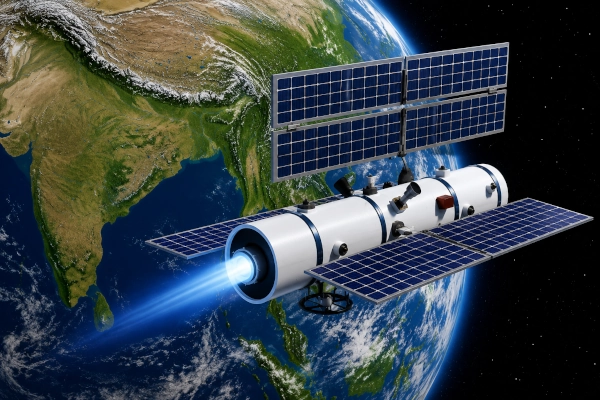
India’s private space industry is rapidly expanding beyond launch vehicles and satellite manufacturing into one of the most technically demanding areas of spaceflight: propulsion. Bengaluru-based Bellatrix Aerospace has emerged as an important player in this field by developing electric, green chemical and water-powered propulsion systems for satellites.
Its most distinctive project is JAL, a microwave-plasma thruster that uses water as its propellant. Instead of carrying highly toxic chemicals or relying entirely on expensive noble gases, the system is designed to convert water into an electrically energised plasma and expel it at high velocity to manoeuvre a spacecraft.
Bellatrix is building a much wider propulsion portfolio around this technology. Its products include the Arka family of Hall-effect thrusters, the Rudra green monopropellant system, the Pushpak orbital transfer vehicle, the Fingernail nano-thruster and an ultra-low-orbit satellite project known as Project 200. Together, these technologies are intended to give satellites the ability to raise and maintain their orbits, avoid collisions, reposition themselves, deploy payloads and safely deorbit at the end of a mission.
From an IISc-incubated startup to a space-propulsion manufacturer
Bellatrix Aerospace was established in 2015 and incubated at the Indian Institute of Science in Bengaluru. The company was founded by engineers including Rohan M. Ganapathy and Yashas Karanam, who now serve as its chief executive and chief operating officer respectively.
Unlike companies that primarily build complete rockets or satellites, Bellatrix concentrates on the propulsion systems that allow a spacecraft to move after it reaches space. These systems determine whether a satellite can reach its intended orbit, maintain its constellation position, compensate for atmospheric drag, conduct collision-avoidance manoeuvres or dispose of itself responsibly at the end of its operational life.
ISRO has described Bellatrix as an IISc-incubated space startup engaged in developing monopropellant thrusters, green propellants and electric propulsion systems. The company has established facilities for thermal-vacuum testing, propellant preparation, catalytic research, high-temperature coatings and the firing of electric and chemical thrusters under simulated space conditions.
By developing propulsion packages, tanks, valves, catalysts, control electronics and thruster components within India, Bellatrix is attempting to create an indigenous supply chain for some of the most specialised hardware installed on a spacecraft.
JAL: a satellite thruster powered by water
JAL is Bellatrix Aerospace’s series of microwave-plasma thrusters using water as the onboard propellant.
Water does not “burn” inside JAL in the manner of conventional rocket fuel. Electrical power from the satellite is used to energise the propellant and create plasma—a highly energetic mixture containing charged particles. The plasma is then accelerated and expelled from the thruster, creating a continuous reaction force that gradually changes the spacecraft’s velocity and orbit.
Electric propulsion produces much less instantaneous thrust than a conventional chemical engine. Its advantage lies in efficiency. Because the propellant can be expelled at considerably higher velocity, a satellite can obtain more manoeuvring capability from a smaller quantity of propellant. Electric thrusters can operate for hundreds or thousands of hours, gradually producing large orbital changes while conserving spacecraft mass.
Bellatrix states that the JAL series combines the handling advantages of water with a high thrust-to-power ratio for an electric propulsion system. The company claims that the system can provide approximately four times the specific impulse of conventional chemical propulsion and is particularly suited to high-power missions involving large communication satellites and geostationary orbit. These performance comparisons are company claims and would ultimately have to be confirmed through complete qualification and operational mission data.
The publicly listed JAL 5000 is designed to operate at 5,000 watts. Bellatrix specifies:
- thrust of 300 millinewtons;
- specific impulse of 1,050 seconds;
- an intended operating life exceeding 20,000 hours;
- water as the propellant.
The company also says it can develop microwave-plasma thrusters at power levels above five kilowatts.
Why water is attractive as a space propellant
Water offers several practical advantages for spacecraft designers.
It is non-toxic, chemically stable under ordinary storage conditions and much easier for technicians to handle than traditional hazardous propellants. It does not require the same level of protective equipment, specialised transport procedures or contamination controls associated with substances such as hydrazine.
Water can also be stored as a compact liquid rather than as a highly pressurised gas. This can simplify ground handling and may reduce some of the costs and risks involved in integrating propulsion systems with satellites and launch vehicles.
International space agencies are independently studying different forms of water propulsion. NASA and the European Space Agency have supported technologies in which water is heated, ionised or separated into hydrogen and oxygen before being used for propulsion. ESA has noted that liquid water can be stored at relatively low pressure in lightweight tanks, while NASA has already flown small spacecraft carrying water-based propulsion demonstrations.
Water also has long-term importance for exploration beyond Earth. It is known to exist as ice on the Moon and in other parts of the Solar System. Future spacecraft could potentially obtain water away from Earth and use it for life support, power generation or propulsion. JAL is presently intended for satellite mobility, but the broader development of water-based propulsion could eventually support systems that replenish propellant beyond Earth.
Microwave plasma propulsion
The use of microwaves is central to the JAL concept.
Microwave energy can excite a propellant without depending entirely on electrodes placed directly inside the hottest part of the plasma. Reducing contact between vulnerable components and energetic plasma can potentially improve reliability and operational life, although actual longevity depends on the detailed thruster design, thermal management, materials and power-processing system.
The satellite must still provide considerable electrical power. Solar panels collect energy, while power-processing electronics convert and regulate it for the thruster. Higher-power engines therefore require larger solar arrays, suitable thermal-control systems and robust electrical architecture.
JAL’s proposed five-kilowatt configuration makes it more appropriate for relatively large spacecraft than for tiny CubeSats with limited power. Bellatrix presents it as a propulsion option for geostationary missions, where high-value communication satellites may need to conduct orbit raising, station keeping, relocation and end-of-life disposal over periods lasting many years.
Arka Hall-effect thrusters
Alongside JAL, Bellatrix has developed the Arka family of Hall-effect electric thrusters.
A Hall thruster uses electric and magnetic fields to ionise and accelerate an onboard propellant. It produces a small but highly efficient stream of thrust that can continue for long periods. Hall-effect propulsion is already widely used internationally for orbit raising, station keeping and deep-space applications. NASA and ESA are developing Hall thrusters for both commercial spacecraft and future exploration missions.
Bellatrix offers Arka models extending from 50 watts to five kilowatts. The company lists the following performance levels:
- Arka 50: 3 millinewtons of thrust;
- Arka 100: 7 millinewtons;
- Arka 200: 13.2 millinewtons;
- Arka 1500: 86 millinewtons;
- Arka 5000: 260 millinewtons.
Their listed specific impulses range from 860 seconds for the smallest model to 2,000 seconds for the five-kilowatt system. This range allows Bellatrix to target nano-satellites, microsatellites, large constellation spacecraft and heavier communication platforms.
The company demonstrated an Arka Hall-effect thruster during ISRO’s PSLV-C58 mission launched on 1 January 2024. According to Bellatrix, the mission validated the 200-watt thruster, its power and control electronics, flow-control components and a heaterless hollow cathode in the space environment.
Unlike JAL, the Arka product family has publicly reported orbital flight heritage. Bellatrix’s currently published mission record lists Hall-effect thruster demonstrations on PSLV-C55 and PSLV-C58. The public mission record reviewed for this article does not yet list an orbital JAL demonstration, meaning that the water-powered system should be described separately from Bellatrix’s already space-qualified Arka and Rudra hardware.
Rudra green chemical propulsion
Electric thrusters are extremely efficient but produce relatively low thrust. Some satellite operations require a faster and stronger response. Chemical systems remain useful for rapid orbit corrections, emergency manoeuvres and attitude control.
Bellatrix developed the Rudra family to provide chemical propulsion without depending on conventional hydrazine-based systems. Hydrazine is effective but highly toxic and requires elaborate safety procedures during manufacture, transportation, fuelling and launch preparation.
Bellatrix says Rudra uses a proprietary green monopropellant and high-performance catalyst that are less toxic and easier to handle than hydrazine. The company offers one-newton, five-newton and 100-newton variants for different spacecraft classes.
The Rudra system achieved an important milestone aboard PSLV-C58 in January 2024, when Bellatrix’s Arka electric propulsion and Rudra green propulsion packages were tested on the same mission. A further Rudra 1N package flew aboard the POEM-4 platform in the PSLV-C60/SpaDeX mission.
ISRO described the POEM-4 payload as a compact three-unit propulsion package containing an indigenously developed propellant tank assembly, diaphragm, thrust chamber, proprietary green monopropellant, catalyst, universal propulsion control unit and flow-control valve. Its mission objectives included maintaining a steady firing for at least 50 seconds and evaluating the system’s thermal behaviour.
Bellatrix announced in January 2025 that the POEM-4 firing represented its third consecutive successful propulsion demonstration in orbit.
Combining electric and chemical propulsion
Bellatrix’s portfolio reflects an important reality of satellite engineering: no single propulsion technology is ideal for every operation.
A chemical thruster can produce relatively high thrust for quick manoeuvres but consumes propellant rapidly. An electric thruster produces lower thrust but can operate efficiently for long periods. A spacecraft equipped with both can use chemical propulsion when speed is essential and electric propulsion for gradual orbit raising, station keeping and fuel-efficient repositioning.
Bellatrix is applying this hybrid approach to Pushpak, its orbital transfer vehicle. Pushpak is designed to carry CubeSats and small satellites with a combined payload mass of up to 750 kilograms. Bellatrix states that the vehicle’s combination of electric and green propulsion can provide a total velocity-change capability of up to seven kilometres per second.
In September 2024, Bellatrix signed a memorandum of understanding with NewSpace India Limited, ISRO’s commercial arm, to explore integrating Pushpak with NSIL launch missions. The vehicle is intended to deploy satellites into different orbits after launch, perform inclination changes, support geostationary-transfer missions and eventually contribute to more complex space operations.
Pushpak could allow several customers to share one launch while still sending their spacecraft to different orbital destinations. Bellatrix has also proposed a hosted-payload service under which scientific instruments or technology demonstrations could operate aboard the transfer vehicle without requiring customers to purchase an entire satellite.
Propulsion for nano-satellites
At the opposite end of the scale is Bellatrix’s Fingernail propulsion system.
Nano-satellites have extremely limited space, electrical power and mass. Many are launched without propulsion, leaving them unable to avoid debris, correct their orbits or conduct controlled end-of-life disposal.
Bellatrix says its nano-thruster is manufactured as a one-piece assembly using advanced fabrication methods. It is intended to provide a compact, plug-and-play propulsion option for collision avoidance and deorbiting.
The development of miniature propulsion has become increasingly important as thousands of small satellites are deployed in large constellations. Satellites that can manoeuvre are better equipped to maintain constellation geometry, avoid collisions and comply with emerging space-debris mitigation requirements.
Project 200 and ultra-low Earth orbit
Bellatrix is also using its propulsion experience to develop Project 200, a satellite technology demonstrator intended to operate between approximately 180 and 250 kilometres above Earth.
Satellites at such low altitudes experience severe atmospheric drag and normally lose altitude rapidly. Bellatrix says it has been developing a propulsion system capable of continuously compensating for this drag, potentially allowing satellites to remain near 200 kilometres for years rather than days.
Operating closer to Earth could improve image resolution, reduce communications latency and allow some missions to use smaller optical instruments and lower-power transmitters. Project 200 could therefore have applications in Earth observation, communications and scientific research.
The project also demonstrates the strategic value of propulsion. A satellite’s capabilities are determined not only by its camera, radar or communications payload, but also by its ability to reach and maintain the orbit from which those instruments perform best.
Building flight heritage with ISRO
Space propulsion companies face a major commercial challenge: customers prefer hardware that has already operated successfully in orbit, while obtaining an initial flight opportunity is difficult and expensive.
ISRO’s PSLV Orbital Experimental Module has provided Bellatrix with a platform for testing its propulsion packages in the actual space environment. Through PSLV-C55, PSLV-C58 and PSLV-C60, the company has been able to evaluate thrusters, control electronics, valves, tanks, catalysts and thermal systems beyond laboratory conditions.
This relationship illustrates the importance of cooperation between India’s public space programme and private manufacturers. ISRO supplies launch opportunities, testing experience and institutional support, while private companies attempt to convert specialised technologies into commercially repeatable products.
Moving from prototypes to commercial production
Bellatrix’s next challenge is manufacturing propulsion systems consistently and at commercial scale.
In March 2026, the company announced that it had raised US$20 million in a pre-Series B funding round led by Cactus Partners and Hero Enterprise. Bellatrix said the investment would be used to expand manufacturing facilities, establish high-throughput production lines, support active customer programmes and integrate the company into global supply chains.
The company described this stage as a transition from being “flight-proven” to becoming “factory-ready.” It is targeting production lead times of less than six months as satellite manufacturers increasingly seek propulsion packages for constellations and commercial spacecraft.
Bellatrix also established a subsidiary in the United States in April 2025 to serve the American commercial space market. The company announced an agreement positioning it as a preferred propulsion supplier to an unnamed US satellite manufacturer and indicated plans to develop local manufacturing capacity to meet regulatory and customer requirements.
In March 2025, Bellatrix signed an agreement with Astroscale Japan to explore propulsion applications in satellite servicing, active debris removal and sustainable in-orbit mobility. The partnership was also intended to support Bellatrix’s entry into Japan and Astroscale’s expansion in India.
Strategic importance for India
Satellite propulsion is a dual-use and strategically significant capability. The same technologies that maintain commercial communication and Earth-observation satellites can support navigation, meteorology, disaster management, surveillance and secure communications.
Dependence on imported propulsion packages can expose satellite projects to export controls, long delivery schedules, currency fluctuations and geopolitical restrictions. An indigenous propulsion industry can give Indian spacecraft manufacturers greater control over mission design, integration schedules, maintenance support and future upgrades.
Bellatrix is particularly significant because it is developing several propulsion categories rather than a single engine. Its electric, green chemical, nano-satellite and orbital-transfer technologies could serve spacecraft ranging from miniature CubeSats to large geostationary platforms.
The company’s progress also supports a broader Indian objective: moving from launching satellites for other countries to supplying advanced subsystems for the international space industry.
Challenges ahead
Promising laboratory performance alone is insufficient in the space sector. Propulsion systems must survive vibration during launch, vacuum, radiation, repeated thermal cycling and years of operation without maintenance.
Bellatrix will have to demonstrate:
- reproducible manufacturing quality;
- long-duration operational life;
- compatibility with different satellite buses;
- reliable valves, tanks and power electronics;
- predictable thrust and efficiency;
- competitive pricing and delivery schedules;
- international regulatory and export-control compliance.
JAL faces the additional challenge of proving that its microwave-plasma architecture can deliver the claimed performance, efficiency and service life in orbit. Water is inexpensive and easy to handle, but converting it into useful plasma requires energy and carefully engineered thermal, microwave and materials systems.
Bellatrix’s Arka and Rudra products already possess publicly reported flight demonstrations. JAL’s defining milestone will come when a complete water-powered propulsion package is qualified and operated aboard a satellite in space.
An Indian propulsion company with global ambitions
Bellatrix Aerospace represents the new direction of India’s private space economy. It is developing mission-critical technology within the country, validating hardware through ISRO missions and attempting to supply propulsion systems to satellite companies around the world.
Its JAL microwave-plasma thruster is especially noteworthy because it reimagines one of the most basic elements of a spacecraft: its propellant. A satellite carrying ordinary water could potentially gain a safer and more easily handled source of long-duration mobility.
At the same time, Bellatrix’s importance extends beyond JAL. Arka provides efficient Hall-effect propulsion, Rudra offers a greener alternative for higher-thrust manoeuvres, Fingernail targets the smallest satellites, Pushpak aims to transport payloads between orbits and Project 200 seeks to keep spacecraft operating at altitudes previously considered impractical.
Bellatrix is therefore building more than an individual engine. It is attempting to create an Indian ecosystem for moving, maintaining and transporting spacecraft after they enter orbit.
For India’s Make in India mission, this is a strategically important transition—from manufacturing satellite structures and electronic components to mastering the propulsion technologies that determine where a spacecraft can go, how long it can remain there and what it can achieve.
References
1. Bellatrix Aerospace — Official website and product portfolio: https://bellatrix.aero/ 2. Bellatrix Aerospace — About the company: https://bellatrix.aero/about 3. Bellatrix Aerospace — JAL microwave-plasma thruster: https://bellatrix.aero/jal 4. Bellatrix Aerospace — Arka Hall-effect thrusters: https://bellatrix.aero/arka 5. Bellatrix Aerospace — Rudra green propulsion systems: https://bellatrix.aero/rudra 6. Bellatrix Aerospace — Pushpak orbital transfer vehicle: https://bellatrix.aero/pushpak 7. Bellatrix Aerospace — Fingernail nano-satellite propulsion: https://bellatrix.aero/fingernail 8. Bellatrix Aerospace — Project 200 ultra-low-orbit satellite: https://bellatrix.aero/project200 9. ISRO — Chairman, ISRO inaugurates Bellatrix Aerospace office and visits propulsion laboratory: https://www.isro.gov.in/Bellatrix_space_propulsion_lab_monopropellant_thruster.html 10. ISRO — Bellatrix Aerospace propulsion laboratory: https://www.isro.gov.in/Aerospacelaboratory.html 11. ISRO — RUDRA 1.0 green propulsion payload aboard POEM-4: https://www.isro.gov.in/ISRO_EN/POEM_4_Payloads_spadex.html 12. Bellatrix Aerospace — Space qualification of Arka and Rudra: https://bellatrix.aero/updates/arka-shines-rudra-roars 13. Bellatrix Aerospace — Successful Rudra firing aboard POEM-4: https://bellatrix.aero/updates/hattrick-in-space 14. Bellatrix Aerospace — Agreement with NewSpace India Limited for Pushpak: https://bellatrix.aero/updates/bellatrix-aerospace-and-nsil-sign-mou 15. Bellatrix Aerospace — Project 200 announcement: https://bellatrix.aero/updates/unveiling-project-200 16. Bellatrix Aerospace — Partnership with Astroscale Japan: https://bellatrix.aero/updates/bellatrix-aerospace-sign-mou-with-astroscale-japan 17. Bellatrix Aerospace — Expansion into the United States: https://bellatrix.aero/updates/bellatrix-aerospace-expands-to-us-with-new-subsidiary 18. Bellatrix Aerospace — US$20-million pre-Series B funding round: https://bellatrix.aero/updates/bellatrix-aerospace-secures-20-million-in-pre-series-b 19. European Space Agency — Introduction to electric propulsion: https://www.esa.int/Enabling_Support/Space_Engineering_Technology/What_is_Electric_propulsion 20. European Space Agency — Water as a future space propellant: https://www.esa.int/Enabling_Support/Space_Engineering_Technology/Shaping_the_Future/Is_water_the_best_new_propellant_for_future_space_missions 21. NASA — In-space propulsion technologies: https://www.nasa.gov/smallsat-institute/sst-soa/in-space_propulsion/ 22. NASA — Pathfinder water-based propulsion demonstration: https://www.nasa.gov/smallspacecraft/pathfinder-technology-demonstrator/
Image Courtesy: Bellatrix
You may also like
-
EON Space Labs and Dhruva Space Advance Indian Space Hardware on Transporter-18 Mission
-
SatLeo Labs’ TAPAS-1 Reaches Orbit, Advancing India’s Private Thermal-Imaging Capability
-
TakeMe2Space’s MOI-1A Reaches Space on Falcon 9 Transporter-18 Mission
-
Bank of Baroda Enters Pension Fund Management After PFRDA Appointment
-
SCI and India’s Push for a Larger Indigenous Maritime Fleet
