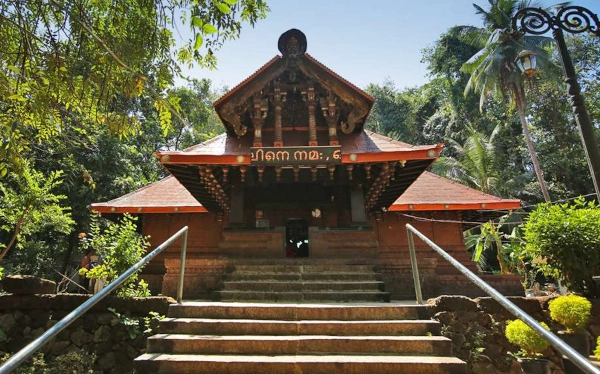
Kottiyoor Temple, situated amid the forested foothills of the Western Ghats in eastern Kannur district, is one of Kerala’s most distinctive centres of Shiva worship. The sacred complex stands on both banks of the Bavali River and consists of two related shrines: Ikkare Kottiyoor, the permanent temple where regular worship is conducted, and Akkare Kottiyoor, the open-air forest sanctuary that becomes accessible only during the annual Vaisakha Mahotsavam.
Officially known as Sree Thricherumanna alias Kottiyoor Devaswom, the pilgrimage centre is celebrated for a ritual tradition in which river, forest, monsoon and temporary architecture become inseparable from worship. Akkare Kottiyoor has no conventional stone sanctum, monumental gateway or permanent roof over the principal deity. Instead, devotees worship a swayambhu Shiva linga at the Manithara, a raised platform surrounded by the waters of the sacred Thiruvanchira.
Two Temples on Opposite Banks
The words ikkare and akkare mean “this side” and “the other side” in Malayalam. Ikkare Kottiyoor stands on the side of the river closer to the settled village, while Akkare Kottiyoor lies across the Bavali in a more secluded natural setting.
Ikkare Kottiyoor is a traditional Kerala temple complex built in the nalukettu architectural form. Daily pujas and annual observances are conducted there throughout the year. Temple tradition associates the established ritual system of this shrine with the spiritual influence of Adi Shankaracharya, although this attribution belongs primarily to religious memory rather than firmly dated historical documentation.
Akkare Kottiyoor functions differently. It opens only for the Vaisakha festival, when temporary thatched structures are erected for priests, ritual functionaries, offerings and ceremonial activities. Their simplicity recalls a Vedic sacrificial enclosure rather than a conventional built temple. When the festival ends, the forest sanctuary returns to silence until the following year.
The Sacred Landscape of Daksha Yaga
The religious identity of Kottiyoor is closely connected with the story of Daksha Yaga, one of the best-known narratives associated with Shiva and Sati.
According to temple tradition, Daksha Prajapati organised a great sacrifice but deliberately excluded his daughter Sati and her husband, Lord Shiva. Sati nevertheless travelled to the sacrificial ground, where she was humiliated by her father. Unable to endure the insult directed at Shiva, she gave up her life in the sacrificial fire.
Shiva’s grief and anger gave rise to Veerabhadra, who destroyed the sacrifice and beheaded Daksha. After the gods intervened, Daksha was restored to life with the head of a goat, and Shiva’s fury subsided. Kottiyoor is traditionally identified as the landscape in which these events unfolded and is consequently revered as Dakshina Kashi, the Kashi of the South.
Local place names are also interpreted through this sacred narrative. Temple tradition connects nearby locations such as Manathana, Neendunokki, Kelakam and Muthirerikavu with stages in Sati’s journey and the aftermath of the sacrifice. These associations belong to the living mythology of the region and give the entire valley the character of an extended pilgrimage landscape.
Manithara and the Open-Air Sanctum
At the centre of Akkare Kottiyoor is the Manithara, where the naturally manifested Shiva linga is worshipped. The platform lies within the water-filled area known as Thiruvanchira, making water a constant element of the ritual setting.
Close to it is the Ammarakkal Thara, traditionally associated with Sati’s self-sacrifice. Temporary palm-leaf and thatched shelters are constructed around these sacred platforms during the festival, reproducing the atmosphere of a yagashala or sacrificial enclosure.
The absence of a permanent roof is central to Kottiyoor’s identity. The deity remains beneath the open sky, surrounded by river stones, forest vegetation and monsoon rain. The landscape therefore functions as part of the temple rather than merely forming its background.
This unusual arrangement distinguishes Akkare Kottiyoor from most major Hindu pilgrimage centres. Its sacredness is expressed through temporary structures and repeated ritual renewal rather than through monumental construction.
Vaisakha Mahotsavam
The annual Kottiyoor Vaisakha Mahotsavam is a 28-day celebration generally held during May and June. It begins on the Chothi or Swati asterism in the Malayalam month of Edavam and concludes during the Chithira asterism in Midhunam. Akkare Kottiyoor remains open only during this period.
The festival takes place as the southwest monsoon approaches Kerala. The Bavali River, surrounding forest and rain-soaked ground create an environment unlike that of a conventional temple festival. Kerala Tourism consequently describes the celebration as a festival of nature.
Different communities traditionally perform designated ritual responsibilities during the observance. Priestly families, tribal communities, artisans and hereditary functionaries participate in interconnected duties that sustain the festival’s ceremonial order. This collective system preserves an old pattern in which the temple festival depends on the contributions of the wider society surrounding it.
The Sword from Muthirerikavu
The ceremonial sequence begins with the arrival of a sacred sword from Muthirerikavu in Wayanad. Temple tradition identifies it with the weapon used by Veerabhadra during the destruction of Daksha’s sacrifice.
The sword’s journey links Kottiyoor with the neighbouring highlands of Wayanad and marks the ritual awakening of the forest sanctuary. The following ceremonies prepare Akkare Kottiyoor for the commencement of public worship.
Another important procession is Bhandaram Ezhunnallath, during which gold and silver vessels, ornaments and other ceremonial objects are brought from Manathana to the festival site. These objects are used only during the annual observance and are returned after the sacred period concludes.
Neyyattam: The Opening Offering
The public festival formally begins with Neyyattam, the ritual pouring of ghee over the swayambhu Shiva linga. Devotees bring ghee as an offering, and the ceremonial ablution establishes the beginning of the 28-day cycle.
The rite carries associations with purification, nourishment and the rekindling of the interrupted Daksha Yaga. It also marks the transformation of Akkare Kottiyoor from a silent forest space into an active pilgrimage centre.
Elaneer Vayppu and Elaneerattam
Among Kottiyoor’s most recognisable observances is Elaneer Vayppu, when thousands of tender coconuts are brought from different parts of Malabar and placed before the deity.
The coconuts are opened ceremonially, and their water is collected for Elaneerattam, an extensive ablution performed over the swayambhu linga on the following day. The rite combines agricultural abundance, bodily cooling and ritual purification, making the coconut—a familiar element of Kerala’s landscape—the central offering.
The scale of the ceremony reflects Kottiyoor’s importance far beyond Kannur. Families and devotional groups carry coconuts over considerable distances, often treating the journey itself as a religious vow.
Rohini Aaradhana
Rohini Aaradhana is considered one of the most exceptional rituals of the festival. During the ceremony, a hereditary priest approaches the Manithara in wet ceremonial clothing, places himself beside the swayambhu linga and embraces it as part of the Alingana Pushpanjali.
The act is interpreted as the worship offered by Brahma and the gods to pacify Shiva following the death of Sati. Temple tradition describes the embrace as the highest expression of devotion within the Vaisakha festival.
The rite is unusual because physical contact with the principal deity is normally highly restricted in Kerala temples. At Kottiyoor, the embrace becomes a symbolic meeting between devotee and divinity, grief and reconciliation.
Concluding Ceremonies
The final stages of the festival include Vaalattam, ritual offerings, ceremonial processions and the thousand-pot ablution associated with the Atham observance. A distinctive coconut-breaking rite known as Thengaeru is also performed at a prescribed location within the sacred enclosure.
The celebration concludes with Thrikkalashattu, after which ritual objects are returned, the temporary settlement begins to close and access to Akkare Kottiyoor ends for the year. The forest shrine once again becomes an unoccupied sacred space, while regular worship continues at Ikkare Kottiyoor.
Odapoovu: A Distinctive Prasadam
One of the characteristic sacred objects associated with Kottiyoor is Odapoovu, made from thinly prepared bamboo material. Devotional tradition interprets its white fibres as representing the beard of Daksha after he received the head of a goat.
Pilgrims traditionally carry Odapoovu home as a blessing from the festival. Unlike edible prasadam, it serves as a visual reminder of the Daksha Yaga narrative and the devotee’s journey to the forest shrine.
Nature as Temple Architecture
Kottiyoor demonstrates a form of sacred architecture in which the natural setting carries as much meaning as the buildings. The Bavali River establishes the boundary between the two shrines; the Western Ghats create the enclosing walls; the sky becomes the roof of the Manithara; and temporary thatched huts define the ritual spaces.
This arrangement protects the idea that Akkare Kottiyoor is the site of an unfinished or eternally recurring sacrifice. A permanent monumental temple would alter the essential meaning of the place. Its yearly construction and dismantling instead present sacred time as a cycle of appearance, worship and withdrawal.
The surrounding forests also possess ecological importance. Large pilgrim gatherings therefore require careful management of waste, river quality, traffic and temporary facilities so that the natural environment supporting the festival remains protected.
How to Reach Kottiyoor Temple
Kottiyoor is accessible by road from Kannur and Thalassery through Mattannur, Iritty, Peravoor and Kelakam. The temple lies roughly 65 kilometres from the Kannur–Thalassery region, although the exact distance varies according to the starting point and route. Travellers from Wayanad can approach through Mananthavady and the Boys Town road.
Thalassery is one of the nearest major railway stations, while Kannur railway station also provides connections with cities along the Kerala and Karnataka coasts. Kannur International Airport is the closest airport and is approximately 43 kilometres from Ikkare Kottiyoor by the route cited by Kerala Tourism.
During Vaisakha Mahotsavam, special bus services and traffic arrangements are commonly introduced because of the volume of pilgrims. As the celebration occurs close to the monsoon season and the Akkare site includes wet, uneven ground near the river, visitors should carry suitable rain protection and follow safety directions issued by the Devaswom and local authorities.
Festival dates are determined according to the Malayalam calendar and should be confirmed with Kottiyoor Devaswom before planning a pilgrimage.
A Temple That Appears with the Monsoon
Kottiyoor is remarkable because its most sacred shrine is defined by what it lacks: walls, a permanent roof and year-round access. Its identity emerges instead from the flowing river, the swayambhu linga, the temporary huts and a sequence of rituals renewed once every year.
For devotees, it is the site where Shiva’s grief was pacified and the interrupted sacrifice reached spiritual completion. For the heritage traveller, it preserves a rare form of worship in which mythology, ecology and architecture remain inseparable.
When the final Thrikkalashattu is completed and the structures begin to disappear, Akkare Kottiyoor returns to the forest. Its annual re-emergence with the monsoon makes the Vaisakha Mahotsavam one of the most profound expressions of living sacred landscape in Kerala.
Reference
Sree Thricherumanna Alias Kottiyoor Devaswom. “Sree Kottiyoor Mahadeva Temple: History, Mythology and Vaisakha Mahotsavam.” Official temple website.
Kerala Tourism, Government of Kerala. “Kottiyoor Vaishaka Mahotsavam — A Festival of Nature.”
Kerala Tourism, Government of Kerala. “Ikkare Kottiyoor Temple, Kannur.”
Kerala Tourism, Government of Kerala. “Kottiyoor Festival — Akkare Kottiyoor and Ikkare Kottiyoor.”
Ministry of Tourism, Government of India. “Vaishaka Mahotsavam, Kottiyoor.”
You may also like
-
Samatata — The Low-Lying Deltaic Realm of Southeastern Bengal
-
Tamralipta — The Maritime Gateway of the Lower Ganga
-
Suhma — The River-and-Forest Country of Southwestern Bengal
-
Gauda — The Western Bengal Country of the Bhagirathi and the Rise of Karnasuvarna
-
Pundra — The Northern Bengal Kingdom of the Karatoya and the Ancient City of Pundranagara
