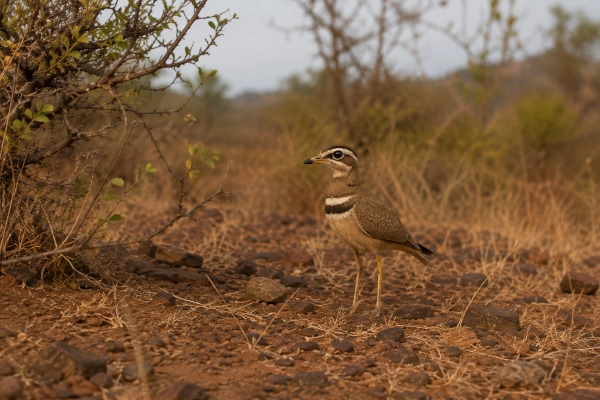
The Jerdon’s Courser (Rhinoptilus bitorquatus) is among India’s rarest, least understood and most threatened birds. Endemic to India, it is associated primarily with the dry scrub forests and rocky foothills of the Eastern Ghats in Andhra Pradesh. Its nocturnal behaviour, cryptic plumage and preference for dense scrub have made it exceptionally difficult to observe, survey or photograph.
For much of the twentieth century, the bird was believed to have disappeared completely. It was rediscovered in 1986, vanished from confirmed scientific records again for many years and was documented once more through a recorded call in August 2025. This extraordinary history has made the Jerdon’s Courser a symbol of both the fragility and resilience of India’s threatened wildlife.
A Distinctive Indian Courser
Jerdon’s Courser belongs to the family Glareolidae, which includes coursers and pratincoles. It is the only member of the genus Rhinoptilus occurring in India; the other members of the genus are found in Africa.
The bird has large eyes suited to activity in low light, comparatively long yellow legs and a short yellow bill with a dark tip. Its brown plumage provides excellent camouflage against dry leaves, soil and scrub vegetation. The face has broad white markings above the eyes, while two narrow white bands cross its brown breast. These paired breast bands gave rise to its older English name, the Double-banded Courser.
Unlike many familiar woodland birds, the Jerdon’s Courser spends much of its time on the ground. Its long legs allow it to move rapidly through open patches between bushes. When disturbed, it may initially run rather than immediately take flight, a characteristic shared by other coursers.
A Bird of Sparse Scrub and Bare Ground
The bird’s habitat is highly specialised. It occupies sparse scrub forest containing mature bushes, open ground, rocky soil and gently undulating terrain. Studies around the Sri Lankamalleswara Wildlife Sanctuary found that the species favoured areas containing approximately 300–700 large bushes per hectare, with fewer than 1,000 smaller bushes per hectare.
This means that neither completely cleared land nor very dense forest provides ideal conditions. The bird needs an intermediate landscape: enough mature scrub for shelter and camouflage, but sufficient open ground for walking, foraging and detecting danger.
Trees and shrubs characteristic of mature dry scrub, including Hardwickia binata, are associated with suitable habitat. Such landscapes are sometimes dismissed as degraded or unproductive land, yet they support specialised wildlife that cannot survive in agricultural fields, plantations or closed forests.
A 2026 habitat-modelling study covering the Sri Lankamalleswara sanctuary and the surrounding Lankamalla landscape identified vegetation height, elevation, slope and habitat structure as important predictors of suitable habitat. The research also indicated that some highly suitable scrub areas may lie beyond existing protected-area boundaries.
Nocturnal and Extremely Elusive
Jerdon’s Courser is primarily active after sunset and during the night. Its large eyes, subdued colouration and secretive behaviour allow it to remain concealed during daylight and move through the scrub after dark.
Studying such a bird presents unusual difficulties. Conventional daytime bird surveys are largely ineffective, while night searches cover only limited areas. Researchers therefore developed specialised methods, including smooth-soil tracking strips on which the bird leaves footprints, infrared-triggered cameras, call playback surveys and automated sound recorders.
The bird’s call was scientifically recorded and identified only in 2002. Knowledge of its distinctive two-note vocalisation later made acoustic surveys possible, giving conservationists a less intrusive method of searching large areas of apparently suitable scrub.
Very little is known about its daily movements, lifespan, territorial behaviour or breeding cycle. Analysis of a small number of droppings indicated that it feeds on insects, particularly termites and ants. No active nest or young chick has been formally described in the wild, although researchers once recorded the footprints of a smaller bird moving with an adult, suggesting successful breeding in the study area.
Lost, Rediscovered and Lost Again
The species was first recorded for science in the nineteenth century from the Eastern Ghats near present-day Nellore and Kadapa. Historical records also came from Sironcha near the Godavari and from the Bhadrachalam region, showing that the bird may once have occupied a wider belt of suitable habitat across parts of peninsular India.
After a record near Anantapur in 1900, the bird disappeared from scientific observation. Repeated expeditions failed to locate it, leading many ornithologists to fear that it had become extinct.
In January 1986, ornithologist Bharat Bhushan of the Bombay Natural History Society rediscovered the species near Reddipalli in Kadapa district, with crucial assistance from a local bird trapper named Aitanna. The rediscovery ended an absence of approximately 86 years from confirmed scientific records. The surrounding landscape was subsequently protected as the Sri Lankamalleswara Wildlife Sanctuary.
Research conducted after 2000 detected the species at several additional locations within approximately 20 kilometres of the rediscovery area. Tracking strips, camera traps and call surveys helped scientists identify suitable habitat and understand the bird’s narrow ecological requirements.
However, confirmed evidence again became scarce. A large acoustic-monitoring project described in 2022 collected more than 24,000 hours of recordings without detecting the bird’s call, illustrating how difficult it had become to establish whether the species still survived.
The 2025 Acoustic Rediscovery
On 24 August 2025, a team of Indian birdwatchers recorded the two-note call of Jerdon’s Courser at a new site in the Lankamalla Hills of Andhra Pradesh. BirdLife International described the record as the first documentation of the species in more than two decades and the first modern record beyond the area where earlier intensive studies had been concentrated.
The recording did not provide a new population count, nor did it establish the full extent of the bird’s distribution. Nevertheless, it confirmed that the species had survived and suggested that unexplored scrub habitats may still support additional individuals. The finding renewed interest in systematic surveys using autonomous sound recorders, camera traps and habitat modelling.
Because the population is exceptionally vulnerable, precise locations should be managed carefully to avoid disturbance, uncontrolled visitor pressure or illegal trapping.
Conservation Status
Jerdon’s Courser is classified as Critically Endangered on the IUCN Red List. Older assessments tentatively estimated a global population of only 50–249 mature individuals, although the true number remains uncertain because the bird is so difficult to detect. It is also placed under Schedule I of India’s Wild Life (Protection) Act, providing the country’s highest level of statutory protection.
The species is treated as a high conservation priority in India. However, insufficient observations mean that reliable long-term and annual population trends cannot yet be calculated.
Threats to Survival
The greatest danger is the destruction and fragmentation of mature scrub forest. Agricultural expansion, plantations, infrastructure projects and land clearance can remove the precise mixture of shrubs and open ground required by the bird.
Construction of the Telugu-Ganga Canal affected parts of the known landscape, and one location where the courser had been detected was destroyed during canal development. Roads, canals and other linear infrastructure can also divide habitat into isolated patches and alter access by people and livestock.
Other pressures include excessive woodcutting, grazing, expansion of settlements, inappropriate vegetation management and illegal bird trapping. Even when the Jerdon’s Courser is not deliberately targeted, a tiny population can be seriously affected by accidental capture or disturbance.
Overprotection through complete exclusion of traditional habitat management may also require careful assessment. If scrub becomes excessively dense, the open ground required by the courser may disappear. Conservation must therefore preserve the correct structure of the habitat rather than simply increasing tree or bush cover.
Protecting the Bird and Its Landscape
The survival of Jerdon’s Courser requires protection extending beyond individual sighting locations. Suitable scrub patches should be mapped, legally secured and connected wherever possible. Development proposals in the Lankamalla landscape should undergo rigorous environmental assessment based on the precautionary principle.
Long-term conservation priorities include:
- systematic acoustic surveys across suitable Eastern Ghats scrub;
- deployment of camera traps near confirmed calling locations;
- protection of habitat outside sanctuary boundaries;
- restoration of cleared or fragmented scrub;
- cooperation with local villages and forest-dependent communities;
- prevention of trapping and uncontrolled disturbance;
- research into breeding, diet, movement and population size.
India’s species recovery plan emphasises research, habitat management, conservation education, institutional cooperation and regular monitoring as essential elements for securing the bird’s future.
A Symbol of India’s Forgotten Scrublands
The story of Jerdon’s Courser demonstrates how easily an entire species can disappear from human knowledge without necessarily becoming extinct. It also highlights the ecological value of dry scrub forests, habitats that often receive less attention than rainforests, wetlands or grasslands.
The bird survived one long period of apparent disappearance and was found again in 1986. Its call emerging from the Lankamalla scrub in 2025 provided another rare sign of hope. That hope now depends on protecting the remaining landscape before silence returns permanently.
REFERENCES
- Andhra Pradesh Forest Department, Government of Andhra Pradesh
“A Species Recovery Plan for Jerdon’s Courser Rhinoptilus bitorquatus”
Published in 2010.
https://www.conservationindia.org/wp-content/uploads/JERDONS_REPORT-SRP.pdf
- Ministry of Environment, Forest and Climate Change, Government of India
“Recovery Programme for Critically Endangered Species and Habitats”
Jerdon’s Courser is included among the species covered under India’s national recovery programme.
https://www.moef.gov.in/index.php/wildlife-wl
- BirdLife International
“Glimmer of Hope: Sought-after Lost Bird Rediscovered in India”
Published: 10 September 2025.
This source documents the recording of the Jerdon’s Courser’s call in the Lankamalla Hills of Andhra Pradesh on 24 August 2025.
- Nature Conservation Foundation
“Saving the Endangered Jerdon’s Courser”
https://www.ncf-india.org/endangered-birds/saving-the-endangered-jerdons-courser
- State of India’s Birds
“Jerdon’s Courser — Rhinoptilus bitorquatus”
https://stateofindiasbirds.in/species/jercou1
- Jeganathan, P. et al.
“Use of Tracking Strips and Automatic Cameras for Detecting Critically Endangered Jerdon’s Coursers in Scrub Jungle in Andhra Pradesh, India”
Oryx, Volume 36, Issue 2, April 2002.
- Jeganathan, P. et al.
“Species Detection Framework Using Automated Recording Units: A Case Study of the Critically Endangered Jerdon’s Courser”
Oryx, Volume 57, Issue 1, January 2023.
- Bombay Natural History Society
“BNHS Timeline — Rediscovery of Jerdon’s Courser in 1986”
https://www.bnhs.org/time-line
You may also like
-
ZSI Scientists Identify New Fish Species Bathymyrus perplexus From the Bay of Bengal
-
Rare Afro-Asian Sand Snake Rediscovered in Kutch After More Than 150 Years
-
Indravati Tiger Reserve to Reopen for Wildlife Safaris After Four Decades
-
Tiny 3.3-mm Parasitic Wasp Discovered in Assam Marks First Record of Its Genus in India
-
How India Brought the Greater One-Horned Rhinoceros Back From the Brink
