Long before kings marched beneath royal banners and warriors gathered on the field of Kurukshetra, the heavens and the earth were shaped by older rivalries—rivalries born among sages, gods, serpents and celestial beings.
Among the great patriarchs of creation was Sage Kashyapa. Two of his wives, Vinata and Kadru, longed for children and sought his blessing. Kadru asked to become the mother of a thousand powerful sons. Vinata, desiring children of greater strength and glory, asked for only two.
In time, Kadru laid a thousand eggs, while Vinata laid two. Five hundred years passed before Kadru’s eggs broke open, releasing a vast race of serpents—the Nagas. They emerged in countless forms, gleaming like polished metal, their hoods marked with strange patterns and their eyes bright with ancient intelligence.
Vinata’s eggs, however, remained unbroken.
Tormented by impatience, she could bear the waiting no longer. She cracked open one of the eggs before its time. From it emerged Aruna, radiant but only partly formed. His upper body shone with celestial brilliance, but his lower limbs had not fully developed.
Aruna looked upon his mother with sorrow.
“Mother,” he said, “your impatience has left me incomplete. For this act, you shall fall into bondage. Yet do not despair. Your second son, if you allow him to be born at the appointed hour, will possess the strength to free you.”
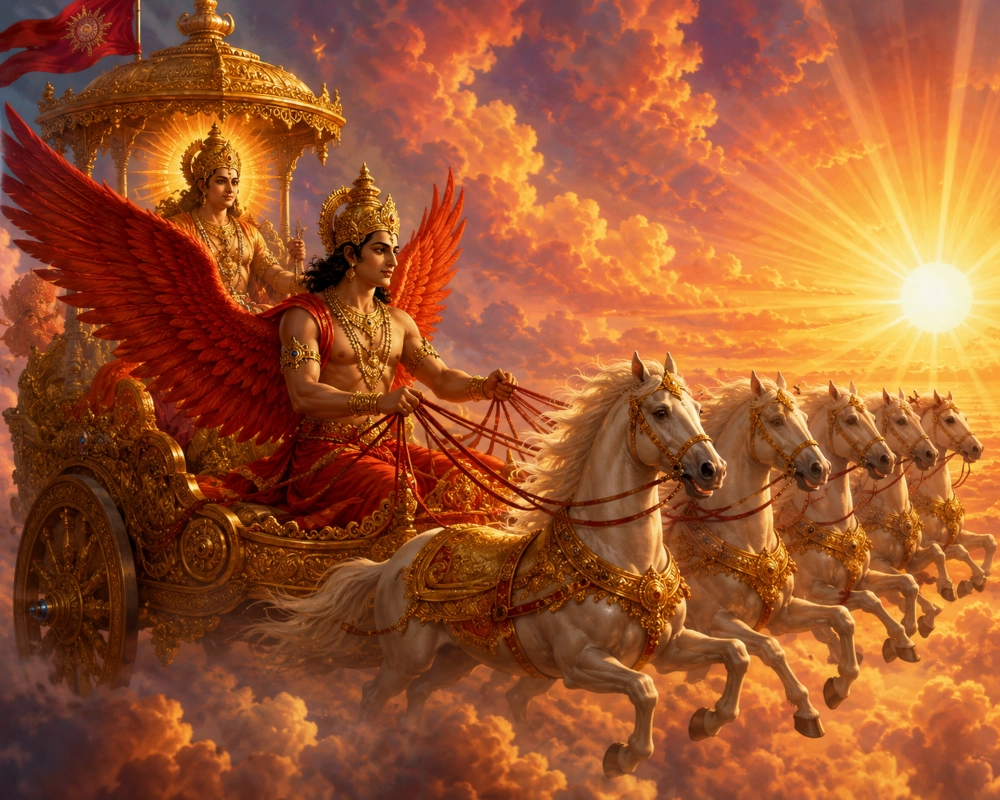
Aruna then rose into the heavens and became the charioteer of Surya, the Sun God. Each dawn, his crimson radiance would soften the unbearable fire of the sun before it touched the world.
Vinata guarded the remaining egg with humility and patience.
When the destined time arrived, the shell burst open in a blaze of light.
Garuda was born.
The Birth of the Mighty Garuda
The moment Garuda emerged, the three worlds trembled.
His body blazed like a mountain of fire. His wings stretched across the sky. His golden feathers flashed like lightning, and the wind from their movement shook forests, stirred oceans and scattered clouds. The gods, seeing the heavens filled with unbearable radiance, mistook him for Agni, the god of fire.
“O Fire,” they cried, “withdraw your flames! The worlds cannot endure this heat.”
But Agni answered, “This is not my power. It is Garuda, son of Vinata, born with strength beyond measure.”
At the request of the gods, Garuda reduced his immense form. He folded his wings, softened his radiance and descended beside his mother.
Vinata looked upon him with joy, but Garuda soon noticed the sorrow hidden in her eyes. Though she was the mother of a celestial being, she lived as a servant to Kadru and her serpent sons.
“Mother,” Garuda asked, “why do you obey Kadru as though you were her slave?”
Vinata hesitated, for the memory filled her with shame. At last, she revealed the story.
The Wager of the Divine Horse
When the gods and Asuras churned the Ocean of Milk, many wonders arose from its depths. Among them was Uchchaihshravas, the magnificent celestial horse, white as moonlight and swift as thought.
One day, Kadru and Vinata saw the divine horse from afar.
Kadru said, “Its body is white, but its tail is black.”
Vinata replied, “No. Uchchaihshravas is entirely white.”
The sisters argued until Kadru proposed a wager.
“Let us inspect the horse tomorrow. Whoever is wrong shall become the servant of the other.”
Vinata agreed, certain that she had spoken the truth.
Kadru, however, feared defeat. That night, she ordered her serpent sons to cling to the horse’s tail so that it would appear black. Some Nagas refused to participate in the deceit, but others obeyed and wrapped themselves around the white hairs of Uchchaihshravas.
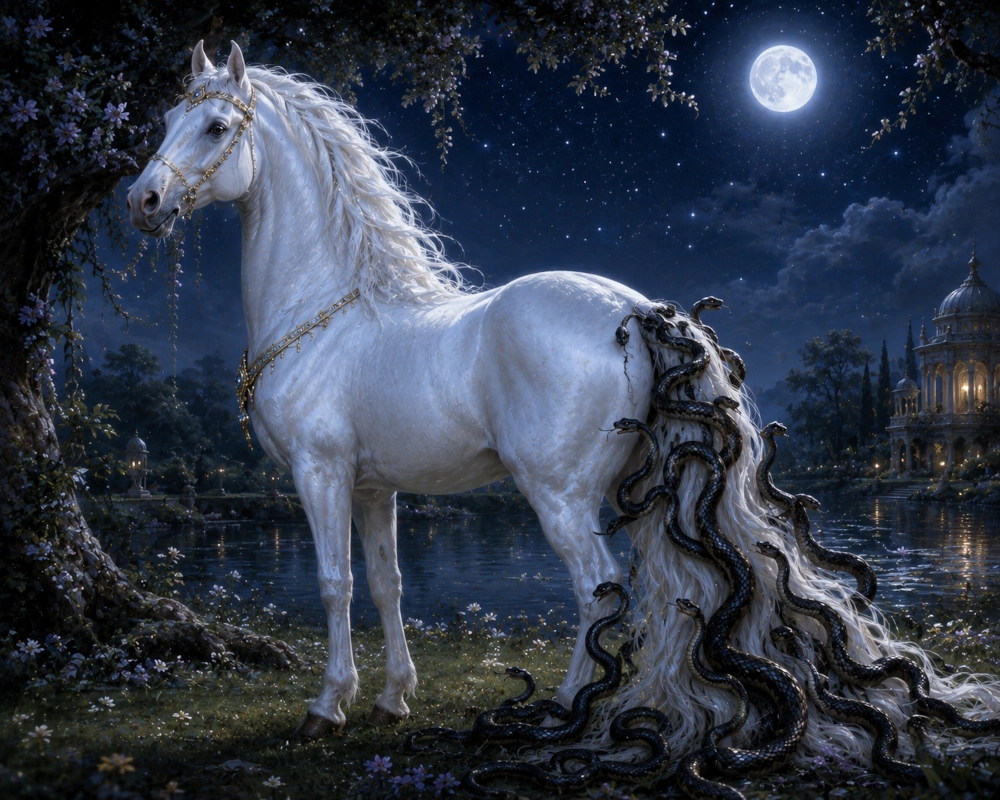
The next morning, Kadru and Vinata approached the celestial horse. Its body shone white, but its tail appeared dark with serpents.
Vinata lost the wager and became Kadru’s slave.
Garuda listened in silence. His great eyes burned with anger, yet he did not blame his mother. Instead, he turned toward the Nagas.
“What price will purchase her freedom?”
The serpents raised their hoods and answered together:
“Bring us Amrita, the nectar of immortality guarded by the gods. Give us the divine nectar, and Vinata shall be free.”
The demand was almost impossible. Amrita was protected in heaven by celestial armies, deadly weapons and the king of the gods himself.
Garuda did not hesitate.
“For my mother’s freedom,” he declared, “I shall bring it.”
The Search for Food
Before beginning his journey, Garuda approached Vinata.
“Mother, the path will be long, and the battles fierce. I must find food sufficient to sustain my strength.”
Vinata directed him toward a distant land inhabited by Nishadas. Yet she warned him never to harm a Brahmana, for the spiritual power of a true sage could burn even the mightiest being.
Garuda descended upon the region like a storm. With one sweep of his beak, he consumed countless beings. But suddenly he felt a terrible heat within his throat, as though he had swallowed a living flame.
He understood that a Brahmana was among those he had taken.
Garuda spoke respectfully into his own throat.
“Revered one, please emerge. I meant you no harm.”
The Brahmana replied, “I will not leave without my wife.”
“Let her come with you,” Garuda said.
The sage and his wife emerged unharmed, and the burning ceased.
Still hungry, Garuda travelled onward and met his father, Sage Kashyapa. The sage told him of two brothers who had once quarrelled bitterly over an inheritance. Through mutual curses, one had become a gigantic elephant and the other an enormous tortoise. Even in their animal forms, they continued their ancient battle in a vast lake.
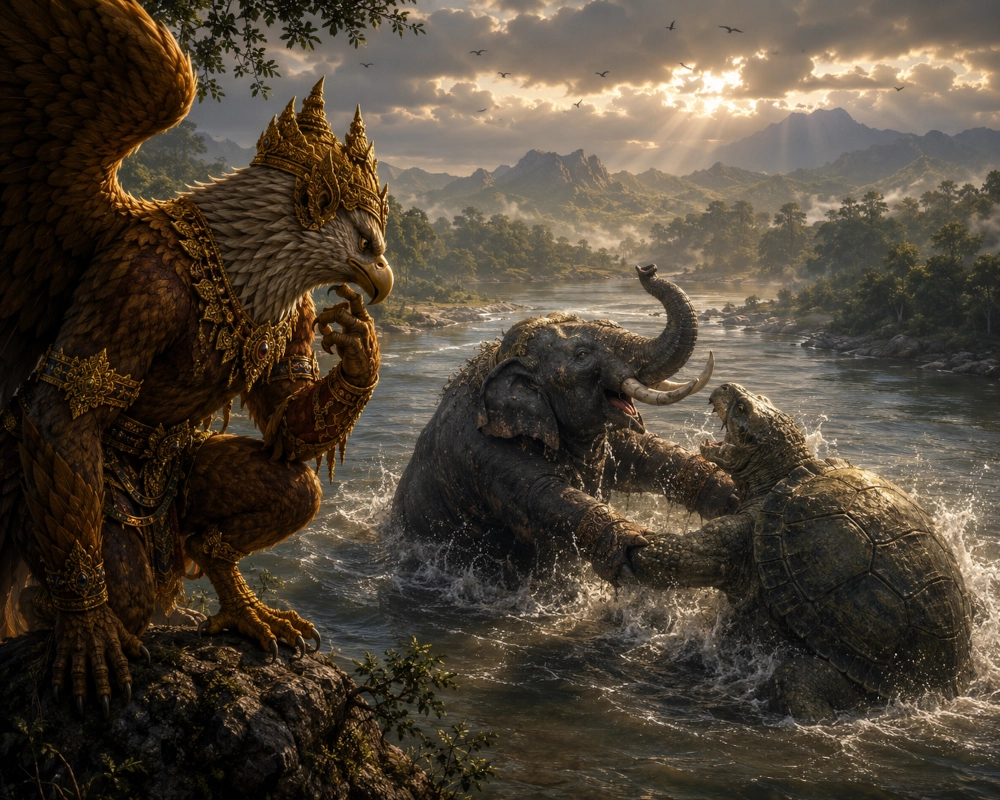
“You may eat them,” Kashyapa said. “Their bodies will restore your strength.”
Garuda swooped down, seizing the elephant in one claw and the tortoise in the other. Looking for a place to consume them, he landed upon the branch of an immense banyan tree.
The branch cracked beneath his weight.
Garuda then saw that many tiny sages, the Valakhilyas, were hanging upside down from the branch in deep meditation. If the branch fell, they would be crushed.
Holding the elephant and tortoise in his claws, Garuda caught the broken branch in his beak and flew onward. He would not allow his hunger or his mission to destroy innocent ascetics.
At last, with Kashyapa’s guidance, he placed the sages safely upon a mountain. He then consumed the elephant and tortoise and regained his full strength.
His wings beat once.
The mountain shook.
Then Garuda rose toward heaven.
The Assault on the Realm of the Gods
The gods saw terrible omens.
The heavens darkened though no storm had gathered. Meteors streaked across the sky. Celestial weapons trembled in their racks. The garlands of the gods faded, and blood-red winds swept through Amaravati.
Indra, king of the gods, turned to Brihaspati, the divine preceptor.
“What approaches?”
Brihaspati answered, “Garuda comes for Amrita. He seeks not immortality for himself, but freedom for his mother. Yet his strength is beyond ordinary measure. Prepare the gods.”
Indra summoned the Vasus, Rudras, Adityas, Maruts, Sadhyas and Gandharvas. Celestial warriors gathered around the nectar, armed with spears, swords, thunderbolts and weapons glowing with divine fire.
Then Garuda appeared.
He filled the horizon.
His wings stirred cyclones through the heavens. Dust and cloud blinded the celestial army. His beak flashed like a weapon, his claws shone like iron hooks, and his golden body blazed against the darkened sky.
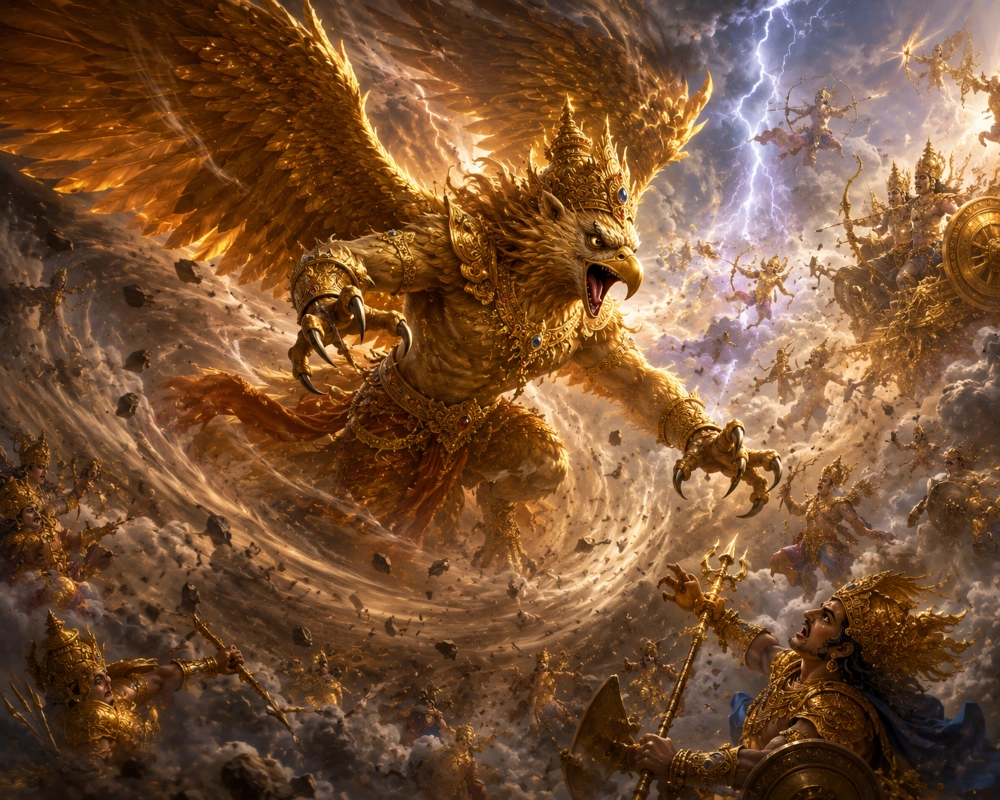
The gods attacked.
Arrows, spears and flaming missiles struck Garuda from every direction. He endured them as a mountain endures rain. With the sweep of his wings, he scattered entire formations. With his claws, he shattered weapons. With his beak, he struck down celestial guards without losing sight of his purpose.
Garuda did not fight from hatred. He fought because chains bound his mother.
The divine hosts could not stop him.
The Defences Around Amrita
Beyond the defeated guardians stood a wall of fire that rose from earth to heaven. Its flames spun in every direction, roaring with such intensity that even the gods approached it with caution.
Garuda expanded his body and flew across rivers, lakes and oceans. With many mouths, he drank enormous quantities of water. Returning to the barrier, he released the water upon the flames until the great fire weakened and died.
Behind it revolved a vast wheel of sharpened blades. It spun without pause, cutting apart anything that attempted to pass. No opening remained visible for more than a fraction of a moment.
Garuda made himself as small as a speck.
Watching the rhythm of the blades, he darted through the wheel at the precise instant when its edges separated.
Beyond the wheel waited two colossal serpents. Their eyes burned with venomous fire. Their gaze alone could reduce an intruder to ashes, and their tongues flickered like lightning.
Garuda beat his wings against the ground, raising a cloud of dust. The dust blinded the serpent guardians. Before they could recover, he struck them down with his claws and beak.
At last, Garuda stood before the vessel containing Amrita.
The nectar of immortality glowed with a light unlike fire, moon or sun. It seemed to contain the silent promise of deathlessness.
Garuda took the vessel in his talons.
He did not drink from it.
Though exhausted from hunger, wounded by divine weapons and standing before the most coveted treasure in creation, he refused to claim it for himself. He had come for one purpose alone: to free Vinata.
Garuda Meets Vishnu
As Garuda departed with the nectar, Lord Vishnu appeared before him.
The Preserver of the universe had watched Garuda’s courage, restraint and devotion. He saw that the mighty bird had overcome the gods, fire, blades and serpents, yet had not been overcome by greed.
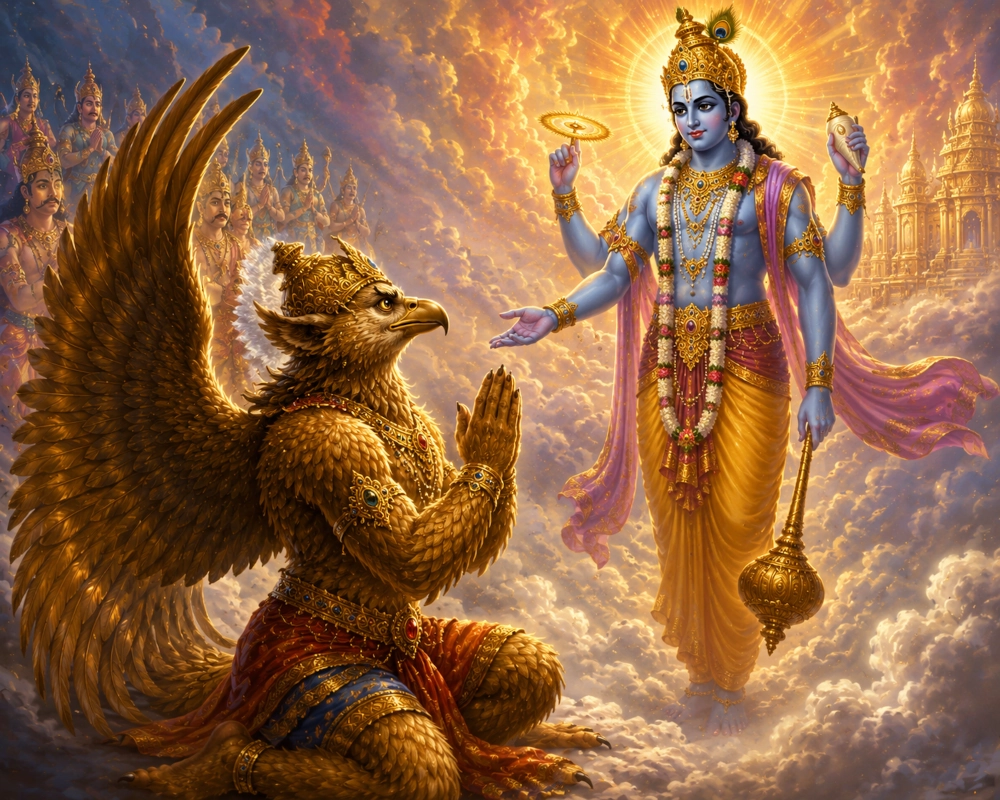
Vishnu spoke:
“Garuda, I am pleased with you. Ask for a boon.”
Garuda bowed.
“Lord, grant that I may remain immortal even without drinking Amrita. And let my place be above the serpents who enslaved my mother.”
Vishnu granted both wishes.
Then Garuda, filled with reverence, said, “Lord, you too may ask a boon from me.”
Vishnu smiled.
“Become my vehicle and bear me through the worlds.”
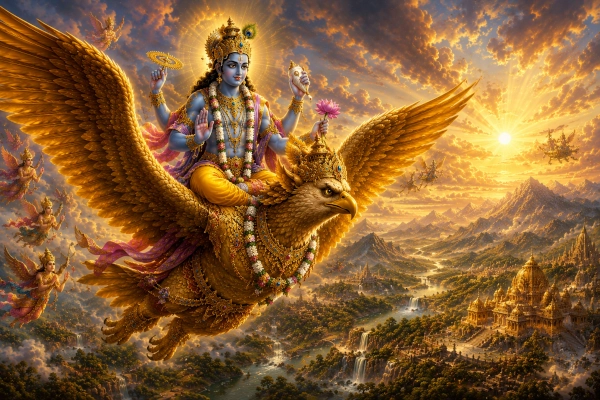
Garuda accepted with joy. From that time onward, he became the vahana of Vishnu, soaring beneath the Lord and carrying the divine presence across heaven and earth.
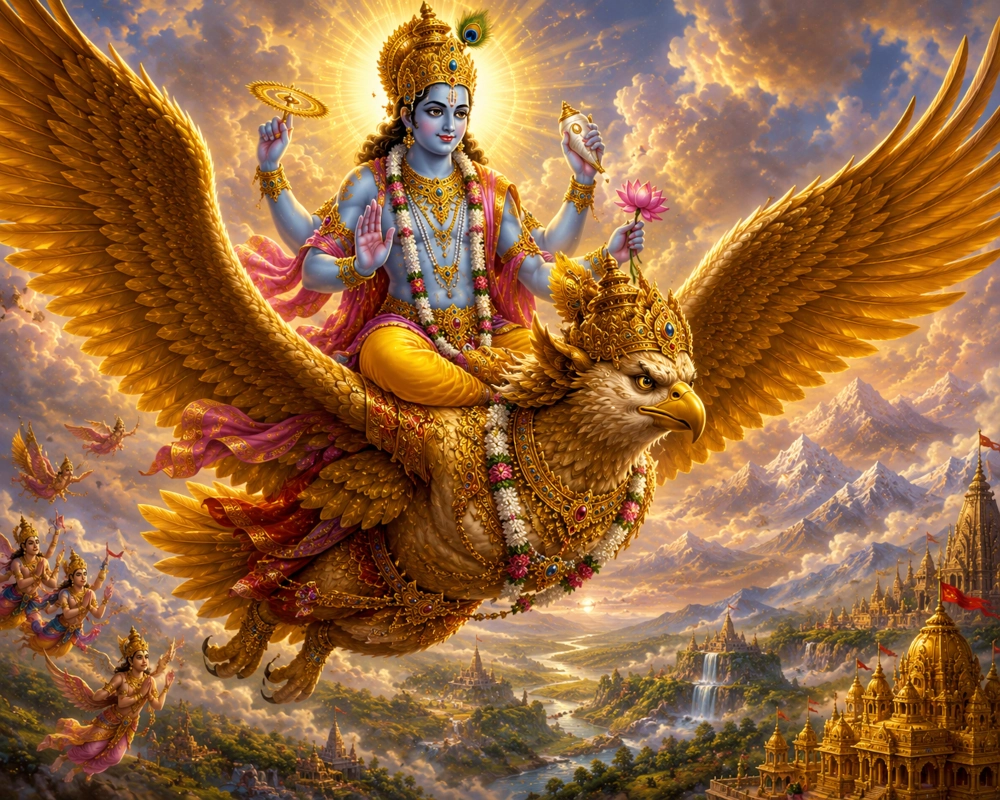
To fulfil Garuda’s wish to remain above him, Vishnu placed Garuda’s image upon his banner. Thus Garuda was both the bearer of Vishnu and the emblem that flew high above him.
The Thunderbolt of Indra
Garuda continued toward the realm of the Nagas, carrying the vessel of Amrita.
Indra pursued him and hurled the Vajra, the thunderbolt fashioned from the bones of the sage Dadhichi. The weapon that had shattered mountains struck Garuda with tremendous force.
Garuda remained unharmed.
Yet out of respect for the sacrifice of Dadhichi and the majesty of Indra’s weapon, he allowed one feather to fall.
He turned to the king of the gods.
“Your thunderbolt cannot destroy me, O Indra. Yet I honour the sage whose bones gave it power. Therefore, I surrender one feather.”
Indra was astonished by his strength and nobility.
“Why do you carry Amrita to the serpents?” he asked.
Garuda explained the bondage of Vinata and the price demanded for her freedom.
Indra then understood that Garuda had no desire to make the Nagas immortal.
The two formed a plan.
Garuda would place the vessel before the serpents and secure his mother’s release. Before the Nagas could drink, Indra would recover the nectar.
Garuda asked for one further boon.
“Let the serpents become my natural food.”
Indra granted it.
Thus began the ancient enmity between Garuda and the Nagas.
Vinata’s Freedom
Garuda descended before Kadru and her serpent sons. The earth shook beneath the wind of his wings.
He placed the vessel of Amrita upon a bed of sacred kusa grass.
“I have fulfilled your demand,” he said. “Release my mother.”
The Nagas, dazzled by the sight of the nectar, agreed. Vinata’s bondage ended.
Garuda looked upon his mother. For the first time in many years, she stood free.
No chain held her. No command of Kadru bound her. The shame of the old wager had been lifted by the devotion of her son.
Garuda then spoke to the Nagas.
“Purify yourselves before drinking the nectar. Bathe and perform the proper rites. The vessel shall remain here until you return.”
Driven by desire, the serpents hurried away.
The instant they departed, Indra descended and carried the Amrita back to heaven.
When the Nagas returned, the vessel was gone.
Believing that drops of nectar might have fallen upon the kusa grass, they licked its sharp blades. The edges cut their tongues, splitting them in two. From that day, serpents were said to possess forked tongues.
The kusa grass, touched by the vessel of Amrita, came to be regarded as sacred.
The Flight of Freedom
Garuda did not gain greatness merely because he was strong.
Many beings possessed strength. Many desired immortality. Many fought the gods.
Garuda’s glory came from the purpose behind his power.
He crossed worlds not for conquest, but for his mother. He faced divine armies without surrendering to anger. He stood before the nectar of immortality without yielding to temptation. He honoured sages, protected ascetics, respected the Vajra and kept his promise even to those who had enslaved Vinata.
His wings became symbols of freedom. His talons became the terror of serpents. His form became inseparable from Vishnu, and his image rose above temples, banners and sacred gateways.
Whenever Garuda soared across the heavens, Vinata could look upward and remember that no bondage is beyond breaking when courage is joined with devotion.
Thus Garuda won something greater than Amrita.
He won immortality without drinking the nectar, divine service without seeking power, and everlasting fame through the liberation of his mother.
You may also like
-
Gnani AI Launches Nationwide Challenge Offering Up to 100 Paid AI Internships
-
NMMSS Scholarship Application Deadline Extended to October 31, 2026
-
DGCA Introduces Training Framework for Gyroplane Pilots in India
-
DRDO CASDIC Opens 30 Paid Internships for Engineering and Science Students
-
Duryodhana Wins Shalya Through Hospitality: Gifts, Obligation and Political Leverage Before the Kurukshetra War
