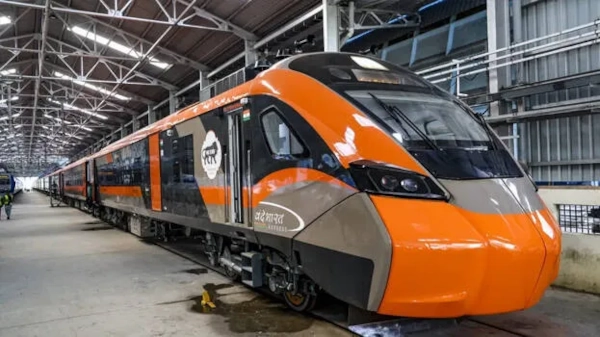
India’s railway freight sector has entered a new technological phase with the commencement of speed and safety trials of the country’s first Vande Bharat platform-based Freight Electric Multiple Unit.
The 16-coach prototype, designed and manufactured by the Integral Coach Factory in Chennai, began its formal trials on July 29, 2026, in the Kota Division of West Central Railway. The Research Designs and Standards Organisation is conducting the extensive evaluation programme along the Kota–Nagda–Sawai Madhopur corridor.
During the initial phase of testing, the train successfully attained a speed of 145 kilometres per hour, demonstrating the potential of the indigenous trainset to support a new category of high-speed, time-sensitive freight transportation.
The Freight EMU is intended to provide faster and more predictable movement of parcels, perishable commodities, pharmaceuticals, electronics, e-commerce consignments and other high-value cargo that currently relies heavily on road or air transport.
Month-Long Testing Programme
The Freight EMU is expected to undergo nearly a month of technical, operational and safety trials. At least two round trips are planned daily to assess its performance under different track, loading and operating conditions.
Trials are being conducted at speeds of 120, 130, 140 and 145 kilometres per hour. The train will be evaluated in loaded as well as simulated operating conditions to determine its stability, braking performance, riding behaviour and structural response.
The tests will help RDSO establish whether the train meets the required safety and performance standards before it can receive approval for commercial operation.
RDSO is Indian Railways’ principal research, testing and standard-setting organisation. Its responsibilities include evaluating new rolling stock, propulsion systems, braking equipment, signalling technologies and railway infrastructure before their regular deployment.
Built on the Vande Bharat Trainset Concept
Unlike a conventional freight train pulled by a separate locomotive, the Vande Bharat Freight EMU uses distributed electric propulsion.
Traction equipment is spread across multiple coaches, allowing the train to accelerate and decelerate more quickly than locomotive-hauled freight rakes. This configuration can help the train maintain higher average speeds, particularly on routes with frequent speed restrictions or traffic-related interruptions.
The system also allows quicker reversal at terminals because a driving cab is provided at both ends. A locomotive does not have to be detached, repositioned or replaced before the train begins its return journey.
The Vande Bharat freight project was conceived as a superfast parcel service for palletised and high-value cargo. Earlier plans envisaged a design speed of up to 160 kilometres per hour, substantially higher than the operating speeds of most conventional freight services.
Configuration of the 16-Coach Freight EMU
The prototype consists of 16 coaches arranged to provide driving, technical and cargo-handling functions.
Its reported configuration includes:
- two Driving Trailer Coaches;
- two Non-Driving Trailer Coaches; and
- 12 dedicated parcel coaches.
The train has an axle-load capacity exceeding 20 tonnes and a reported total payload capacity of approximately 397 tonnes.
This makes it fundamentally different from a passenger Vande Bharat train. The internal layout has been developed for cargo handling rather than seating, passenger amenities or onboard catering.
Wide door openings, reinforced floors and mechanised cargo-handling features are intended to reduce the time required for loading and unloading.
Designed for Express Cargo
Conventional freight trains primarily carry bulk commodities such as coal, cement, foodgrains, steel, petroleum products and fertilisers. Their operating model prioritises large carrying capacity rather than rapid delivery.
The Freight EMU is intended for a different logistics market: goods that are relatively lightweight, commercially valuable and highly sensitive to delivery time.
Possible cargo categories include:
- e-commerce and courier parcels;
- medicines, vaccines and medical equipment;
- fruits, vegetables, flowers and dairy products;
- electronics and telecommunications equipment;
- automotive and industrial components;
- processed and packaged foods; and
- urgent commercial consignments.
The train could occupy a middle position between road freight and air cargo. It may offer higher capacity and lower transportation costs than aircraft while providing faster and more predictable delivery than conventional railway parcel services.
Refrigerated Freight Facilities
One of the significant features of the Freight EMU is the provision for refrigerated or temperature-controlled parcel transportation.
Cold-chain facilities can support the movement of medicines, vaccines, dairy products, seafood, fruits, vegetables and other temperature-sensitive commodities.
Maintaining the required temperature throughout the journey is essential because even a brief interruption can damage pharmaceutical or perishable cargo. Integrating cold-chain capability into a high-speed rail freight service could therefore reduce spoilage and expand the market reach of farmers, food processors and medical suppliers.
Forced-ventilation systems have also been incorporated to maintain airflow inside cargo areas and support the safe carriage of products requiring controlled ventilation.
Mechanised Loading and Roller Flooring
The train is equipped with pneumatic retractable roller flooring to improve cargo handling.
When activated, the rollers allow palletised consignments and cargo units to move more easily across the coach floor. After loading is completed, the system can be retracted to provide a stable surface during the journey.
Mechanised loading can substantially reduce terminal stoppage time compared with the manual handling of individual packages. It can also reduce physical strain on workers and lower the risk of cargo damage.
Efficient terminal infrastructure will nevertheless be essential. Freight stations serving the train may require compatible pallets, forklifts, loading platforms, storage facilities, scanners and digital cargo-management systems.
Higher Average Operating Speed
The Freight EMU is expected to target an average operating speed of approximately 80 to 90 kilometres per hour.
This would represent a major improvement over conventional cargo trains, which often operate at average speeds of around 60 to 70 kilometres per hour or lower, depending on the route, congestion and type of service.
Its ability to accelerate quickly could be as important as its maximum speed. On a mixed-traffic railway network, trains frequently encounter temporary restrictions, signals and route conflicts. A distributed-power trainset can recover speed faster after each slowdown.
The actual commercial journey time will depend on track capacity, signalling, permitted sectional speed, terminal efficiency and the priority allocated to the service.
Automatic Door Safety System
Cargo doors represent a major safety concern in a high-speed freight train. The prototype therefore incorporates interlocking and automatic locking mechanisms.
All doors are designed to lock automatically once the train exceeds a speed of 5 kilometres per hour. The train cannot begin normal operation unless every cargo door is confirmed to be fully closed and secured.
This interlocking system is intended to prevent the accidental opening of doors during movement, reduce the risk of cargo falling from the train and protect railway infrastructure and personnel along the route.
Door-operation tests form an important part of the RDSO evaluation programme.
Kavach Protection System
The Freight EMU is also equipped with Kavach, Indian Railways’ indigenous automatic train-protection and collision-avoidance system.
Kavach is designed to assist the locomotive pilot or train operator by enforcing speed restrictions and intervening when the train approaches a signal at danger under specified operating conditions.
The inclusion of Kavach reflects the need for advanced safety protection as freight trains begin operating at significantly higher speeds.
Its effectiveness depends on the availability of compatible trackside and signalling infrastructure along the route on which the train is deployed.
Emergency Braking Trials
Emergency Braking Distance testing is among the most critical components of the trial programme.
Engineers measure the distance required for the train to come to a complete stop after emergency brakes are applied at different speeds and under varying load conditions.
The results help determine safe signalling distances, braking curves and operational restrictions. Braking performance can be affected by train weight, speed, wheel condition, track gradient, weather and rail adhesion.
The train will also undergo regular braking, traction and jerk tests to evaluate the smoothness and reliability of its acceleration and deceleration systems.
Oscillation and Stability Testing
Oscillation trials are being conducted to assess the train’s behaviour at high speeds.
Sensors installed across the train measure lateral movement, vertical acceleration, suspension response and the forces generated between the wheels and rails.
Excessive oscillation could affect cargo stability, damage components or increase the risk of derailment. The tests therefore help determine whether the suspension, bogies and coach bodies remain within prescribed safety limits.
Curve-performance tests will separately examine how the Freight EMU behaves while negotiating bends at different speeds and loading conditions.
Coupler-Force Evaluation
The forces transmitted through the couplers connecting the coaches are also being measured.
Sudden acceleration, braking, changes in gradient and movement through curves can produce compressive and tensile forces throughout the train. Excessive coupler forces could damage equipment or affect the stability of the rake.
The evaluation will determine whether the couplers and inter-coach connections can safely withstand the dynamic loads generated during high-speed freight operations.
Traction and Regenerative Energy Tests
The advanced propulsion system is undergoing detailed testing to assess acceleration, power consumption, wheel-slip control and operation under different loading conditions.
The train also uses regenerative braking. During deceleration, traction motors operate as generators and convert a portion of the train’s kinetic energy into electrical energy.
Where the traction network can receive it, this electricity can be returned to the railway power system. Regenerative braking can reduce energy consumption and decrease wear on conventional braking components.
The trials will measure the amount of energy recovered and examine the interaction between the train and the railway’s electrical infrastructure.
Signalling and Telecom Interference Tests
Modern trainsets contain high-power electrical and electronic equipment that can potentially produce electromagnetic interference.
RDSO will test whether the Freight EMU’s propulsion, communication and onboard electrical systems interfere with railway signalling, track circuits, telecommunications or other safety-critical equipment.
These assessments are essential because reliable signalling and communication must be maintained even when the train is accelerating, braking or operating at maximum power.
Passenger-information and communication systems associated with the train, including applicable PAPIS functions, will also be assessed during the trial programme.
Static and Interior-System Tests
Testing is not confined to speed runs.
Static inspections are being carried out on CCTV systems, lighting, onboard electrical installations, ventilation equipment, cargo doors and short-circuit protection.
Engineers will also verify emergency systems, power distribution, wiring integrity, fire-safety arrangements and the functioning of equipment under different fault conditions.
These tests are intended to ensure that the train remains safe not only during normal operation but also when individual components malfunction.
Potential Benefits for Indian Logistics
India’s logistics system depends heavily on road transportation for express and high-value cargo. Trucks offer flexibility and door-to-door connectivity but can be affected by traffic congestion, road conditions, driver availability and seasonal disruptions.
A scheduled high-speed freight train could provide predictable departure and arrival times between major industrial and commercial centres.
Potential benefits include reduced transit time, lower dependence on highways, improved reliability and reduced emissions per unit of cargo when compared with long-distance road transport.
The system could be particularly effective on high-density routes linking major cities, logistics parks, manufacturing centres, airports and consumption markets.
Challenges Before Commercial Deployment
Successful technical trials will represent only one stage in the Freight EMU’s development.
Its commercial viability will also depend on securing sufficient cargo, providing fast loading and unloading facilities, integrating first- and last-mile road transport and maintaining reliable schedules.
A premium high-speed freight train must minimise terminal delays. Saving several hours during the rail journey would provide limited benefit if consignments remain at terminals awaiting sorting or onward transportation.
Indian Railways will therefore need close coordination with logistics companies, e-commerce platforms, pharmaceutical manufacturers, agricultural producers, cold-chain operators and industrial customers.
Pricing will also be important. Freight charges must be competitive enough to attract cargo from road and air transport while covering the higher operating and infrastructure costs of an express train.
Towards a New Railway Freight Segment
The Vande Bharat Freight EMU is not intended to replace conventional goods trains. Heavy-haul rakes will remain essential for transporting bulk commodities and large container volumes.
Instead, the new trainset could create a premium railway logistics segment built around speed, punctuality, temperature control and scheduled delivery.
The successful attainment of 145 kilometres per hour during the initial Kota trials is an important technical milestone. The continuing RDSO tests will determine whether the train can safely and consistently meet the demanding standards required for commercial operation.
Should the trial programme succeed, India’s first Vande Bharat Freight EMU could establish a new model for high-speed rail cargo—combining indigenous trainset technology, modern safety systems, mechanised handling and environmentally efficient electric transportation.
You may also like
-
EON Space Labs and Dhruva Space Advance Indian Space Hardware on Transporter-18 Mission
-
SatLeo Labs’ TAPAS-1 Reaches Orbit, Advancing India’s Private Thermal-Imaging Capability
-
TakeMe2Space’s MOI-1A Reaches Space on Falcon 9 Transporter-18 Mission
-
Bank of Baroda Enters Pension Fund Management After PFRDA Appointment
-
SCI and India’s Push for a Larger Indigenous Maritime Fleet
