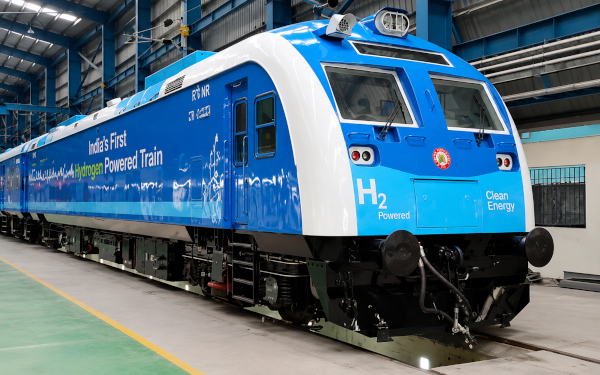
Indian Railways is on the verge of achieving a landmark in sustainable transportation with the launch of the country’s first indigenous hydrogen-powered train, a project that combines advanced fuel-cell technology, battery-electric propulsion and green hydrogen production. The initiative represents one of the most ambitious efforts by Indian Railways to decarbonise rail operations beyond conventional electrification and establish India as a global player in hydrogen-based mobility.
The pilot train has been developed for the Jind-Sonipat section of Northern Railway in Haryana, where dedicated hydrogen production, storage and refuelling infrastructure has also been established. Unlike a conventional diesel train, the new trainset will generate electricity onboard using hydrogen fuel cells, producing only water vapour and heat as by-products, thereby eliminating tailpipe carbon emissions.
A Fuel Cell Instead of a Diesel Engine
At the heart of the train is a Proton Exchange Membrane Fuel Cell (PEMFC) system, one of the most widely adopted fuel-cell technologies for transport applications due to its high efficiency, quick start-up and compact design. Inside the fuel cell, compressed hydrogen reacts electrochemically with oxygen drawn from ambient air. Instead of combustion, the reaction generates electricity, with water as the only direct emission.
The electricity produced powers traction motors through sophisticated power electronics, while a lithium-ion battery bank acts as a secondary energy source. The batteries store energy recovered during regenerative braking and provide additional power during acceleration or peak-load conditions, improving overall efficiency and reducing hydrogen consumption. This hybrid architecture enables the fuel cells to operate closer to their optimum efficiency rather than responding to every rapid change in power demand.
Indigenous Engineering
Rather than designing an entirely new train from scratch, Indian Railways has retrofitted an existing Diesel Electric Multiple Unit (DEMU) into a hydrogen-powered Distributed Power Rolling Stock (DPRS). The conversion required engineers to remove the diesel engine, alternator and fuel tank before integrating fuel-cell stacks, hydrogen storage cylinders, battery systems, inverters, converters, thermal management equipment and an advanced Energy Management System (EMS).
The project specifications were prepared by the Research Designs and Standards Organisation (RDSO), while manufacturing and system integration have been carried out within the Indian Railways ecosystem as part of the government’s “Atmanirbhar Bharat” initiative.
One of the World’s Most Powerful Hydrogen Trainsets
The hydrogen train consists of a 10-coach formation equipped with two hydrogen-powered driving cars. Each power unit develops approximately 1,200 kW of traction power, providing a combined installed capacity of around 2,400 kW (about 3,200 horsepower). This makes it among the most powerful hydrogen-powered passenger trainsets developed on broad-gauge railways globally.
For regular passenger operations, the train has been approved to run at a maximum speed of 75 km/h on the dedicated Jind-Sonipat corridor, although higher-speed trials have been undertaken during the testing phase to validate system performance and safety.
Hydrogen Storage and Safety Systems
Hydrogen’s low density and high flammability require specialised engineering solutions. The train stores compressed hydrogen in lightweight Type IV composite cylinders, designed to withstand operating pressures of around 350 bar. These cylinders feature polymer liners wrapped in carbon-fibre composites, offering high strength while minimising weight.
The train incorporates multiple layers of safety systems, including hydrogen leak detectors, flame detection sensors, continuous gas monitoring, automatic isolation valves, emergency venting systems and specialised ventilation arrangements to prevent hydrogen accumulation. Every major subsystem has undergone extensive testing and safety assessment before operational approval.
Green Hydrogen Supply
To support the pilot project, Indian Railways is establishing a dedicated hydrogen production facility at Jind, where hydrogen will be generated through electrolysis. In this process, electricity splits water into hydrogen and oxygen. When powered by renewable electricity, the resulting fuel qualifies as green hydrogen, significantly lowering lifecycle carbon emissions compared with hydrogen produced from natural gas.
The project also includes hydrogen compression, storage and refuelling systems capable of supplying the train safely and efficiently, laying the foundation for future hydrogen-powered railway operations.
Why Hydrogen When Most Routes Are Electrified?
Indian Railways has already electrified nearly its entire broad-gauge network, making it one of the world’s largest electrified railway systems. As a result, hydrogen trains are not intended to replace electric trains operating under overhead wires.
Instead, hydrogen propulsion is viewed as a solution for routes where electrification is technically difficult, economically unviable or strategically undesirable. These include remote branch lines, heritage railways, hilly terrain and isolated corridors where installing overhead catenary infrastructure would involve significant costs. Hydrogen trains can provide zero-emission operation on such routes without requiring continuous electrification.
Technical Challenges Ahead
While hydrogen fuel-cell technology offers substantial environmental benefits, several challenges remain before large-scale deployment becomes commercially viable. Producing green hydrogen is currently more expensive than diesel fuel on an energy-equivalent basis, and the infrastructure needed for hydrogen generation, compression, storage and distribution requires significant investment.
Fuel-cell stacks also depend on advanced materials and catalysts, while high-pressure hydrogen storage systems must meet stringent safety standards. Long-term reliability under India’s diverse climatic conditions—including high temperatures, dust and humidity—will be closely monitored during the pilot phase.
In addition, hydrogen’s lower volumetric energy density compared with liquid fuels means storage systems occupy more space, making efficient onboard packaging a critical engineering challenge.
A Strategic Step Towards Green Mobility
Beyond demonstrating a new propulsion technology, the hydrogen train serves as a testbed for developing indigenous expertise in fuel cells, hydrogen storage, power electronics, battery integration and railway safety systems. The experience gained from this pilot could accelerate domestic manufacturing of hydrogen technologies and support India’s broader ambitions under the National Green Hydrogen Mission.
If successful, the project could pave the way for hydrogen-powered trains on select non-electrified routes while strengthening India’s position in the emerging global hydrogen economy. For Indian Railways, the initiative marks not just the introduction of a new train, but the beginning of a new chapter in clean, low-carbon transportation.
You may also like
-
EON Space Labs and Dhruva Space Advance Indian Space Hardware on Transporter-18 Mission
-
SatLeo Labs’ TAPAS-1 Reaches Orbit, Advancing India’s Private Thermal-Imaging Capability
-
TakeMe2Space’s MOI-1A Reaches Space on Falcon 9 Transporter-18 Mission
-
Bank of Baroda Enters Pension Fund Management After PFRDA Appointment
-
SCI and India’s Push for a Larger Indigenous Maritime Fleet
