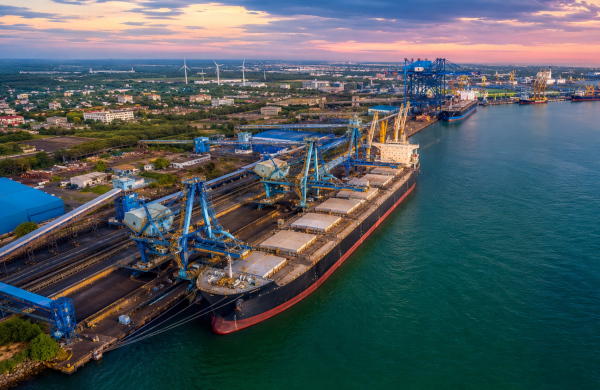
India is stepping up investment across ports, inland waterways and shipbuilding as part of its wider effort to build a globally competitive maritime economy under the Viksit Bharat 2047 vision.
The Ministry of Ports, Shipping and Waterways is working to add more than 700 million tonnes per annum of port-handling capacity by 2030. At a high-level review chaired by Union Minister Sarbananda Sonowal, officials were directed to accelerate major projects, improve coordination and ensure that critical infrastructure is completed within scheduled timelines.
Several large projects are expected to drive this expansion. The proposed Vadhavan Port is projected to contribute around 164 MTPA of capacity by 2030–31. The Tuticorin Outer Harbour project is expected to add about 39 MTPA, while the Tuna Tekra Terminal at Kandla is planned to contribute another 33 MTPA by 2027–28.
The ministry has outlined plans to create nearly 682 MTPA of additional capacity through new terminals, mechanisation, operational improvements and greater private participation. Cargo-handling mechanisation at ports is targeted to rise from 76 per cent in FY 2025–26 to 93 per cent by 2030.
Public-private partnerships are also set to play a much larger role in port operations. The share of cargo handled through PPP projects, which stood at 44 per cent in 2013–14, is expected to reach 85 per cent by 2030–31. The government is simultaneously aiming for complete digitisation of the maritime sector by 2030 to improve transparency, reduce turnaround times and strengthen logistics efficiency.
India has also recorded notable progress in inland water transport and ship recycling. Cargo movement through inland waterways has crossed 200 million tonnes, reaching the Maritime India Vision 2030 target ahead of schedule. The country has also emerged as the world’s largest ship-recycling nation, underlining its growing importance in the global maritime industry.
Domestic shipbuilding is another major focus area. India’s shipbuilding output increased by 41 per cent, rising from 40,923 gross tonnes in 2024 to 57,637 gross tonnes in 2025. To expand future production, in-principle approval has been granted for greenfield shipbuilding clusters in Tamil Nadu, Andhra Pradesh and Gujarat.
Each proposed cluster is planned with a capacity of about 1.2 million gross tonnes. Similar approvals for Maharashtra and Odisha are expected to follow, creating a wider network of shipbuilding hubs along India’s coastline.
Together, these initiatives are expected to reduce logistics costs, attract private investment, improve cargo-handling efficiency and support indigenous ship construction. The expansion also forms part of India’s broader ambition to strengthen maritime manufacturing, modernise port infrastructure and establish itself as a major global shipping and logistics power.
You may also like
-
EON Space Labs and Dhruva Space Advance Indian Space Hardware on Transporter-18 Mission
-
SatLeo Labs’ TAPAS-1 Reaches Orbit, Advancing India’s Private Thermal-Imaging Capability
-
TakeMe2Space’s MOI-1A Reaches Space on Falcon 9 Transporter-18 Mission
-
Bank of Baroda Enters Pension Fund Management After PFRDA Appointment
-
SCI and India’s Push for a Larger Indigenous Maritime Fleet
