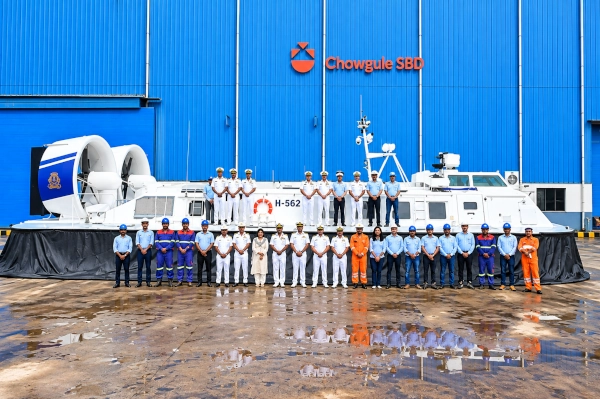
The Indian Coast Guard has received ICG H-562, the second of six indigenously built Air Cushion Vehicles being constructed by Chowgule & Company Private Limited in Goa, marking another step in the Coast Guard’s programme to strengthen high-speed operations across India’s shallow and difficult coastal waters.
H-562 follows the delivery of the first vessel, ICG H-561, by about three months. Chowgule Shipbuilding Division confirmed that both craft were delivered within their contractual timelines and exceeded the contracted maximum speed of 45 knots during trials.
Second Craft in Six-Hovercraft Programme
The Ministry of Defence signed a ₹387.44 crore contract with Goa-based Chowgule & Company on 24 October 2024 for the construction of six Air Cushion Vehicles for the Indian Coast Guard under the Buy (Indian) category.
The programme represents the first time hovercraft for the Indian Coast Guard are being manufactured in India. The Ministry of Defence has described the project as an important element of the Aatmanirbhar Bharat initiative and a step towards developing domestic expertise in specialised maritime platforms.
H-562 is the second vessel to emerge from this six-craft programme, while the remaining four are at advanced stages of construction.
H-562 Exceeds Contracted 45-Knot Speed
According to Chowgule Shipbuilding Division, H-562 successfully exceeded its contracted maximum speed of 45 knots during trials, matching the performance achieved by the first craft, H-561.
Speed is one of the defining operational characteristics of an Air Cushion Vehicle. Unlike conventional patrol boats, hovercraft travel on a cushion of air generated beneath the hull, allowing them to move rapidly across water as well as terrain that would restrict ordinary vessels.
This capability gives the Coast Guard a platform suited to situations where rapid access is required across shallow coastal waters, mudflats, marshes and inter-tidal zones.
Built for India’s Difficult Coastal Environment
The new hovercraft are designed for operations across shallow, marshy and inter-tidal areas where conventional boats may face restrictions because of draught or underwater obstacles.
Their planned roles include high-speed coastal patrol, reconnaissance, interception and interdiction, search-and-rescue missions and assistance to vessels in distress.
Such capabilities are particularly relevant along India’s extensive coastline, which includes estuaries, creeks, mudflats, mangrove regions, river mouths and shallow coastal stretches that cannot always be accessed effectively by conventional patrol vessels.
The ability to transition between water and exposed coastal surfaces also allows hovercraft to approach locations that may otherwise require separate marine and land-based assets.
First H-561 Entered Service in June
The first indigenous craft from the programme, H-561, was inducted into Indian Coast Guard service at Goa on 18 June 2026.
Its induction marked the beginning of operational deployment for a new generation of Indian-built Coast Guard hovercraft. H-562 now extends the programme from a single delivered platform towards a growing operational fleet.
The relatively short interval between the first and second vessels also indicates that the construction programme is moving into a serial-production phase rather than remaining centred on the initial prototype or lead craft.
Dedicated Hovercraft Manufacturing Facility in Goa
The vessels are being constructed at Chowgule’s dedicated hovercraft manufacturing facility in Goa. The shipyard established specialised infrastructure for aluminium construction, including controlled manufacturing environments and precision equipment required for the programme.
The Ministry of Defence has stated that the ACVs are being produced with around 50 per cent indigenous material. Local industries and MSMEs are contributing components and manufacturing support, gradually creating a domestic supply chain around a category of maritime vessel that India had previously procured from overseas.
The programme therefore combines foreign-origin design experience with increasing Indian manufacturing participation, production skills and component sourcing.
Based on Proven Griffon Hoverwork Design
The Coast Guard’s new ACVs are based on proven designs from UK-based Griffon Hoverwork, while construction and a significant portion of manufacturing are being undertaken in India.
This distinction is important when describing the indigenous character of the programme. The vessels represent India’s first domestic manufacture of Coast Guard hovercraft rather than a completely indigenous design developed entirely within India.
The programme nevertheless creates domestic expertise in specialised aluminium fabrication, hovercraft construction, integration, testing, maintenance and supply-chain development that can support future Indian capabilities in this field.
Hovercraft Fill a Specialised Coast Guard Role
Air Cushion Vehicles occupy a distinctive position between conventional boats and land vehicles. Powerful fans generate the air cushion beneath the craft, lifting much of its hull clear of the surface, while propulsion systems drive it forward.
This allows hovercraft to operate across shallow water, tidal flats and other difficult surfaces without requiring the conventional hull depth needed by patrol boats.
For the Indian Coast Guard, this makes them useful for missions requiring rapid intervention close to the shoreline. Coastal surveillance, interception of suspicious craft, disaster response and rescue missions can all require access to locations where deeper-draught vessels cannot safely operate.
Strengthening Coastal Surveillance and Response
India’s maritime security requirements extend beyond deep-sea patrol to thousands of kilometres of coastline and numerous sensitive coastal approaches.
Fast Air Cushion Vehicles can complement offshore patrol vessels, interceptor boats and aircraft by providing mobility in the difficult transition zone between the open sea and the shoreline.
Their ability to operate by day and night and across varied coastal terrain gives the Coast Guard additional flexibility in surveillance, law enforcement, search-and-rescue and emergency-response missions.
Four More Hovercraft Under Construction
With H-561 and H-562 now delivered, four additional Air Cushion Vehicles remain under construction for the Indian Coast Guard.
Chowgule has stated that these vessels are already at advanced stages of construction, indicating that additional deliveries should progressively expand the fleet as the programme advances.
The six-craft project is significant not simply because of the number of hovercraft involved, but because it establishes an Indian manufacturing base for a highly specialised class of amphibious vessel.
H-562 therefore represents another tangible step in the Indian Coast Guard’s modernisation programme while adding domestic shipbuilding capability in an area that had previously depended on imported platforms.
References
Ministry of Defence, Press Information Bureau — “MoD inks Rs 387.44 crore contract with Chowgule & Company Pvt. Ltd., Goa for six Air Cushion Vehicles for Indian Coast Guard,” 24 October 2024. (Press Information Bureau)
https://www.pib.gov.in/PressReleasePage.aspx?PRID=2067697
Ministry of Defence, Press Information Bureau — “Indigenous Hovercraft Construction for ICG Begins at Chowgule Shipyard,” 30 July 2025. (Press Information Bureau)
https://www.pib.gov.in/PressReleasePage.aspx?PRID=2150049
Ministry of Defence, Press Information Bureau — “Indian Coast Guard Conducts Girder Laying Ceremony for Indigenous Air Cushion Vehicles in Goa,” 11 May 2026. (Press Information Bureau)
https://www.pib.gov.in/PressReleasePage.aspx?PRID=2259968
Ministry of Defence, Press Information Bureau — “ICG bolsters operational effectiveness with induction of indigenous Air Cushion Vehicle,” 18 June 2026. (Press Information Bureau)
https://www.pib.gov.in/PressReleasePage.aspx?PRID=2274642
Chowgule & Company – Shipbuilding Division — Official update announcing delivery of ICG H-562, 24 September 2026. (in.linkedin.com)
https://www.linkedin.com/company/chowgulesbd/
You may also like
-
JSR Dynamics Advances Indigenous Jet-Powered Weapons and Guided Rockets
-
Pune Startup Hyperonic Engineering Develops Indigenous Hydrogen Refuelling Systems for Clean Transportation
-
IIT Madras Startup Folium Sensing Develops Fibre-Optic Technology to Monitor Railways, Pipelines and Border Security
-
IIT Roorkee Startup Metastable Materials Develops Indigenous Technology to Recover Critical Battery Metals
-
Chennai Startup Evoxia Develops Hydrogen Plasma Technology for Indigenous Silicon Manufacturing
