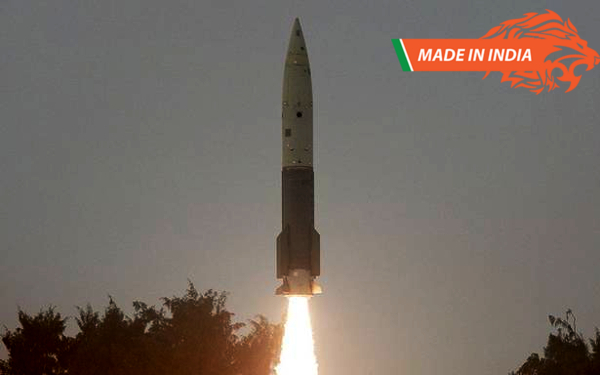
The Defence Research and Development Organisation (DRDO) has successfully conducted another test of India’s indigenously developed Pralay surface-to-surface quasi-ballistic missile from the Integrated Test Range (ITR) at Chandipur in Odisha. The missile, launched on 3 November 2026, reportedly engaged two simulated targets located approximately 500 kilometres away, demonstrating the capabilities of India’s domestically developed precision-strike technology.
According to Akashvani News, the missile was launched from Launch Complex-3 at the Integrated Test Range. The test represents another development in India’s indigenous missile programme, which seeks to equip the Armed Forces with advanced conventional strike systems designed and manufactured within the country. Pralay is capable of carrying different types of warheads and has a reported maximum strike range of 500 kilometres.
Pralay Strengthens India’s Conventional Precision-Strike Capabilities
Pralay is an indigenously developed, solid-propellant quasi-ballistic missile designed to engage designated ground targets with high precision. Unlike conventional ballistic missiles that follow largely predictable trajectories, quasi-ballistic systems can incorporate manoeuvres during flight, making their trajectories less predictable and potentially complicating interception by hostile air defence systems.
The missile employs advanced guidance and navigation technologies to support accurate target engagement. Its solid-propellant configuration also offers operational advantages associated with storage, handling and launch readiness. These characteristics make the system relevant to modern battlefield requirements, where mobility, responsiveness and the ability to engage strategically important targets are increasingly significant.
The missile’s reported range of up to 500 kilometres provides the Armed Forces with an additional indigenous option for conventional strikes against designated military targets. Its ability to accommodate different warhead configurations further supports operational flexibility across varying mission requirements.
Developed Through Collaboration Between DRDO Laboratories and Indian Industry
Pralay has been developed by DRDO’s Research Centre Imarat (RCI) in Hyderabad in collaboration with several specialised laboratories, including the Defence Research and Development Laboratory (DRDL), Advanced Systems Laboratory (ASL), Armament Research and Development Establishment (ARDE) and High Energy Materials Research Laboratory (HEMRL).
Other participating establishments include the Defence Metallurgical Research Laboratory (DMRL), Terminal Ballistics Research Laboratory (TBRL), Research and Development Establishment (Engineers) and the Integrated Test Range. The programme brings together expertise in propulsion, missile guidance, navigation, warhead technologies, materials engineering and flight testing.
Bharat Dynamics Limited (BDL) and Bharat Electronics Limited (BEL) are among the programme’s principal development-cum-production partners. Their participation, alongside other Indian industries and MSMEs, illustrates the growing integration of domestic manufacturing capabilities into complex indigenous defence technology programmes.
The involvement of multiple DRDO laboratories and Indian production partners also reflects the broader objective of establishing domestic capabilities across the missile development lifecycle, from initial research and engineering to system integration, testing and eventual production.
Successive Flight Trials Demonstrate Progress in Missile Development
The latest test follows a series of successful evaluations conducted during 2025 to establish Pralay’s performance across different operational parameters. On 28 and 29 July 2025, DRDO conducted two consecutive flight tests from Dr APJ Abdul Kalam Island off the Odisha coast as part of user evaluation trials.
According to the Ministry of Defence, these trials were intended to validate the missile’s minimum and maximum range capabilities. Both missiles followed their intended trajectories and reached their designated target points with the required accuracy. Tracking sensors deployed by the Integrated Test Range, including instruments positioned aboard a ship near the impact area, recorded the flight performance and confirmed the successful completion of the test objectives.
Another significant development occurred on 31 December 2025, when DRDO successfully launched two Pralay missiles in quick succession from the same launcher off the Odisha coast. The salvo firing demonstrated the missile system’s ability to undertake successive launches while maintaining the required flight performance.
The successful completion of these earlier trials provided important validation of the missile’s technical capabilities and supported its progression towards operational induction. DRDO Chairman Dr Samir V. Kamat had described the December 2025 achievement as an indication of the system’s readiness for induction into the Armed Forces.
The November 2026 test adds to this sequence of evaluations, with Akashvani reporting successful engagement of simulated targets at a distance of approximately 500 kilometres.
Safety Measures Undertaken During Odisha Missile Test
Authorities implemented precautionary measures around the Chandipur test facility before the launch. According to Akashvani News, more than 2,500 residents from nearby villages were temporarily evacuated to designated safe locations ahead of the missile test.
Such measures form part of established safety arrangements associated with missile testing activities, particularly at coastal ranges where flight trajectories and designated impact zones require restrictions on civilian movement.
The Integrated Test Range at Chandipur is an important component of India’s defence research infrastructure. Together with other testing facilities along the Odisha coast, it supports the evaluation of indigenous missiles and associated defence technologies developed for the country’s Armed Forces.
Indigenous Missile Technology and India’s Defence Self-Reliance
The continued development of Pralay reflects India’s increasing emphasis on establishing domestic capabilities in advanced missile technologies. The programme combines indigenous research in propulsion, navigation, guidance and materials engineering with manufacturing participation from defence public sector undertakings and private industries.
Pralay is particularly relevant to India’s conventional deterrence architecture because it provides a domestically developed precision-strike capability intended to complement other missile and artillery systems. The successful testing of advanced indigenous weapons also contributes to the wider modernisation of the Indian Army and Indian Air Force.
The missile programme demonstrates the importance of sustained collaboration between DRDO, the Armed Forces and Indian industry in developing sophisticated weapon systems. With successive flight evaluations establishing its capabilities, Pralay represents a significant achievement in India’s pursuit of technological self-reliance and a stronger indigenous defence manufacturing ecosystem.
You may also like
-
India Targets ₹3 Lakh Crore Defence Production and ₹50,000 Crore Exports by 2029
-
Hindustan Zinc Introduces VedAZ and VedAyush Zinc Alloys for Galvanising Industry
-
Chennai Space Startup Inbound Aerospace Seeks $10 Million to Develop Reusable Spacecraft
-
ISRO’s Space Supply Chain Opens New Opportunities for Indian Companies as Gayatri Rubbers Enters Aerospace Sector
-
Maestros Electronics Wins ₹1.67 Crore Order to Equip Four Indian Navy Ships with Telemedicine Systems
