GI Produce of India — 09
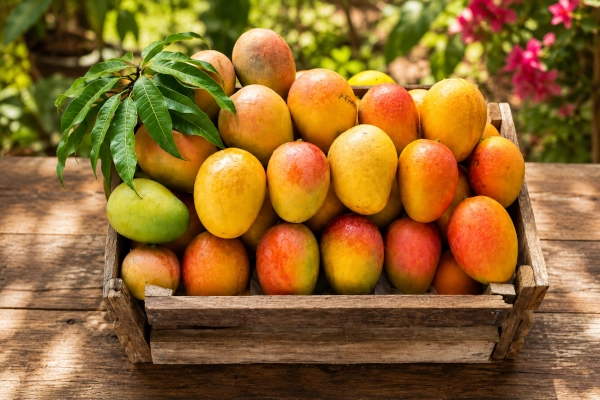
Among the mangoes of Malda, Fazli announces itself through sheer scale. Where Himsagar is prized for compact sweetness and fibreless saffron flesh, and Laxman Bhog for fragrance and dessert quality, Fazli belongs to an entirely different category. A mature fruit commonly weighs between 600 grams and one kilogram, and particularly large specimens can become even more imposing. Its yellowish-green skin conceals a generous mass of light-orange pulp, making Fazli one of India’s most distinctive large-fruited mangoes.
The fruit also arrives when much of Bengal’s premium mango season is already moving towards its conclusion. Himsagar and Laxman Bhog dominate the earlier weeks, Langra follows, and then Fazli enters the markets during July and August, extending Malda’s mango season deep into the monsoon months. Its size, late maturity, large quantity of pulp and suitability for both fresh consumption and processing have given it a commercial identity very different from that of smaller dessert mangoes.
These qualities, combined with its longstanding association with Malda, ultimately received legal recognition when Malda Fazli Mango was registered as a Geographical Indication on 9 September 2008. The GI placed formal protection around a mango whose reputation had already been built over generations within one of eastern India’s most important orchard landscapes.
Malda — Where Rivers Created a Mango Country
The story of Fazli begins with the geography of Malda district in northern West Bengal, a region shaped over centuries by some of the most important river systems of the Gangetic plain. The Ganga enters West Bengal near Manikchak in Malda, while the Mahananda and other rivers have repeatedly deposited layers of sand, silt and clay across the district. These deposits created the deep alluvial soils upon which Malda’s agricultural reputation developed.
Mango cultivation here is no marginal activity. According to the Malda district administration’s Aamar Malda initiative, approximately 31,958 hectares were under mango cultivation during 2025–26, producing around 380,776 metric tonnes of fruit. Nearly 480,000 people are estimated to be directly or indirectly connected with the mango economy, while more than 96,000 orchard owners participate in this vast horticultural landscape.
Fazli therefore grows within one of India’s most specialised mango economies, where orchard management, harvesting, packing, processing and trade form an important part of rural life. The fruit is not merely an agricultural product of Malda but part of a seasonal economic system that involves growers, labourers, traders, transporters, processors and exporters.
The Giant Among Malda Mangoes
Size is the most immediately recognisable characteristic of Fazli, but size alone does not explain its commercial importance. Malda Fazli mangoes generally weigh between 600 and 1,000 grams, making them substantially larger than Himsagar or Laxman Bhog, which ordinarily occupy much smaller commercial weight ranges.
What gives Fazli greater value is that much of this impressive size consists of usable pulp rather than an excessively large stone. The skin is of medium thickness and usually develops a yellowish-green appearance as maturity advances, while fully ripe fruit carries abundant light-orange flesh. The variety has a milder sweet profile than intensely sugary dessert mangoes, which makes it suitable for both fresh eating and processing.
This combination allows Fazli to occupy a rare position in the mango economy. It can be sliced and eaten at the table, but its generous pulp volume also makes it highly useful for chutneys, preserves, jams, mango leather and other processed products. Few famous Indian mangoes move as naturally between the fresh-fruit and value-added markets.
A Different Kind of Mango Sweetness
Consumers accustomed to very sweet mangoes may initially expect Fazli to resemble Himsagar or a premium Dusseheri, but the variety offers a different sensory profile. Its sweetness is comparatively gentle and is balanced by enough acidity to keep the large quantity of pulp from becoming excessively sugary or heavy.
The light-orange flesh is juicy and substantial, giving the fruit a satisfying eating quality when fully mature. This more restrained sweetness should not be regarded as a weakness because it forms part of Fazli’s identity and contributes directly to its versatility in the kitchen and processing industry.
A mango with extremely concentrated sweetness may be exceptional when eaten fresh but often requires greater balancing when cooked or processed. Fazli’s combination of substantial pulp, moderate sweetness and mild acidity gives households and commercial processors more flexibility, allowing the same fruit to appear on a summer table, in chutney, as jam or in dried mango preparations.
The Mango That Extends Malda’s Summer
Timing is another defining characteristic of Fazli, and it is one of the reasons the variety has substantial economic importance. Malda’s mango calendar places Fazli principally in the July-to-August harvest window, classifying it as a late-season mango that becomes important after many earlier premium cultivars have already begun disappearing from the markets.
This late maturity benefits the entire mango economy. If every cultivar ripened during the same few weeks, markets would be flooded with fruit simultaneously, prices could fall sharply, pack houses would struggle with excessive volumes and spoilage could increase. A succession of varieties spreads production and marketing across a much longer season.
Malda’s orchard calendar begins with early varieties such as Gopalbhog, progresses through Himsagar and Laxman Bhog, continues with Langra and other mid-season fruit, and then enters the late-season phase represented by Fazli, Brindabani and Ashwina. Fazli therefore does more than provide another flavour choice; it extends the commercial mango season and provides additional weeks of activity for farmers, traders, labourers and processors.
Monsoon Mangoes and the Challenge of Late Ripening
Late ripening provides Fazli with a valuable market window, but it also exposes the fruit to environmental challenges that early-season mangoes may partly escape. The crop develops through the hottest period of Bengal’s year and approaches maturity just as monsoon conditions strengthen across the district.
Increasing humidity and rainfall can raise disease pressure in the orchard, while thunderstorms and strong winds may cause heavy fruit drop. For a mango that can weigh close to one kilogram, premature fruit fall can represent a considerable economic loss because each individual fruit contains substantial marketable value.
Rain also complicates harvesting and post-harvest handling. Wet fruit must be managed carefully, and fungal problems can develop rapidly if harvested mangoes are stored under conditions of poor ventilation or excessive moisture. Late-season Fazli cultivation therefore requires growers to manage not only tree nutrition and fruit development but also the changing weather conditions associated with the monsoon.
The Alluvial Soils Beneath Fazli Orchards
Malda’s orchard landscape developed in deep riverine deposits created by generations of flooding, channel movement and sedimentation. These alluvial soils contain varying proportions of sand, silt, clay and loam, creating agricultural conditions that have long supported mango cultivation across much of the district.
Mature mango trees develop extensive root systems capable of exploring considerable volumes of soil for moisture and nutrients. Deep loamy and alluvial soils can provide both moisture retention and root penetration when drainage remains adequate, allowing established trees to withstand the increasingly hot months before the monsoon.
Waterlogging, however, can become dangerous because mango roots require aeration. Malda contains low-lying and flood-prone areas, so productive orchards depend not simply upon fertile soil but upon suitable local elevation, adequate drainage and generations of experience concerning where mango trees perform best.
This illustrates an important principle behind geographical indications. A region does not produce a celebrated agricultural product because one environmental characteristic is universally perfect; quality emerges from a particular combination of geography, cultivar and human adaptation. Fazli developed its reputation within precisely such an accumulated orchard landscape.
One Variety Across Malda’s Orchard Belt
Fazli is not associated with only one small cluster of villages within Malda. Its cultivation became widespread across the district’s traditional administrative blocks, including areas such as Chanchal, Ratua, Harishchandrapur, English Bazar, Gazole, Habibpur, Kaliachak, Manikchak, Old Malda and Bamangola.
This broad distribution distinguishes Fazli from geographical indications whose recognised production landscapes are confined to a narrow micro-region. The cultivar has instead become part of Malda’s district-wide orchard identity, with generations of growers cultivating and marketing the fruit across a broad agricultural area.
Local soils, water availability and microclimates naturally vary from orchard to orchard, meaning every Fazli mango will not be perfectly identical. Nevertheless, the collective reputation of the district developed strongly enough that the name Malda Fazli itself acquired commercial significance, and that broad geographical association ultimately formed the basis of the GI identity.
The Story Behind the Name Fazli
The name Fazli carries a well-known local tradition, although the historical account requires some caution. A frequently repeated story associates the cultivar with a woman remembered as Fazli or Fazal Bibi, whose orchard in the Malda region reportedly contained an exceptional large-fruited mango tree that gradually became famous.
According to this tradition, people began referring to the fruit through its association with her orchard, and the name Fazli eventually became attached to the variety. Older accounts from Malda preserve similar stories, but the chronology and personal details differ between versions, making it difficult to establish every element as documented historical fact.
The most responsible interpretation is therefore to treat the Fazli Bibi narrative as an important part of Malda’s horticultural oral tradition while distinguishing it from the more securely documented agricultural history. What is beyond dispute is that Fazli became a longstanding mango cultivar of Malda and developed sufficient regional reputation to receive formal geographical protection.
Old fruit cultivars frequently survive longer than the documents explaining their names. Trees are grafted from generation to generation, and the stories connected with them often travel just as widely, gradually becoming part of the cultural identity of the fruit.
Grafting Preserved the Giant Mango
A Fazli mango tree cannot be faithfully reproduced simply by planting the stone from an excellent fruit. Seed-grown mangoes display substantial genetic variation, which means a seedling may inherit some characteristics of its parent while differing considerably in fruit size, flavour, texture, ripening period or bearing behaviour.
The traditional solution is grafting, a technique through which growers preserve the identity of a selected cultivar. Scion material taken from an authentic Fazli tree is joined to a suitable mango rootstock, and the upper portion of the resulting tree develops with the fruit-producing genetics of the selected variety.
This technique allows one desirable genetic line to survive across generations and thousands of individual trees. Malda’s historical orchard economy itself distinguished between seedling mangoes and carefully propagated grafted varieties because grafting allowed desirable characteristics to be maintained much more consistently.
The commercial success of Fazli therefore rests partly upon a horticultural practice that Indian orchardists have refined over generations. Without vegetative propagation, the particular combination of size, season and fruit quality associated with Fazli could not have been reproduced so reliably across Malda.
Why Authentic Nursery Material Matters
The dependence on grafting immediately raises another important issue: the quality and authenticity of nursery material. A mango tree may take several years to reach meaningful commercial production, so farmers cannot simply look at a young plant and confirm whether it will eventually produce genuine Fazli fruit.
If a graft has been mislabelled, years can pass before the mistake becomes obvious. The grower may already have invested considerable labour, land, irrigation and nutrients by the time the first significant crop reveals that the tree is not what was expected.
For a GI variety, this problem extends beyond the individual orchard because geographical reputation depends upon consistent product identity. Mother plants, verified scion sources and reliable nurseries are therefore essential to the long-term protection of Malda Fazli.
The GI certificate protects the geographical name, but nursery systems protect the biological material that gives that name meaning. Both are necessary if the variety is to retain its reputation across future generations.
The Giant Fruit Requires Patient Development
Producing a mango weighing several hundred grams requires a lengthy period of fruit development. After flowering and fruit set, the young mango must remain attached to the tree through months of increasing heat, rainfall and biological stress while gradually accumulating the large quantity of pulp for which Fazli is known.
The tree must supply sufficient water and nutrients during this period while maintaining fruit quality. Crop load becomes important because a tree carrying excessive numbers of developing mangoes may produce smaller fruit, while severe fruit drop can dramatically reduce total yield.
Growers consequently manage nutrition, irrigation, orchard sanitation and pest control throughout the season. Conditions during flowering influence how many fruits begin their development, while management during the following months determines how many remain healthy enough to reach harvestable maturity.
Every large Fazli visible in the market therefore represents a considerable biological and agricultural investment. Its size is the result of months of work by both the tree and the orchardist rather than a characteristic that appears only in the final weeks before harvest.
Harvesting a One-Kilogram Mango
Harvesting such a large mango presents practical challenges that smaller varieties create to a lesser degree. Allowing a mature Fazli simply to fall from the tree can result in serious bruising, cracking or internal damage, particularly when the fruit is intended for premium fresh sale.
Careful harvesting methods therefore become important. Suitable mango harvesters allow workers to cut the stalk while supporting the fruit in a collection device, reducing the risk that a heavy mango will strike the ground or another fruit.
Timing is equally critical because Fazli intended for transport should normally be harvested after achieving physiological maturity but before becoming excessively soft. An immature mango may fail to develop its proper flavour after harvest, while an overripe fruit of such considerable size becomes difficult to transport without damage.
Growers therefore combine visual characteristics, fruit shape, shoulder development, estimated fruit age and familiarity with individual orchards when making harvest decisions. The larger the mango, the greater the financial loss when that judgement is wrong.
Fazli Was Made for More Than the Dessert Plate
Fazli’s enormous quantity of pulp gives it a natural advantage in food processing. The variety is associated not only with fresh eating but with pickles, chutneys, jams, aam papad and other mango preparations, allowing fruit of different maturity stages and commercial grades to retain value.
This processing role becomes particularly important during seasons of abundant production. Premium fresh-fruit markets demand attractive mangoes with correct maturity, good skin quality and minimal physical damage, but a large Fazli with superficial blemishes may still contain an enormous quantity of perfectly usable pulp.
Processing provides an alternative outlet for such fruit. Mangoes can be converted into pulp, chutney, jam, mango leather and other value-added products rather than being wasted or sold at extremely low prices.
For a district producing hundreds of thousands of tonnes of mangoes within a relatively short harvest season, this capacity to redirect fruit becomes economically important. Processing effectively extends the commercial life of the harvest beyond the immediate fresh-market window.
Bengal’s Chutney Mango
Fazli fits particularly well within Bengal’s long tradition of mango-based preserves and accompaniments. Bengali cuisine uses mangoes at several stages of maturity, with green fruit becoming pickle or chutney and mature pulp entering sweet preparations, drinks and preserved foods.
The large size of Fazli makes it especially convenient where substantial quantities of flesh are required. A single mature fruit can provide enough mango for a household preparation, while processors benefit from the high pulp recovery available from relatively few individual mangoes.
Its moderate sweetness also gives cooks greater control over the final balance of sugar, acidity and spices. This allows Fazli to function differently from intensely sweet dessert varieties, whose flavour may dominate preparations unless carefully balanced.
Fazli’s identity is therefore both horticultural and culinary. It belongs in orchards and fruit markets, but it also belongs in the kitchens and processing traditions that developed methods of preserving Bengal’s mango abundance long after the fresh-fruit season ends.
Fazli and Malda’s Three GI Mango Identities
Malda possesses an unusual advantage within India’s GI landscape because three of its major mango varieties carry Geographical Indication protection. Himsagar or Khirsapati represents the intensely sweet, fibreless early-season dessert mango, while Laxman Bhog provides another aromatic premium fruit during the earlier part of the season.
Fazli completes this trio by occupying the giant late-season segment. The three varieties differ substantially in fruit size, sweetness, pulp colour, texture, harvest period and commercial use, demonstrating how a single agricultural region can produce several distinct horticultural identities.
This diversity allows Malda to participate in several parts of the mango market rather than depending upon one cultivar. Himsagar can be promoted for premium fresh eating, Laxman Bhog for fragrance and dessert appeal, while Fazli offers extraordinary size, late availability and processing potential.
The GI system therefore protects not simply a broad idea of “Malda mangoes” but separate expressions of the district’s orchard heritage. Together, the three varieties allow Malda to present itself as a landscape of mango diversity rather than a region associated with only one famous fruit.
The Road to GI Recognition
The formal geographical-indication process for Fazli began when the Patent Information Centre of the West Bengal State Council of Science & Technology, Department of Science & Technology, Government of West Bengal, filed the application for Malda Fazli Mango on 1 October 2007. The application was assigned GI Application No. 113 under Class 31 for agricultural goods and was subsequently published in Supplementary GI Journal No. 2, which became available on 26 May 2008.
Formal registration followed on 9 September 2008, when Certificate No. 96 was issued. The registration was later renewed, and the current record places its validity through 30 September 2027, maintaining legal protection for the geographical identity associated with Malda Fazli Mango.
GI Details at a Glance
- Geographical Indication: Malda Fazli Mango
- State: West Bengal
- Product: Agricultural
- Class: 31
- Application Number: 113
- Date of Filing: 1 October 2007
- GI Journal: Supplementary 2
- Journal Availability Date: 26 May 2008
- Certificate Number: 96
- GI Certificate Date: 9 September 2008
- Registered Proprietor: Patent Information Centre, West Bengal State Council of Science & Technology, Department of Science & Technology, Government of West Bengal
- Geographical Area: West Bengal
- Registration Valid Until: 30 September 2027
What the GI Tag Protects
Fazli as a cultivar is not biologically restricted to one political boundary. Mango grafts can travel, and related Fazli trees may be established elsewhere if climate and soils permit successful cultivation.
The Indian GI protects something more specific: Malda Fazli Mango. This geographical identity links the fruit with its recognised producing landscape and the reputation created there through generations of cultivation and trade.
The distinction between cultivar and geographical indication is therefore essential. A tree may possess the genetics of Fazli without automatically acquiring Malda’s geographical identity, just as the ability to reproduce a cultivar elsewhere does not recreate the environmental and historical relationship protected by the GI.
This becomes increasingly important as regional foods develop premium brands. When consumers begin associating a famous geographical name with particular quality, traceability helps ensure that the economic value of that reputation remains connected with genuine producers from the recognised area.
The Authorised Producer and the Future of the GI
Geographical indications become economically meaningful only when the farmers producing the crop are connected with the protected identity. Registered authorised users provide one mechanism through which growers can formally participate in the GI system and use the geographical name commercially.
A registration held only by an institution cannot by itself transform farmer income. The identity must eventually appear through traceable fruit, appropriate packaging, grading and marketing so that buyers can distinguish genuine GI produce from ordinary fruit merely carrying the same cultivar name.
For Malda’s growers, the economic promise of GI protection lies in converting reputation into measurable market value. If consumers, retailers and exporters pay a premium for authenticated Malda Fazli, the incentive to conserve orchards and maintain varietal integrity becomes much stronger.
GI recognition therefore works best when legal protection, producer participation and market development operate together. The certificate provides the framework, but the orchard economy determines whether that framework has practical value.
Fazli Becomes an Export Mango
Fazli’s geographical identity has already entered international trade. In July 2021, a consignment of GI-certified Fazli mangoes from Malda district was exported to Bahrain, marking an important step in efforts to increase the international presence of mangoes from eastern India.
The significance of the shipment extended beyond the quantity of fruit involved. Premium Indian mango exports had historically been dominated more strongly by established varieties from western and southern India, while the eastern orchard regions possessed less visibility in international retail markets.
A GI-certified Fazli consignment demonstrated that Malda could participate using its own regional identity rather than competing only through generic mango exports. The geographical name itself could become part of the commercial story accompanying the fruit.
For Malda, this creates the possibility of positioning Fazli not simply as a large mango from India but as a distinctive late-season product whose origin, history and processing versatility differentiate it from competing varieties.
Export Markets Require a Different Orchard
Taking Fazli into premium international markets requires much more than selecting the largest mangoes. Export consignments have to meet requirements concerning pesticide residues, phytosanitary safety, maturity, grading, packaging and traceability, meaning export preparation begins months before the fruit reaches a pack house.
Growers must use plant-protection products carefully and observe appropriate waiting periods before harvest. Integrated Pest Management, improved orchard sanitation, pheromone traps, sticky traps and other targeted approaches can help reduce pest pressure while limiting unnecessary chemical use.
Fruit appearance also matters because premium buyers expect uniformity and minimal physical damage. Improved harvesting equipment and protective fruit bags can therefore influence whether a mango enters an export box or is diverted towards lower-value markets.
These techniques may appear very different from the image of a traditional mango orchard, but they increasingly determine whether famous regional fruit can compete in regulated global markets. The future of Fazli exports therefore begins with scientific orchard management long before international transportation becomes relevant.
Malda Mangoes Enter a New Export Phase
Malda’s broader mango-export ecosystem has continued to develop through cooperation between growers, agricultural scientists, exporters and government agencies. Programmes have increasingly focused on the three GI varieties Laxman Bhog, Fazli and Himsagar, encouraging Good Agricultural Practices, residue management, integrated pest control, branding and stronger connections with buyers.
The significance of this work extends beyond individual export consignments. Pack houses, residue-testing systems, trained workers, exporter networks and buyer relationships created for Malda mangoes can support several cultivars simultaneously and make it easier for growers to move beyond ordinary wholesale channels.
This collective infrastructure is particularly important for small farmers because establishing independent export systems would be prohibitively expensive. Regional facilities allow growers to participate in larger supply chains while retaining orchard ownership and local production.
The stronger Malda’s export ecosystem becomes, the greater the opportunity for Fazli to develop as a premium GI mango rather than remaining principally a large domestic-market fruit.
The Aamar Malda Initiative
The Malda district administration is attempting to coordinate this transformation through the Aamar Malda programme. The initiative connects information relating to exporters, mango suppliers, growers, pack houses, quarantine facilities, residue-testing laboratories and agricultural institutions with the broader objective of strengthening Malda’s mango economy.
Such coordination is particularly valuable for geographical-indication products because legal recognition alone does not create a functioning commercial brand. Buyers need predictable quality, exporters require sufficient volumes, farmers need technical assistance and laboratories must verify compliance with market standards.
Pack houses also have to grade and handle fruit correctly so that the geographical reputation built in the orchard is not destroyed during transportation. A bruised or improperly ripened mango can damage consumer perceptions even when its origin is genuine.
The success of Malda Fazli will therefore increasingly depend upon how efficiently these different parts of the value chain work together. The GI provides the identity, while the regional market and export system determine how far that identity can travel.
Fruit Bagging and Better Surface Quality
Modern mango production increasingly pays attention to fruit quality before harvest rather than attempting to correct problems after the mango leaves the tree. Protective bags can be placed around developing fruit to reduce insect damage, physical blemishes and exposure to certain pests.
Such techniques are especially useful when mangoes are intended for premium retail or export markets because seemingly minor surface damage can substantially reduce the commercial grade of otherwise excellent fruit. For Fazli, the challenge is greater because protective systems must accommodate a mango that continues expanding to an unusually large size.
Integrated pest management is equally important, particularly against fruit flies that can cause significant damage in ripe and late-season mangoes. Pheromone traps, orchard sanitation and carefully planned plant-protection measures can reduce infestation while helping growers comply with residue requirements.
The premium Fazli of the future may therefore be produced through a combination of traditional orchard knowledge and highly deliberate modern management. The tree remains rooted in Malda’s old alluvial landscape, but the fruit hanging from it is increasingly being prepared for markets far beyond the district.
Processing Could Become Fazli’s Greatest Commercial Advantage
Fresh exports attract considerable attention because a box of GI mangoes appearing in an overseas supermarket provides a visible symbol of agricultural success. Yet processing may ultimately offer Fazli an equally important or even larger commercial opportunity because the variety possesses such an extraordinary quantity of pulp.
A processing industry can absorb fruit that is too large, irregularly shaped or cosmetically imperfect for premium fresh retail while still containing excellent usable flesh. These mangoes can be converted into beverages, concentrates, chutneys, jam, mango leather and other value-added products rather than being discarded or sold at extremely low prices.
Semi-ripe fruit can also enter pickle production, while fully mature mangoes can supply pulp-based industries. This diversification becomes especially valuable during heavy harvest years when large quantities of fruit enter markets simultaneously and fresh-market prices weaken.
Processing therefore extends the economic life of the harvest beyond the short fresh-fruit window. For a late-season cultivar exposed to monsoon weather and market saturation, that flexibility may become one of Fazli’s greatest long-term advantages.
Climate Variability and the Late-Season Mango
Fazli may become an important indicator of how changing climatic conditions affect traditional mango calendars. Mango flowering responds strongly to winter temperature and moisture, and unusually warm conditions can alter flower induction while rain during flowering can increase disease pressure and interfere with successful pollination.
Later in the season, extreme heat can increase water stress and influence fruit development. Because Fazli remains on the tree longer than many early cultivars, its crop also extends into the period when monsoon storms, high humidity and heavy rainfall become increasingly important.
This prolonged exposure creates additional risk. A severe storm shortly before harvest can damage large mature fruits, while changing rainfall patterns can influence disease incidence, fruit quality and the timing of harvesting operations.
The future of Fazli production will therefore depend increasingly upon weather forecasting, improved drainage, canopy management, efficient irrigation and precise orchard protection. Traditional experience will remain essential, but modern climate and crop advisory systems can help growers respond more quickly when seasonal conditions become abnormal.
Preserving a Late-Season Genetic Resource
Fazli’s importance extends beyond present-day markets because the variety represents a distinctive genetic resource within India’s enormous mango diversity. Its combination of unusually large fruit, abundant pulp and late maturity creates characteristics that may have value for future breeding and crop-improvement programmes.
Late ripening is particularly valuable because growers and breeders continually seek varieties capable of extending harvest seasons. Large pulp recovery can benefit processing industries, while old regional cultivars may also contain useful traits relating to environmental tolerance, pest response or disease resistance that have not yet been fully exploited.
Preserving Fazli therefore means protecting more than a traditional food. It means conserving a biological combination created through generations of selection and cultivation that may contribute to future horticultural development.
India’s mango heritage was built through diversity rather than uniformity. Maintaining that diversity will become increasingly important as climate conditions, market demands and production challenges change.
The Importance of Malda’s Lesser-Known Mangoes
The commercial success of Fazli, Himsagar and Laxman Bhog should not encourage Malda to reduce its orchard heritage to only three GI-protected cultivars. The district continues to grow varieties such as Gopalbhog, Langra, Brindabani, Ashwina, Mohanbhog, Rakhal Bhog, Amrapali and Mallika, along with numerous lesser-known local mangoes.
These cultivars provide different combinations of sweetness, maturity period, fruit size, aroma and commercial use. Some arrive earlier, others extend the season later, while certain varieties remain primarily associated with local markets and household consumption.
This diversity also distributes agricultural risk. A weather event damaging the flowering period of one cultivar may not affect another in exactly the same way because flowering and fruit-development periods differ.
The strongest future for Malda is therefore not an orchard landscape dominated entirely by one commercially successful mango. It is a mosaic in which famous GI cultivars coexist with lesser-known varieties that preserve the district’s deeper horticultural diversity.
Protecting the Orchard Behind the Name
A GI certificate can protect the words Malda Fazli Mango, but it cannot keep a mango tree alive. The actual geographical indication survives in orchards through genuine grafted plants, old mother trees, suitable soils and growers who understand the timing of flowering, fruit development and harvest.
If orchard land disappears, planting material becomes unreliable or farmers no longer find mango cultivation economically viable, legal registration cannot recreate the agricultural system. The long-term survival of the GI therefore depends upon maintaining the living production landscape from which its reputation emerged.
A premium for authenticated fruit can encourage growers to conserve orchards, while processing can create markets for lower-grade mangoes and export infrastructure can improve returns for the highest-quality consignments. Scientific management can reduce avoidable losses and strengthen the reliability of production.
Together, these measures protect more than a commercial brand. They preserve the biological, economic and cultural system that gives the name Malda Fazli its meaning.
Malda’s Giant Mango of the Closing Summer
Fazli appears when Bengal’s mango year is already mature. By July, consumers have tasted the early Gopalbhog, celebrated the Himsagar season and watched Laxman Bhog and Langra pass through the markets, but the arrival of Fazli signals that Malda’s mango story is not yet over.
The fruit immediately separates itself through size. A single Fazli can fill both hands, and beneath its yellowish-green skin lies a broad mass of light-orange flesh whose sweetness is gentler than that of the intensely sugary early-season varieties.
What Fazli offers instead is abundance, late-season availability and extraordinary versatility. It can be eaten fresh, prepared as chutney, preserved as jam, transformed into mango leather, used for pickle or processed into pulp, allowing the same variety to participate in several different food economies.
The 9 September 2008 GI registration formally recognised the connection between this distinctive mango and its Malda origin. Today, Fazli stands alongside Himsagar and Laxman Bhog as one of the three protected mangoes through which the district can present its orchard heritage to India and the wider world.
Yet Fazli tells a different part of Malda’s story. It speaks of the late monsoon-edge harvest, giant mangoes hanging heavily from orchard trees, enormous quantities of pulp and a fruit culture designed not merely around dessert but around preservation, processing and abundance.
That is the enduring identity of Malda Fazli. It is Bengal’s giant late-summer mango, shaped by the river-made soils of Malda, preserved through generations of grafting and transformed by its extraordinary size and versatility into one of India’s most distinctive geographical-indication fruits.
You may also like
-
Norway Begins LNG Supplies to India Under 15-Year Agreement, Strengthening Bilateral Energy Cooperation
-
Premier Energies and Germany’s RCT Group Establish Joint Venture for 12 GWh Battery Storage Manufacturing Facility
-
Indian Defence Companies Secure ₹8,600 Crore in Q2 FY27 Orders, Led by Radar, Electronics and Weapon Systems
-
NMDC Explores Rare Earth and Critical Mineral Partnerships with Russia to Strengthen India’s Mineral Security
-
160 Norwegian Companies Operating in India as Bilateral Trade and Investment Partnership Expands
