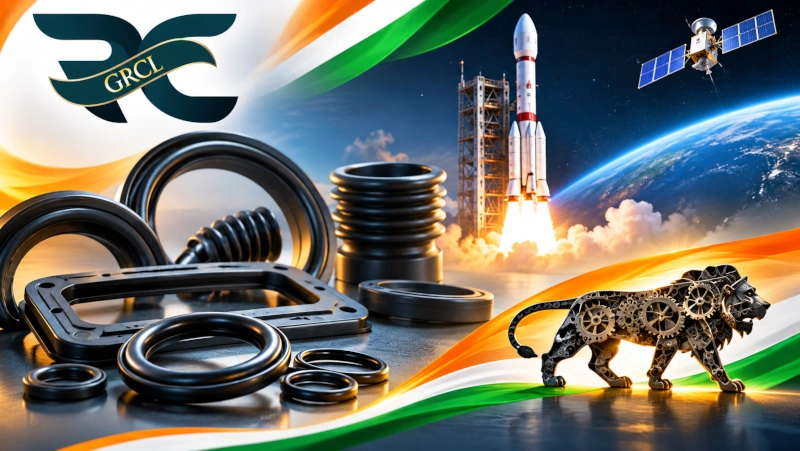
India’s expanding indigenous space technology ecosystem is creating opportunities for smaller domestic manufacturing companies to participate in specialised aerospace supply chains, as demonstrated by Faridabad-based Gayatri Rubbers and Chemicals Limited securing a pilot order from the Indian Space Research Organisation (ISRO). The company’s entry into the space sector illustrates how enterprises traditionally associated with railway components, automotive applications and industrial rubber products can diversify into technologically demanding areas of national importance.
Gayatri Rubbers highlighted its ISRO engagement while announcing its financial results for the first half of FY2026–27 on November 3. The pilot order, originally disclosed in August 2026, involves the supply of specialised ethylene propylene diene monomer (EPDM) rubber products. Although the company has not disclosed the contract value or specific aerospace applications, the development represents an opportunity for a relatively small Indian manufacturer to establish its capabilities within the country’s space technology supply chain.
Smaller Indian Manufacturers Find Opportunities in Space Technology
India’s space industry requires a wide range of specialised materials, precision-engineered components, electronic systems and supporting industrial products. While major aerospace organisations undertake the design and integration of launch vehicles, satellites and other complex systems, their manufacturing activities also depend on suppliers capable of producing components that satisfy demanding technical specifications.
Gayatri Rubbers’ entry into this sector demonstrates the potential for smaller enterprises with established industrial manufacturing capabilities to participate in specialised space-related procurement. The company has developed its business around engineered rubber products used in transportation, infrastructure and other industrial applications, providing a technical foundation from which it can explore additional markets.
The ISRO pilot order is particularly relevant because it involves specialised polymer materials rather than large aerospace structures or propulsion systems. This illustrates how participation in the space industry can extend to manufacturers operating in supporting fields such as elastomers, seals, insulation materials and other engineered components.
However, entry into the space supply chain does not automatically establish a company as a qualified supplier for every aerospace application. Pilot orders generally provide opportunities to demonstrate product capabilities and satisfy customer requirements before any potential expansion into larger or recurring procurement arrangements.
EPDM Rubber and Its Importance in Aerospace Applications
Ethylene propylene diene monomer rubber is a synthetic elastomer widely used in industrial applications requiring resistance to environmental exposure, weathering, ozone and temperature variations. Its properties make it suitable for several types of sealing, insulation and protective applications, depending on the formulation and operating conditions.
In aerospace engineering, specialised elastomeric materials can perform important functions in sealing systems, insulation arrangements and components exposed to demanding environmental conditions. Their suitability depends on factors including thermal behaviour, mechanical strength, ageing characteristics and compatibility with the intended operating environment.
For space-related applications, materials may need to undergo additional testing to establish whether they can meet requirements associated with temperature variations, vibration, material degradation and operational reliability. The precise standards depend on the component and its intended function, making qualification an important part of aerospace materials procurement.
Gayatri Rubbers has confirmed that its ISRO pilot order concerns EPDM rubber products. However, the company has not publicly identified the spacecraft, launch vehicle, subsystem or particular application for which the products are intended. It would therefore be premature to associate the order with a specific ISRO mission or claim that the products have already qualified for operational use in space.
Railway Manufacturing Expertise Supports Industrial Diversification
Gayatri Rubbers’ aerospace engagement follows its established participation in India’s railway manufacturing ecosystem. The company produces specialised rubber and rubber-metal components used in railway applications, where product durability, dimensional accuracy and compliance with prescribed technical requirements are essential.
In its November 3 financial announcement, the company highlighted two Indian Railways purchase orders worth a combined ₹4.53 crore for specialised rubber-metal components. These orders are scheduled for execution by May 28, 2027, and represent continued business opportunities in the railway sector.
The company also reported becoming an approved vendor for the Karnataka State Road Transport Corporation, with an initial Letter of Intent worth ₹1.29 crore for EPDM rubber glazing products used in buses. This development extends its participation in public transportation manufacturing beyond railway applications.
Such diversification demonstrates how specialised manufacturing capabilities can be applied across different industrial markets. Although railway, road transport and aerospace products have distinct technical and regulatory requirements, experience in material formulation, manufacturing consistency and quality assurance can provide a foundation for developing products for additional applications.
The expansion also reflects the importance of technical specialisation among smaller manufacturers. Rather than competing exclusively through production volume, companies possessing expertise in particular materials or manufacturing processes can explore markets where product performance and reliability are important procurement considerations.
Company Reports Strong Financial Growth in First Half of FY2026–27
Gayatri Rubbers reported total income of ₹27.52 crore for the six months ended September 30, 2026, representing growth of 58.75% compared with ₹17.33 crore during the corresponding period of the previous financial year. The company also reported a 54.21% increase in profit after tax to ₹4.06 crore, compared with ₹2.63 crore in the first half of FY2025–26.
Earnings before interest, taxes, depreciation and amortisation increased by 60.91% to ₹6.46 crore, reflecting growth in the company’s overall business operations. The reported performance was supported by its existing industrial manufacturing activities and expanding participation in transportation-related supply chains.
The company’s latest announcement places its aerospace entry alongside other developments, including railway procurement, bus-component manufacturing and the expansion of its customer base. These activities indicate an effort to diversify revenue opportunities while building on established expertise in specialised rubber products.
The ISRO pilot order is strategically relevant to this diversification, but its financial contribution cannot be independently assessed because the company has not disclosed its value. Consequently, the latest revenue and profit growth should not be attributed directly to the space-sector order.
Building a Broader Indigenous Aerospace Supply Chain
The participation of smaller manufacturing enterprises is important to the development of a diversified domestic aerospace industry. Space programmes require supporting industrial capabilities spanning advanced materials, machining, electronics, fabrication, testing and other specialised manufacturing processes.
A broader supplier ecosystem can create opportunities for Indian companies possessing technical expertise in fields that may not traditionally be associated with spacecraft manufacturing. Such participation can also encourage enterprises to invest in product development, testing capabilities and quality management systems relevant to more demanding industrial markets.
For companies such as Gayatri Rubbers, successfully completing a pilot order may provide experience in meeting the procurement and technical requirements of a specialised government customer. Whether this leads to recurring orders or larger aerospace contracts will depend on product performance, qualification requirements and future procurement decisions.
The development is relevant to India’s wider efforts to strengthen indigenous industrial capabilities in space technology. The expansion of the domestic space ecosystem provides opportunities not only for launch vehicle manufacturers and satellite developers but also for smaller businesses supplying specialised components and materials.
Nevertheless, the precise domestic value addition associated with Gayatri Rubbers’ ISRO products has not been disclosed. Its participation should therefore be understood as an example of an Indian manufacturer entering the aerospace procurement ecosystem rather than evidence of a completed indigenisation milestone for a specific space system.
Space Industry Expansion Creates Opportunities Beyond Major Aerospace Companies
Gayatri Rubbers’ entry into the ISRO supply chain illustrates the potential for India’s space programme to generate manufacturing opportunities across a wider range of domestic industries. Companies producing specialised materials and components can contribute to complex technological programmes by supplying products that meet the required technical standards.
The company’s latest financial announcement also demonstrates how a smaller manufacturer can pursue growth through a combination of established industrial customers and emerging technology markets. Its railway and transportation contracts provide a commercial base, while the aerospace pilot order introduces an opportunity to develop capabilities relevant to a new industry.
The broader significance lies in the expanding role of smaller Indian enterprises within strategic industrial supply chains. As the country’s space sector develops, opportunities for indigenous manufacturing may increasingly extend beyond major aerospace corporations to specialised suppliers whose products, materials and engineering capabilities support the larger technological ecosystem.
You may also like
-
Chennai Space Startup Inbound Aerospace Seeks $10 Million to Develop Reusable Spacecraft
-
Maestros Electronics Wins ₹1.67 Crore Order to Equip Four Indian Navy Ships with Telemedicine Systems
-
BAE Systems Explores Indian Manufacturing Partnership for Bofors TRIDON Mk2 Air Defence System
-
MIDHANI, BARC and Heavy Water Board Join Forces to Recover Strategic Cobalt and Nickel for Defence and Aerospace Industries
-
GE Aerospace Delegation Visits LMW’s Coimbatore Facility to Explore Aerospace Manufacturing Collaboration
