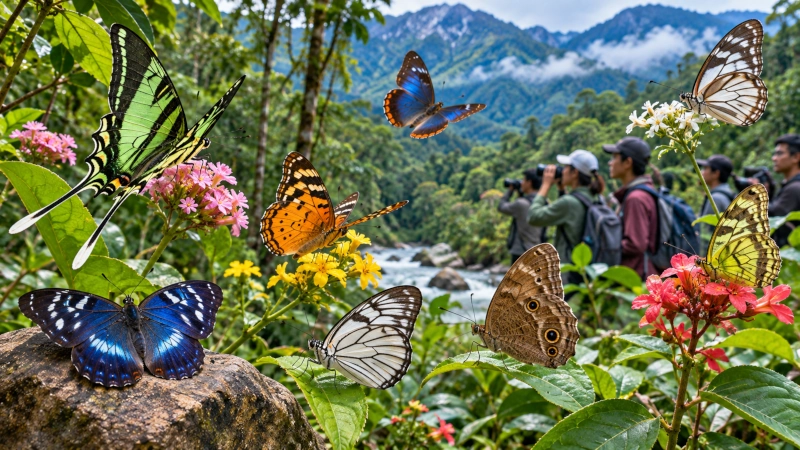
The third Wakro Butterfly Meet in Arunachal Pradesh’s Lohit district documented 207 butterfly species during a three-day biodiversity exploration programme conducted in and around the Kamlang Tiger Reserve and Wildlife Sanctuary. The event brought together wildlife researchers, naturalists, students and local communities to document the region’s butterfly diversity while promoting ecological awareness, scientific observation and responsible nature-based tourism in the eastern Himalayan landscape.
Organised by the Kamlang Tiger Reserve and Wildlife Sanctuary in collaboration with the Kamlang Valley Nature Club, the programme was held from October 30 to November 1, 2026. The findings were reported on November 3, highlighting the extraordinary diversity of butterflies inhabiting the forests and surrounding landscapes of Wakro. More than 120 students participated in the activities, demonstrating the growing involvement of educational institutions and local communities in biodiversity documentation and conservation initiatives.
Survey Documents 207 Butterfly Species in Wakro Landscape
The documentation of 207 butterfly species emerged as the principal scientific highlight of the event. Field explorations across the Wakro landscape revealed a remarkable variety of butterflies, including species associated with the region’s forest habitats and diverse ecological conditions. The observations further demonstrated the importance of the Kamlang landscape for understanding butterfly distribution and biodiversity in northeastern India.
Among the notable species recorded were the green dragontail, columbine, elusive prince, Watson’s bushbrown, blue-striped palmfly, great swift, grand duke, singleton and yellow-veined lancer. These observations provided participants with opportunities to examine differences in butterfly appearance, behaviour and habitat preferences while contributing to the documentation of species occurring in the region.
The green dragontail, known scientifically as Lamproptera meges, is particularly distinctive because of its slender body, elongated hindwing tails and rapid flight. The columbine, Stiboges nymphidia, is another noteworthy butterfly associated with forested habitats in parts of northeastern India. Their presence among the recorded species highlights the ecological diversity of the Wakro landscape and the importance of maintaining suitable forest environments for different butterfly groups.
The latest findings also build upon earlier butterfly documentation efforts in the region. The second Wakro Butterfly Meet, conducted in October 2025, recorded 235 species, including 35 described as rare or uncommon. The 2026 documentation of 207 species represents another substantial field observation, although differences between the annual totals should not automatically be interpreted as changes in butterfly populations. Survey duration, weather, seasonal conditions, observer effort and the locations examined can all influence the number of species recorded during individual events.
Kamlang Tiger Reserve Supports Rich Eastern Himalayan Biodiversity
The Kamlang Tiger Reserve and Wildlife Sanctuary forms part of the biodiversity-rich landscape of eastern Arunachal Pradesh, where forest ecosystems support a wide variety of plants, birds, mammals, reptiles and insects. The region’s varied topography, vegetation and climatic conditions create habitats suitable for numerous butterfly species, making it an important location for biodiversity observation and ecological research.
Butterflies are significant components of forest ecosystems because many species contribute to pollination and participate in food webs involving plants, birds and other organisms. Their caterpillars depend on particular host plants, while adults obtain nectar and other resources from the surrounding environment. Changes in vegetation, forest structure and habitat conditions can therefore influence the distribution and abundance of butterfly populations.
Butterflies are also widely studied as potential indicators of ecological conditions. Their comparatively short life cycles and sensitivity to environmental changes can make them useful subjects for monitoring habitat quality and biodiversity. However, interpreting changes in butterfly communities requires systematic observations over time, rather than relying exclusively on species counts from individual surveys.
The Wakro Butterfly Meet contributes to conservation awareness by encouraging participants to observe these relationships directly. Repeated documentation of butterflies in the same landscape can also provide useful information for future ecological studies, particularly when observations are accompanied by consistent records of locations, habitat conditions and survey methods.
More Than 120 Students Participate in Biodiversity Exploration
An important objective of the 2026 programme was to encourage students and young people to develop an understanding of wildlife conservation through direct engagement with nature. More than 120 students from educational institutions in Arunachal Pradesh participated in the activities, alongside young people from villages bordering Kamlang Tiger Reserve.
The participating institutions included Indira Gandhi Government College, Mahabodhi Lord Buddha College, Arunachal University, Kids Foundation School and Government Higher Secondary School, Wakro. Of the participants, 45 students and nature enthusiasts joined as residential campers, allowing them to take part in field activities and interact more extensively with researchers and conservation specialists.
The programme combined butterfly observation with birdwatching, guided nature walks, interactive educational sessions and activities focusing on environmental protection and waste management. These experiences enabled students to examine wildlife in natural habitats while developing a broader understanding of ecological relationships and the importance of conserving biodiversity.
According to Kamlang Tiger Reserve Range Forest Officer Bunty Tao, the event was dedicated particularly to students and young people, with the objective of connecting the younger generation with the natural environment and encouraging greater awareness of the region’s biodiversity. He also highlighted the enthusiasm shown by participants and the contribution of researchers, wildlife experts and forest department personnel in developing public interest in conservation.
Wildlife Experts Encourage Scientific Observation and Conservation
The programme benefited from the participation of experienced naturalists, researchers and conservation professionals who provided guidance during field explorations and educational activities. Their involvement helped participants understand butterfly identification, ecological observation and the broader importance of documenting wildlife diversity.
Among the resource persons were Roshan Upadhaya, popularly known as the Butterfly Man of Arunachal Pradesh, researcher Dr Lobsang Tashi Thugon, wildlife filmmaker Tallo Anthony, biologist Aditya Dass and Kamlang Tiger Reserve botanist Rosnita Kora. Their field experience and scientific knowledge contributed to the educational activities conducted during the meet.
Direct interaction with experts is particularly valuable for students interested in wildlife biology because butterfly identification often requires careful observation of wing patterns, colouration, behaviour and habitat characteristics. Field-based learning can introduce participants to the methods used in biodiversity documentation while encouraging a more systematic approach to observing and recording wildlife.
The presence of researchers and naturalists also demonstrated the value of cooperation between conservation organisations, educational institutions and local communities. Such collaboration can strengthen public participation in biodiversity studies and create opportunities for young people to develop skills relevant to ecology, conservation biology and environmental research.
Community Participation Strengthens Conservation Awareness
The Wakro Butterfly Meet brought together local residents, village representatives, self-help groups, students, researchers and visiting nature enthusiasts, reflecting the importance of community participation in conserving the region’s natural heritage. The involvement of communities living near protected forests is particularly significant because wildlife conservation depends not only on activities within reserve boundaries but also on the condition of surrounding habitats.
The organisers emphasised the potential of responsible nature-based tourism to provide opportunities for local communities while encouraging the protection of biodiversity. Butterfly observation, guided nature walks and wildlife photography can support specialised tourism activities when conducted with appropriate safeguards to prevent disturbance to habitats and wildlife.
The programme also provided opportunities for participants to understand the relationship between environmental protection and local livelihoods. Responsible tourism initiatives can encourage communities to recognise the ecological and economic value of maintaining healthy forest landscapes, particularly when benefits from tourism are shared locally and activities are managed sustainably.
However, expanding butterfly tourism requires careful attention to habitat protection, visitor behaviour and the ecological sensitivity of observation sites. Developing Wakro as a destination for biodiversity exploration would therefore depend on maintaining the natural conditions that support its wildlife rather than increasing visitor numbers without appropriate environmental safeguards.
Wakro Emerges as a Centre for Butterfly Conservation Awareness
The third edition of the Wakro Butterfly Meet builds upon an initiative that has developed into a recurring platform for biodiversity documentation, environmental education and community engagement. The first event, held in October 2024, recorded more than 205 butterfly species, while the second edition in 2025 documented 235 species. The continued organisation of these programmes demonstrates sustained interest in exploring the region’s butterfly diversity and encouraging participation in wildlife conservation.
The 2026 event was attended by representatives of the district administration, forest department and local institutions. The inaugural programme included Chow Tseng Tsing Mein, Officer on Special Duty to Arunachal Pradesh’s Deputy Chief Minister, and Lohit Zilla Parishad Chairperson Basanlu Dellang, while Kamlang Tiger Reserve Divisional Forest Officer Alok Kumar was also present.
The organisers acknowledged the contributions of the Forest Department, district administration, educational institutions, volunteers, local communities and participating experts. Their cooperation supported the field activities and educational sessions, reinforcing the event’s role as a collaborative conservation initiative.
The documentation of 207 butterfly species provides another valuable account of the biodiversity found in the Wakro and Kamlang landscapes. Beyond the species observations, the participation of more than 120 students demonstrates the potential of field-based environmental education to encourage lasting interest in wildlife and ecological research.
As Arunachal Pradesh continues to develop initiatives linking biodiversity documentation with community participation, the Wakro Butterfly Meet offers a practical model for promoting conservation awareness in the eastern Himalayas. Sustained habitat protection, systematic wildlife monitoring and responsible nature-based tourism can help preserve the region’s butterfly diversity while strengthening local involvement in safeguarding its ecological heritage.
Source: The Arunachal Times, November 3, 2026; statements attributed to Kamlang Tiger Reserve Range Forest Officer Bunty Tao. Additional background: Second Wakro Butterfly Meet, October 2025.
You may also like
-
India to Host Global Agricultural Science and Partnership Week in April 2027, Over 5,000 Delegates Expected
-
India Brings Together Over 5,000 Global Delegates at ESTIC 2026
-
AI Journey 2026 Rescheduled to November 26–28 in Moscow, Indian AI Experts Among International Participants
-
IIT Bombay and Russia’s Rosatom Launch Atomic Hack India 2026 to Advance Nuclear Engineering and Digital Twin Technologies
-
Indian Experts to Participate in Moscow Startup Summit as Global Technology Leaders Gather in Russian Capital
