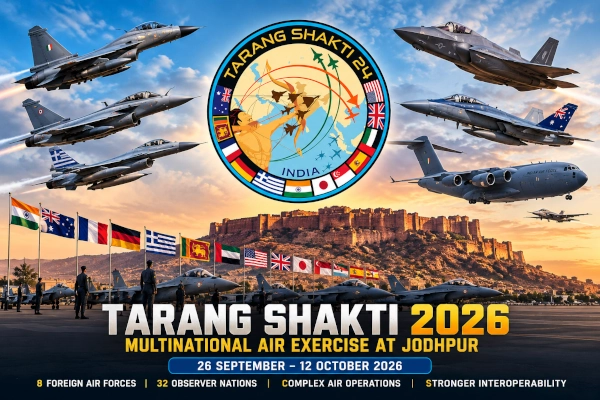
The Indian Air Force will host the second edition of its multinational air exercise Tarang Shakti from September 26 to October 12, 2026, bringing together air forces from across the world for a major programme of combined air operations at Air Force Station Jodhpur and adjoining air bases.
Eight friendly foreign countries — Australia, Bangladesh, France, Germany, Greece, Sri Lanka, the United Arab Emirates and the United States — are scheduled to participate with air assets. Another 32 countries will attend the exercise as observers, giving Tarang Shakti 2026 one of the broadest international representations at an Indian Air Force-hosted exercise.
The exercise has been designed around realistic multinational combat operations rather than ceremonial flying or simple formation training. Participating forces will work together in planning, coordinating and executing complex missions while adapting different aircraft, operating procedures and tactical doctrines to a common operational environment.
Complex Air Operations Across Multiple Mission Sets
Vice Chief of the Air Staff Air Marshal Ashutosh Dixit said Tarang Shakti 2026 is intended to allow participating air forces to learn from one another, operate together and prepare for emerging challenges in air warfare.
The exercise will cover a wide spectrum of air operations, including counter-air missions, air defence, combat operations, reconnaissance, airlift and air-to-air refuelling. These activities will be combined with increasingly complex mission sets requiring aircraft and crews from different countries to coordinate their operations within the same battlespace.
Such training is particularly important because modern air campaigns rarely depend on fighter aircraft operating independently. Combat missions increasingly require the integration of fighters, transport aircraft, aerial refuellers, surveillance assets, ground-based air defence, command-and-control networks and intelligence systems.
Tarang Shakti therefore provides participating forces with an opportunity to examine how these different elements can work together when aircraft, communications systems, tactical procedures and operational philosophies differ between countries.
Forty Countries Represented at the Exercise
The scale of international participation is one of the defining features of the 2026 edition. While eight foreign countries are deploying air assets, the presence of 32 observer nations expands the exercise into a much wider platform for international military engagement.
Australia, Bangladesh, France, Germany, Greece, Sri Lanka, the UAE and the United States represent a geographically diverse group of air forces with different aircraft fleets and operational experiences.
Their participation also reflects the expanding network of bilateral and multilateral air-force relationships maintained by India. The IAF now exercises regularly with partners in Europe, the Indo-Pacific, West Asia and North America, giving Indian crews exposure to a wide range of aircraft, tactics and operational environments.
Observer participation is equally significant. Countries attending without deploying aircraft can study exercise procedures, mission planning and multinational coordination while developing contacts that could support participation in future editions.
Interoperability at the Centre of Tarang Shakti
Interoperability remains one of the principal objectives of multinational exercises. It involves much more than aircraft from different countries simply flying together.
Crews must understand common mission objectives, airspace-management procedures, communications protocols, refuelling procedures, identification systems and command structures. Mission planners must also account for differences in aircraft performance, weapons envelopes, sensors and operating doctrine.
Exercises such as Tarang Shakti provide a controlled environment in which these differences can be identified and addressed before forces are required to operate together during an actual contingency.
The experience can also prove valuable outside combat. Many of the same coordination mechanisms are required during humanitarian assistance, disaster relief, evacuation missions and other international operations involving aircraft from several countries.
Jodhpur Again Becomes a Major Multinational Air Hub
Jodhpur played an important role in the inaugural Tarang Shakti exercise in 2024 and will again form the centre of multinational air activity during the 2026 edition.
The first Tarang Shakti was the Indian Air Force’s first multinational air exercise and represented an important expansion of India’s military engagement with foreign air forces. Jodhpur hosted a major phase of that exercise, including operational flying and an international symposium on air-domain awareness.
The 2024 exercise was also used to showcase India’s growing domestic aerospace capabilities. The Indian Defence Aviation Exposition held alongside the exercise brought together defence public-sector companies, DRDO, private manufacturers and Indian startups, allowing foreign military delegations to examine indigenous aviation technologies and systems.
Tarang Shakti has consequently developed into more than an air-combat training event. It also provides India with a platform to demonstrate the capabilities of its aerospace and defence ecosystem to military representatives from numerous countries.
A Growing Role for India in Multinational Air Exercises
The IAF has accumulated considerable experience through participation in major exercises abroad and through bilateral exercises conducted in India.
Indian aircraft and personnel have trained with air forces including those of the United States, France, Australia, Japan, the United Kingdom, Germany, Greece, Singapore and the UAE. These exercises have exposed Indian crews to different mission-planning systems, aircraft types and tactical concepts.
Hosting Tarang Shakti allows India to reverse that relationship by creating its own large multinational training environment and bringing foreign forces into an exercise designed and coordinated by the Indian Air Force.
The first edition in 2024 established the framework. The 2026 edition expands the concept through a large group of countries participating either with aircraft or as observers and through a wider range of complex air operations.
Tarang Shakti as a Platform for Defence Cooperation
Multinational exercises also have a diplomatic dimension. Military personnel who repeatedly train together develop familiarity with each other’s operating methods, command structures and professional cultures.
For India, Tarang Shakti provides an opportunity to deepen air-force relationships without limiting the exercise to a single strategic grouping or region. Participating countries include partners from South Asia, Europe, West Asia, North America and the Indo-Pacific.
Germany’s participation, for example, had already been highlighted during India-Germany defence discussions earlier in 2026. India and Germany have been expanding service-level military engagement alongside their broader defence-industrial relationship.
The exercise therefore complements India’s growing network of defence relationships while remaining centred on practical military training.
Preparing for an Increasingly Complex Air Battlespace
The significance of Tarang Shakti ultimately lies in the operational environment it attempts to reproduce.
Modern air warfare involves increasingly dense networks of sensors, long-range weapons, electronic-warfare systems, unmanned aircraft and integrated air-defence systems. Aircraft must operate within this environment while exchanging information and coordinating actions across multiple platforms.
No air force can replicate every aircraft, technology or doctrine used by other countries during its routine domestic training. Multinational exercises provide exposure that would otherwise be difficult to obtain.
From September 26, Jodhpur will become the centre of that effort for the Indian Air Force. With eight foreign countries bringing air assets and another 32 nations observing, Tarang Shakti 2026 will provide India with both a demanding multinational training environment and a platform for strengthening defence relationships across several regions of the world.
The exercise also marks the continued evolution of Tarang Shakti from India’s first multinational air exercise in 2024 into a recurring international air-power engagement hosted by the Indian Air Force.
References
Akashvani / News On AIR — “TARANG SHAKTI 2026 Multinational Air Exercise to Begin on 26th September in Jodhpur,” 22 September 2026. (News on Air)
Press Information Bureau, Ministry of Defence — “IAF Conducts Symposium on ‘Air Domain Awareness’ During Exercise Tarang Shakti 2024,” 11 September 2024. (Press Information Bureau)
Press Information Bureau, Ministry of Defence — “IAF Set to Host the Indian Defence Aviation Exposition-II at Jodhpur,” 11 September 2024. (Press Information Bureau)
Press Information Bureau, Ministry of Defence — Statement on Exercise Tarang Shakti 2024 and multinational defence cooperation, 12 September 2024. (Press Information Bureau)
Press Information Bureau — India-Germany joint statement recording Germany’s planned participation in Tarang Shakti 2026. (Press Information Bureau)
You may also like
-
JSR Dynamics Advances Indigenous Jet-Powered Weapons and Guided Rockets
-
Solar Defence Delivers Single Batch Supply of 450 Indigenous Nagastra-1R Loitering Munitions to Indian Army
-
Bharat Electronics Secures ₹533 Crore in New Orders for Drones, Avionics, Cybersecurity and Defence Systems
-
India and Cyprus Strengthen Naval Cooperation with Focus on Maritime Security and Joint Training
-
India and Czech Republic Agree to Expand Defence Industrial Cooperation During Rajnath Singh–Karel Havlíček Talks
