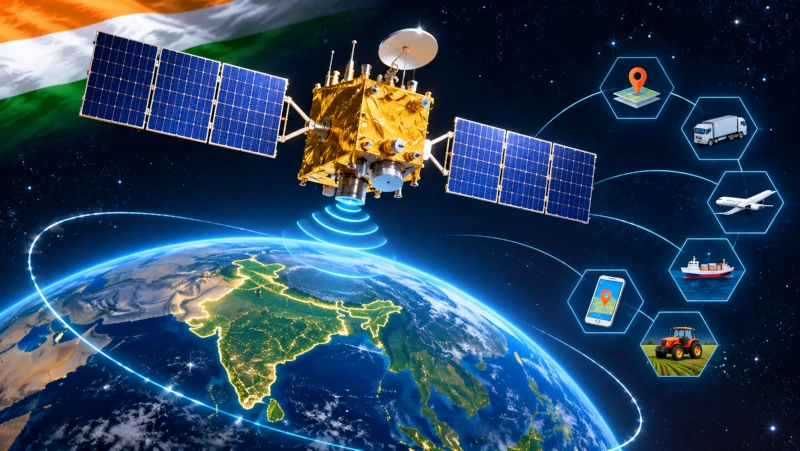
The Indian Space Research Organisation (ISRO) has successfully completed four orbital manoeuvres of the NVS-03 navigation satellite, placing the spacecraft into geosynchronous orbit following its launch aboard the GSLV-F18 rocket on 30 October 2026. The achievement marks an important milestone in India’s second-generation satellite navigation programme, which aims to strengthen the country’s indigenous Navigation with Indian Constellation (NavIC) system and ensure the continuity of satellite-based positioning and timing services.
According to an official mission update released by ISRO on 4 November 2026, the satellite has reached a geosynchronous orbit measuring approximately 35,765 kilometres by 36,196 kilometres, with an orbital inclination of 29.98 degrees. The four manoeuvres involved a cumulative firing duration of 6,164 seconds for the spacecraft’s Liquid Apogee Motor (LAM). ISRO confirmed that all four manoeuvres were completed successfully and that the satellite’s health remains normal.
Four Orbital Manoeuvres Successfully Completed
NVS-03 was launched from the Satish Dhawan Space Centre at Sriharikota aboard the Geosynchronous Satellite Launch Vehicle GSLV-F18 at 11:51 PM IST on 30 October 2026. The launch vehicle successfully injected the spacecraft into an elliptical transfer orbit measuring approximately 170.3 kilometres at its closest point to Earth and 38,080 kilometres at its farthest point.
Following separation from the launch vehicle, the satellite entered the orbital manoeuvring phase, during which its onboard propulsion system was used to progressively modify its trajectory. These operations were necessary to raise the spacecraft from the initial transfer orbit towards the geosynchronous orbital configuration required for its navigation mission.
The Liquid Apogee Motor plays a central role in this process by providing the thrust needed to adjust the satellite’s orbit after launch vehicle separation. The successful completion of four manoeuvres, involving a combined firing duration of 6,164 seconds, demonstrates the spacecraft’s ability to execute the planned propulsion operations and achieve the required orbital parameters.
The latest update confirms that NVS-03 has reached a near-circular geosynchronous orbit, representing a substantial progression from its initial highly elliptical transfer orbit. The successful orbital operations establish an important foundation for subsequent spacecraft activities associated with its navigation mission.
NVS-03 Strengthens India’s Second-Generation Navigation Satellite Programme
NVS-03 is the third spacecraft in India’s second-generation navigation satellite series, developed to provide continuity and enhanced capabilities for the Indian Regional Navigation Satellite System (IRNSS), operationally known as NavIC. The programme is designed to sustain India’s independent satellite navigation infrastructure while incorporating improvements in onboard technologies and navigation signals.
NavIC is India’s indigenous regional satellite navigation system, providing positioning, navigation and timing services across the Indian landmass and a region extending approximately 1,500 kilometres beyond India’s geopolitical boundaries. The system has applications in transportation, maritime navigation, terrestrial navigation, location-based services, surveying and other activities that require reliable satellite-derived positioning information.
The development of an independent navigation constellation is an important component of India’s space technology capabilities. It provides a domestically developed infrastructure for navigation and timing services, reducing reliance on foreign satellite navigation systems for applications within its designated service region.
The NVS series forms part of ISRO’s efforts to strengthen this infrastructure through newer spacecraft incorporating improved navigation capabilities. By introducing additional satellites into the constellation, the programme supports the continuity of services and the long-term development of India’s regional navigation network.
Indigenous Atomic Clock Highlights India’s Technological Capabilities
One of the important technological features of NVS-03 is its navigation payload, which incorporates an indigenously developed atomic clock alongside procured atomic clocks. Atomic clocks are essential components of satellite navigation systems because they provide the highly precise timing references required to calculate distances between satellites and navigation receivers.
Satellite navigation depends on accurately measuring the time taken for radio signals to travel from orbiting satellites to receivers on Earth. Even extremely small timing errors can introduce significant inaccuracies into positioning calculations, making atomic clock performance a critical requirement for navigation satellite systems.
The inclusion of an indigenous atomic clock in NVS-03 reflects India’s continuing progress in developing specialised technologies required for advanced space missions. Such capabilities are particularly important for maintaining independent navigation infrastructure and strengthening domestic expertise in precision timing systems.
NVS-03 also supports navigation signals in the L1, L5 and S frequency bands. The addition of the L1 signal is an important feature of the second-generation navigation satellite programme, as it broadens the range of potential applications and supports compatibility with additional categories of navigation receivers.
The combination of indigenous timing technology and multiple navigation frequency bands represents a significant element of ISRO’s efforts to improve the capabilities and accessibility of India’s satellite navigation services.
Geosynchronous Orbit Supports Regional Navigation Services
A geosynchronous orbit is one in which a satellite takes approximately one sidereal day to complete a revolution around Earth, matching the planet’s rotation period. Such orbits are particularly useful for regional satellite navigation systems because they allow spacecraft to maintain predictable positions relative to the Earth’s surface.
Unlike a geostationary satellite, which remains above a fixed point on the equator, a satellite in an inclined geosynchronous orbit traces a repeating path across the sky when viewed from Earth. This orbital arrangement contributes to the geometry of satellite navigation constellations and helps provide coverage across their designated service regions.
NavIC employs a combination of geostationary and inclined geosynchronous satellites to deliver regional navigation services. The orbital configuration is designed to ensure that navigation signals remain available over India and surrounding areas, supporting applications requiring continuous positioning and timing information.
The successful placement of NVS-03 into geosynchronous orbit is therefore an important operational achievement. It confirms that the spacecraft has completed the major orbital transition following launch and reached the orbital regime required for its navigation mission.
Another Milestone in India’s Indigenous Space Programme
The successful orbital manoeuvring of NVS-03 adds to ISRO’s continuing efforts to expand and modernise India’s satellite navigation capabilities. The mission brings together indigenous spacecraft engineering, advanced propulsion operations, navigation payload development and precision timing technologies within a nationally developed space infrastructure programme.
The NVS series also illustrates the importance of sustaining existing satellite constellations through the introduction of newer spacecraft. As navigation services become increasingly integrated into transportation, communications, surveying and digital infrastructure, maintaining reliable satellite-based positioning and timing capabilities remains an important national technological priority.
With four orbital manoeuvres completed and the spacecraft confirmed to be in normal health, NVS-03 has achieved a major post-launch milestone. The development advances India’s second-generation NavIC programme and reinforces ISRO’s capabilities in satellite navigation, orbital operations and the development of indigenous space technologies.
You may also like
-
Novel Silicon Chip AllowingTerahertz Waves to Pass Through Barriers Could Enable Future 6G Networks
-
VELC on Board Aditya-L1 Reveals Asymmetric Expansion of Solar Eruption that Could Impact Space Weather
-
University of Hyderabad and IIT Researchers Develop Advanced Titanium Alloys for Safer, Longer-Lasting Medical Implants
-
24 Years X-ray Observations Trace the Mystery Behind One of the Brightest X-Ray Emitters in Nearby Galaxies
-
ISRO Successfully Raises NVS-03 Satellite Orbit, Moves Closer to Strengthening India’s NavIC System
