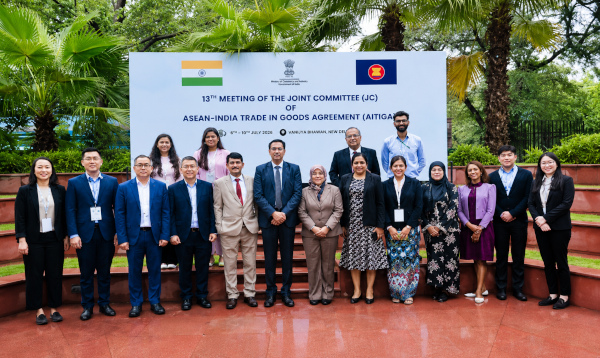
India’s hosting of the 13th ASEAN-India Trade in Goods Agreement Joint Committee Meeting at Vanijya Bhawan, New Delhi, marks an important step in accelerating the review of the ASEAN-India trade pact. Held from 6 to 10 July 2026 in hybrid format, the meeting brought together India and all ten ASEAN member states to advance negotiations under the ongoing review of the ASEAN-India Trade in Goods Agreement, widely known as AITIGA.
The meeting comes at a crucial time when India is strengthening its trade engagement with Southeast Asia under its Act East policy and broader Indo-Pacific economic strategy. ASEAN remains one of India’s most important trading partners, accounting for around 11 percent of India’s global trade, with bilateral trade reaching USD 128 billion in 2025–26. This strong trade base gives both sides a major opportunity to modernise the agreement, resolve pending issues, improve market access and create a more balanced trade framework.
The 13th Joint Committee meeting was co-chaired by Shri Nitin Kumar Yadav, Additional Secretary, Department of Commerce, Ministry of Commerce and Industry, Government of India, and Ms. Mastura Ahmad Mustafa, Deputy Secretary General for Trade, Ministry of Investment, Trade and Industry, Malaysia. Delegations from Brunei, Cambodia, Indonesia, Lao PDR, Malaysia, Myanmar, the Philippines, Singapore, Thailand and Viet Nam participated in the discussions.
The key focus of the meeting was to review the progress of negotiations and push the outstanding chapters toward faster finalisation. The Joint Committee gave strategic guidance to the Sub-Committees working under the AITIGA review and directed them to complete pending areas within agreed timelines. This time-bound approach is significant because the review is aimed at making the trade pact more practical, business-friendly and responsive to today’s supply-chain realities.
Three important Sub-Committees are meeting on the sidelines of the 13th Joint Committee meeting. These are the Sub-Committee on Customs Procedures and Trade Facilitation, the Sub-Committee on National Treatment and Market Access, and the Sub-Committee on Rules of Origin. These three areas are central to the effectiveness of any trade agreement. Customs procedures decide the ease of movement of goods. Market access determines how freely exporters can enter partner markets. Rules of origin define which goods qualify for preferential tariff treatment.
For India, the review of AITIGA carries major economic importance. The original ASEAN-India Trade in Goods Agreement was signed in 2009 and came into force in 2010. In September 2022, India and ASEAN tasked the AITIGA Joint Committee with reviewing the agreement to make it more trade-facilitative and mutually beneficial. The review process has since moved through multiple Joint Committee rounds and Sub-Committee negotiations.
The need for review is linked to the changing nature of regional trade. Since the agreement came into force, global supply chains, digital trade, manufacturing networks, customs systems, logistics and rules of origin practices have evolved sharply. India’s own economy has also changed, with rising emphasis on manufacturing, exports, electronics, automobiles, pharmaceuticals, textiles, food processing, engineering goods and MSME-driven supply chains.
A stronger AITIGA can help Indian exporters by improving transparency, simplifying customs procedures, addressing non-tariff barriers, and making rules of origin more effective. It can also help ASEAN businesses access India’s expanding consumer market, infrastructure economy and manufacturing ecosystem. This creates a two-way opportunity where trade becomes more balanced, rules become clearer and businesses gain greater confidence.
The Rules of Origin chapter is especially important. Strong and transparent rules of origin can help ensure that the benefits of the agreement flow to genuine producers within India and ASEAN. This is vital for preventing trade deflection, encouraging value addition within the region and supporting resilient supply chains. For Indian industry, better rules can also protect domestic manufacturing while allowing legitimate trade to grow.
Customs procedures and trade facilitation are equally important. Faster clearance, predictable documentation, digital processes, and smoother border procedures can reduce costs for exporters and importers. This is especially useful for MSMEs, which often face difficulties in navigating complex trade documentation. A more user-friendly AITIGA can therefore support smaller businesses along with large exporters.
Market access is another major pillar of the review. India and ASEAN have strong complementarities in sectors such as agriculture, processed food, engineering goods, electronics, auto components, chemicals, pharmaceuticals, textiles, minerals and services-linked goods trade. Better market access can help both sides expand trade volume while addressing sector-specific concerns in a balanced manner.
The 13th Joint Committee meeting also reflects India’s wider strategy of deepening trade partnerships through structured negotiations. India is pursuing trade arrangements that combine market opportunities with domestic manufacturing interests. In the ASEAN context, this means creating a pact that supports trade expansion while responding to concerns over asymmetry, utilisation gaps, tariff issues and non-tariff barriers.
The importance of this process has been visible in earlier AITIGA review meetings as well. In 2025, India hosted the 10th AITIGA Joint Committee meeting in New Delhi, where seven of the eight Sub-Committees met on the margins to advance the review and improve the agreement’s effectiveness, accessibility and trade facilitation capabilities. The 12th Joint Committee meeting in Jakarta in March 2026 also focused on resolving outstanding issues and moving the review toward substantial conclusion in 2026.
The present meeting in New Delhi therefore represents continuity and momentum. By assigning time-bound deliverables to the Sub-Committees, the Joint Committee has signalled that the review must move from discussion to concrete outcomes. This can help maintain negotiating discipline and give businesses greater confidence that the upgraded pact will address real operational problems.
The wider strategic context also matters. ASEAN is central to India’s Act East policy and Indo-Pacific outreach. Stronger trade ties with ASEAN can support India’s integration with regional value chains, deepen maritime economic links, and strengthen economic cooperation with Southeast Asia. A modernised AITIGA can become a bridge between India’s manufacturing ambitions and ASEAN’s production networks.
For ASEAN, India offers a large and fast-growing market, expanding infrastructure, digital public infrastructure, an improving logistics ecosystem and rising demand across sectors. For India, ASEAN offers connectivity to major Asian supply chains, export markets, resource flows and investment opportunities. A balanced trade pact can therefore support both India’s Viksit Bharat 2047 vision and ASEAN’s regional growth agenda.
The 13th AITIGA Joint Committee meeting is more than a technical trade negotiation. It is part of a larger effort to reshape India-ASEAN economic engagement for a new era. By focusing on customs procedures, market access, rules of origin and time-bound finalisation of outstanding chapters, India and ASEAN are working to make their trade agreement more efficient, transparent and business-ready.
As negotiations progress, the success of the AITIGA review will depend on how effectively both sides address the concerns of industry, exporters, MSMEs, manufacturers and consumers. A well-balanced upgraded agreement can strengthen trade flows, encourage investment, reduce friction, improve supply-chain resilience and give India-ASEAN economic relations a stronger foundation for the coming decade.
India-ASEAN trade partnership is moving toward a more modern, practical and growth-oriented phase. With USD 128 billion in bilateral trade and strong political commitment on both sides, the AITIGA review can become a key driver of deeper economic integration between India and Southeast Asia.
Source: PIB
You may also like
-
Indian Semiconductor Companies Propose New Manufacturing and Chip Design Investments in Madhya Pradesh
-
CSIR-CRRI Partners with Industry to Develop Advanced Indigenous Airport Runway and Pavement Materials
-
Paras Semiconductors Secures 43 Acres in Madhya Pradesh for Proposed ₹6,200 Crore Advanced Chip Packaging Facility
-
Petronet LNG Plans ₹1,200 Crore Joint Venture for Ten Compressed Biogas Plants Across India
-
India Strengthens Trade Ties with Netherlands as Piyush Goyal Visits Port of Rotterdam
