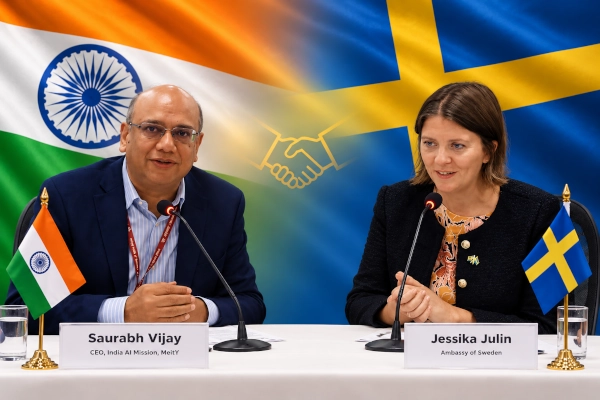
India and Sweden are exploring deeper cooperation in artificial intelligence, digitalisation and advanced industrial technologies as the two countries seek to connect India’s rapidly expanding AI ecosystem with Sweden’s established strengths in manufacturing, research and technology.
The IndiaAI Mission, under the Ministry of Electronics and Information Technology, held a bilateral dialogue with a Swedish delegation in New Delhi on September 7, 2026 under the Sweden-India Technology and AI Corridor, or SITAC.
The meeting brought together officials from MeitY and the IndiaAI Mission alongside representatives from the Embassy of Sweden, Business Sweden and major companies from both countries. Discussions centred on identifying areas where India’s AI capabilities, digital infrastructure and large technology talent base could complement Swedish industrial and technological expertise.
Saurabh Vijay, CEO of the IndiaAI Mission, highlighted the complementary strengths of the two countries. Sweden possesses substantial expertise in industrial technology, research and advanced manufacturing, while India offers large-scale digital infrastructure, an extensive AI talent pool and significant opportunities for deploying and testing emerging technologies.
The discussions covered the broader architecture of the IndiaAI Mission and the opportunities it is creating for domestic as well as international technology companies.
IndiaAI presented its priorities across high-performance computing infrastructure, datasets and AI models, indigenous and domain-specific AI systems, application development, skills, startup financing and Safe & Trusted AI.
These areas form part of India’s effort to build a comprehensive domestic artificial intelligence ecosystem rather than concentrating exclusively on AI applications. Expanding access to computing resources, developing Indian datasets and models and supporting local AI companies are expected to play central roles in that strategy.
International companies could also find opportunities as India expands AI adoption across industrial, government and enterprise environments.
The dialogue examined some of the major policy and regulatory questions surrounding this expansion, including data governance, data localisation, responsible AI, infrastructure requirements and market access.
The Swedish delegation was led by Johnny Eriksson, Market Manager at Business Sweden, which presented the objectives of SITAC and Sweden’s priorities in artificial intelligence and digitalisation.
Several major Swedish industrial companies participated, including Autoliv, Consat, IKEA, Saab, Sandvik AI, Sandvik Intelligent Manufacturing, SKF and Volvo Group. Their involvement highlighted the potential for artificial intelligence cooperation to extend beyond the conventional software sector into manufacturing, automotive systems, aerospace, engineering and industrial automation.
Indian technology and AI companies participating in the discussions included Tech Mahindra, Tata Consultancy Services, Zenteiq, Avataar AI, Innefu, CoRover.ai, Gnani and Globals ITES.
The interaction provided both sides with an opportunity to identify areas where Swedish industrial expertise could be combined with India’s growing AI capabilities.
Among the areas discussed were industrial AI, trusted data ecosystems, computing infrastructure, AI skills and responsible artificial intelligence.
Industrial AI could become a particularly promising area of cooperation. Sweden is home to several globally established engineering, automotive and manufacturing companies, while India has been rapidly expanding its capabilities in software development, artificial intelligence, digital public infrastructure and industrial technology.
Combining these capabilities could support AI applications in areas such as intelligent manufacturing, predictive maintenance, autonomous systems, supply-chain optimisation, engineering design and industrial automation.
The discussions were also focused on moving beyond broad technology cooperation toward practical projects.
Participants explored possibilities for joint pilot programmes, technology testbeds, co-development projects, commercial partnerships and other forms of industry collaboration based on specific industrial and enterprise requirements.
For Swedish companies, the engagement offered greater visibility into India’s growing ecosystem of deployment-ready AI technologies and enterprise solutions. Indian companies, meanwhile, could gain opportunities to work with Swedish manufacturers and technology groups on industrial applications requiring advanced AI and digitalisation.
India and Sweden are expected to use SITAC as a framework for maintaining a more structured dialogue in these areas. Future cooperation could include dedicated testbeds, pilot deployments, ecosystem partnerships and collaborations linking startups, established companies, researchers and government institutions.
The discussions also reflect the increasing importance India is placing on responsible and trusted artificial intelligence as AI adoption expands across critical industries and public-facing systems.
Swedish Deputy Head of Mission Agnes Julin emphasised the importance of maintaining opportunities for businesses from both countries as technological change accelerates, particularly in AI and electronics. The emerging cooperation is expected to cover not only technological development but also issues such as regulation, trade and stronger connections between innovative companies.
The bilateral engagement comes as India builds the infrastructure necessary to support AI development at national scale while encouraging domestic models, startups and specialised applications.
For Sweden, closer engagement with India offers access to one of the world’s largest technology markets as well as a rapidly growing pool of AI developers, startups and industrial users.
SITAC could therefore develop into an important platform connecting Swedish industrial and advanced-manufacturing capabilities with India’s scale, software expertise and emerging artificial-intelligence ecosystem.
By focusing on practical deployments, co-development and responsible technology adoption, India and Sweden are seeking to transform their technology relationship into a broader strategic partnership spanning AI, digitalisation, electronics and next-generation industrial innovation.
Source: PIB: https://www.pib.gov.in/PressReleaseDetail.aspx?PRID=2307629®=48&lang=1
You may also like
-
India, Russia and the Ukraine Conflict: Putin Highlights Modi’s Continued Push for Dialogue and a Negotiated Settlement
-
India and France Discuss Aerospace Manufacturing, UPI Integration and India-EU FTA
-
Côte d’Ivoire Military Delegation Visits HAL, Shows Interest in India’s Indigenous Aerospace Platforms
-
India and Netherlands Move to Deepen Agricultural Cooperation in Seeds, Horticulture and Innovation
-
Tarang Shakti Delegates from 28 Countries Visit HAL and BEL to Explore India’s Defence Manufacturing Ecosystem
